
How to Pray Salah: A Step-by-Step Guide (Hanafi)
Learn how to pray Salah the Hanafi way, from start to finish: what to do before you pray, how many rak‘at each prayer has, every position and exactly what to say, with the book and page for each step.
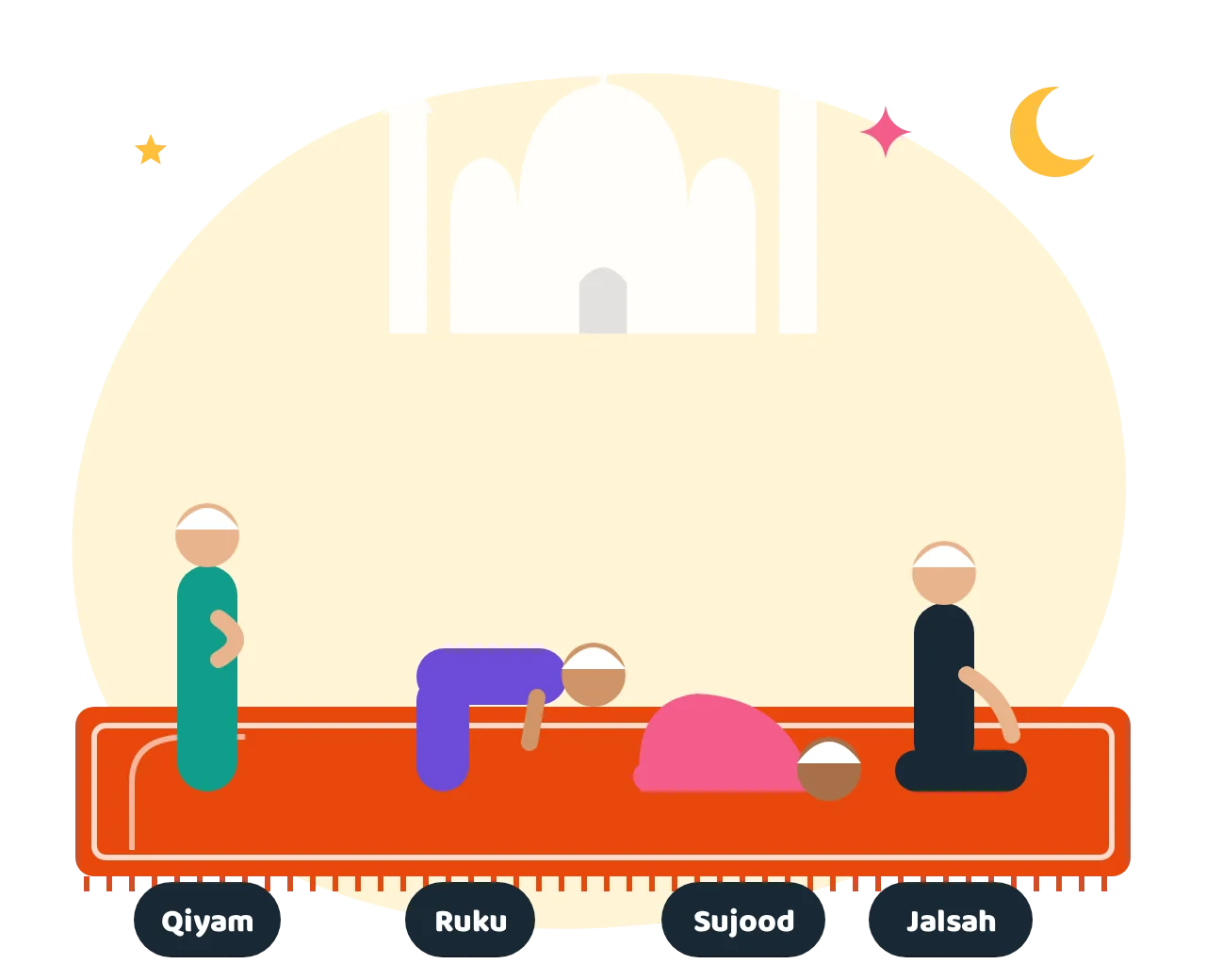
Before you pray
- Wudu: see how to make wudu.
- Clean body, clothes and place.
- Cover the satr: for men from the navel to below the knees; for women the whole body except the face, the hands and the feet.
- Face the qiblah: use the Qibla finder.
- The right time: check today’s prayer times.
- Intention in the heart.
These are the conditions of Salah given in Method of Salah (Dawat-e-Islami), chapter on the conditions of Salah.
How many rak‘at in each prayer
| Prayer | Before the fard | Fard | After the fard |
|---|---|---|---|
| Fajr | 2 sunnat-e-mu’akkadah | 2 | – |
| Dhuhr | 4 sunnat-e-mu’akkadah | 4 | 2 sunnat-e-mu’akkadah |
| Asr | 4 sunnat (ghair mu’akkadah) | 4 | – |
| Maghrib | – | 3 | 2 sunnat-e-mu’akkadah |
| Isha | 4 sunnat (ghair mu’akkadah) | 4 | 2 sunnat-e-mu’akkadah, then 3 witr (wajib) |
| Jumu‘ah | 4 sunnat-e-mu’akkadah | 2 | 4 sunnat-e-mu’akkadah |
This guide follows the Hanafi method as taught in Dawat-e-Islami’s books, such as Method of Salah and Bahar-e-Shariat. Sunnah prayers: Bahar-e-Shariat, part 4 (English tr.), pp. 19 and 24. Witr: same, p. 6.
How to pray, step by step (two rak‘at)
Here is a two-rak‘ah prayer, such as the fard of Fajr. Prayers with three or four rak‘at are explained below.
- Make your intentionIntend in your heart which prayer you are praying. Saying it in words is mustahab, for example: “I intend to offer the two rak‘at fard of Fajr for Allah” (Method of Salah, p. 19).
- Say Allahu AkbarMen raise their hands so the thumbs touch the earlobes, palms facing the qiblah; women raise them to the shoulders. Say the opening takbir (Method of Salah, pp. 7 and 12).
- Fold your hands and recite the thanaMen fold the hands below the navel, the right palm on the back of the left wrist; women place the left palm on the chest and the right over it (Method of Salah, pp. 7 and 12).
- Recite Al-Fatihah and a surahSay A‘udhu billah and Bismillah, recite Surah Al-Fatihah, then a surah or verses (Method of Salah, p. 8).
- Bow (ruku)Say Allahu Akbar and bow. Say Subhana rabbiyal-‘azim at least three times (Method of Salah, p. 8).
- Stand up (qawmah)Rise saying Sami‘allahu liman hamidah; when praying alone, also say Allahumma rabbana wa lakal-hamd (Method of Salah, p. 9).
- Prostrate (sujood)Say Allahu Akbar and prostrate. Say Subhana rabbiyal-a‘la at least three times (Method of Salah, p. 9).
- Sit, then prostrate againSit up saying Allahu Akbar, then make the second sujood the same way. This completes one rak‘ah (Method of Salah, p. 9).
- Pray the second rak‘ahStand up and pray it the same way, beginning with Bismillah and Al-Fatihah (Method of Salah, p. 10).
- Sit for the tashahhudAfter the second rak‘ah, sit and recite the tashahhud. In the last sitting, also recite the durood and a dua (Method of Salah, p. 11).
- End with salamTurn your face to the right and then to the left, saying As-salamu ‘alaikum wa rahmatullah each time (Method of Salah, pp. 7–12).
What to say in each position
Prayers with three or four rak‘at
- After the second rak‘ah, sit and recite only the tashahhud, then stand up saying Allahu Akbar.
- In the third and fourth rak‘at of a fard prayer, recite Bismillah and Al-Fatihah only, with no surah (Method of Salah, p. 10).
- In sunnah and nafl prayers, adding a surah after Al-Fatihah is wajib in every rak‘ah (Method of Salah, p. 33). In witr, recitation is fard in all three rak‘at (Bahar-e-Shariat, part 4, p. 7).
- In the last rak‘ah, sit for the tashahhud, durood and dua, then finish with salam.
Guides to other prayers
Teaching children to pray
The Prophet ﷺ said: “Teach the child the prayer at seven years” (Jami‘ at-Tirmidhi 407; Imam Tirmidhi: hasan sahih). Start with wudu, then Al-Fatihah, then the positions, then the tashahhud.
Our one-to-one Islamic studies classes teach Salah step by step.
Frequently asked questions
How many rak‘at are in the five daily prayers?
The fard rak‘at are Fajr 2, Dhuhr 4, Asr 4, Maghrib 3 and Isha 4, with witr (3, wajib) after Isha. The sunnah prayers are shown in the table above (Bahar-e-Shariat, part 4, pp. 6, 19 and 24).
Do women pray differently?
Yes, in a few positions: women raise their hands to the shoulders, place their hands on the chest, bow only slightly in ruku, keep their limbs close together in sujood and sit on the left side with the feet turned out to the right (Method of Salah, p. 12).
What if I make a mistake in prayer?
If a wajib part of the prayer is missed by mistake, make sajdah-e-sahw: after the tashahhud in the last sitting, give one salam to the right, make two sujood, then recite the tashahhud, durood and dua again and finish with salam (Islam ki Bunyadi Baatein, part 3, p. 57). If a wajib is left out on purpose, the prayer must be repeated (Faizan-e-Madina, March 2021).
When should children start to pray?
The Prophet ﷺ said: “Teach the child the prayer at seven years” (Jami‘ at-Tirmidhi 407; Imam Tirmidhi: hasan sahih).
How do I know the prayer times and the qiblah?
Use our free prayer times tool for today’s times in your city and the Qibla finder for the direction of the Kaaba.
Sources
- Method of Salah (Hanafi), Dawat-e-Islami (Maktaba-tul-Madinah), English edition: chapter on the conditions of Salah (including satr); method of Salah, pp. 7–12; intention, p. 19; takbir and folding the hands, pp. 7 and 12; recitation, pp. 7–10; ruku, qawmah and sujood, pp. 8–9; tashahhud, durood and dua, p. 11; women’s method, p. 12; wajibat, p. 33.
- Bahar-e-Shariat, Mufti Amjad Ali A‘zami, part 4 (English translation by M. Afthab Cassim): witr, pp. 6–7; sunnah prayers, pp. 19 and 24.
- Islam ki Bunyadi Baatein, part 3, Dawat-e-Islami (Maktaba-tul-Madinah): sajdah-e-sahw, p. 57.
- “Where Sajda-e-Sahw is necessary”, Faizan-e-Madina magazine, March 2021, Dawat-e-Islami.
- Hadith: Sunan Abi Dawud 775 (thana); Sahih al-Bukhari 831 (tashahhud) and 3370 (durood); Jami‘ at-Tirmidhi 407 (teaching children; Imam Tirmidhi: hasan sahih).
- Quran: Arabic from the Tanzil Quran text; English meaning based on Kanz-ul-Iman by Imam Ahmad Raza Khan, checked against the Kanz-ul-Iman text on dawateislami.net (Al-Baqarah 2:201, the words of the dua after durood).
Help your child love Salah
In our one-to-one Islamic studies classes, children learn wudu and every part of Salah, and practise in front of a caring teacher. Three free trial classes.
More prayer guides and tools
Last updated: October 2026