
How to Use the Arabic Alphabet Tool
Arabic Alphabet Chart: All Letters in English
Here is the full Arabic alphabet with each letter’s name, its English transliteration, the nearest English sound and its point of articulation (makhraj). Arabic is read from right to left, starting with Alif.
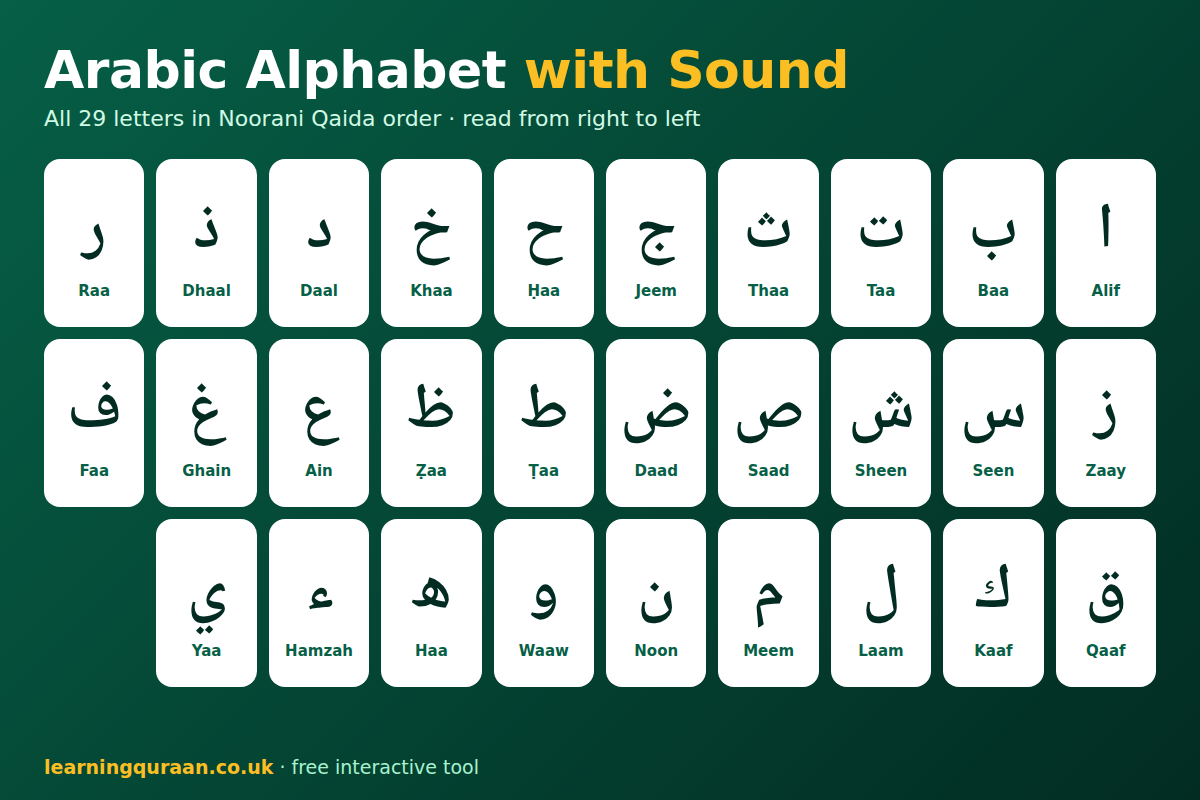
| # | Letter | Name | In English | Sound | Makhraj |
|---|---|---|---|---|---|
| 1 | ا | Alif | ā / a | Long “aa”; carries a vowel | Mouth space (al-jawf) |
| 2 | ب | Baa | b | b as in bat | Both lips |
| 3 | ت | Taa | t | Soft t | Tongue tip + roots of upper teeth |
| 4 | ث | Thaa | th | th as in think | Tongue tip + edges of upper teeth |
| 5 | ج | Jeem | j | j as in jam | Middle of tongue + roof of mouth |
| 6 | ح | Haa | ḥ | Strong breathy h from the throat | Middle of throat |
| 7 | خ | Khaa | kh | kh as in loch | Top of throat |
| 8 | د | Daal | d | Soft d | Tongue tip + roots of upper teeth |
| 9 | ذ | Dhaal | dh | th as in this | Tongue tip + edges of upper teeth |
| 10 | ر | Raa | r | Rolled r | Tongue tip + upper gum |
| 11 | ز | Zaay | z | z as in zoo | Tongue tip near lower teeth |
| 12 | س | Seen | s | s as in sun | Tongue tip near lower teeth |
| 13 | ش | Sheen | sh | sh as in ship | Middle of tongue + roof of mouth |
| 14 | ص | Saad | ṣ | Heavy s | Tongue tip near lower teeth (heavy) |
| 15 | ض | Daad | ḍ | Heavy d from the side of the tongue | Side of tongue + upper molars |
| 16 | ط | Taa (heavy) | ṭ | Heavy t | Tongue tip + roots of upper teeth (heavy) |
| 17 | ظ | Dhaa (heavy) | ẓ | Heavy th as in this | Tongue tip + edges of upper teeth (heavy) |
| 18 | ع | Ain | ʿ | Squeezed sound from the throat | Middle of throat |
| 19 | غ | Ghain | gh | Gargled gh, like French r | Top of throat |
| 20 | ف | Faa | f | f as in fish | Lower lip + upper teeth |
| 21 | ق | Qaaf | q | Deep, heavy q | Back of tongue + soft palate |
| 22 | ك | Kaaf | k | k as in kite | Back of tongue (a little forward) |
| 23 | ل | Laam | l | l as in lamp | Front edges of tongue + upper gum |
| 24 | م | Meem | m | m as in moon (with ghunnah) | Both lips + nose |
| 25 | ن | Noon | n | n as in noon (with ghunnah) | Tongue tip + upper gum + nose |
| 26 | و | Waaw | w | w as in water | Rounded lips |
| 27 | ه | Haa (light) | h | Light h as in hat | Deepest part of throat |
| 28 | ء | Hamzah | ʾ | Short catch in the throat (uh-oh) | Deepest part of throat |
| 29 | ي | Yaa | y | y as in yes | Middle of tongue + roof of mouth |
How Many Letters Are in the Arabic Alphabet?
The Arabic alphabet has 28 letters. Quran primers used in the UK, Pakistan and India, such as the Noorani Qaida and the Madni Qaida, also list the hamzah (ء) as a separate letter, which makes 29. This tool follows the Noorani Qaida, so it shows all 29 letters in the order children learn them: ا ب ت ث ج ح خ د ذ ر ز س ش ص ض ط ظ ع غ ف ق ك ل م ن و ه ء ي.
Arabic has no capital letters. Instead, most letters change their shape depending on where they sit in a word.
Arabic Letters at the Beginning, Middle and End
Most Arabic letters join the letter after them, so each one has up to four shapes: alone, at the start, in the middle and at the end of a word. Six letters, ا د ذ ر ز و, never join the letter after them, so their start and middle shapes look like the alone and end shapes.
| Letter | Alone | End | Middle | Start |
|---|---|---|---|---|
| Alif | ا | ـا | ـا | ا |
| Baa | ب | ـب | ـبـ | بـ |
| Taa | ت | ـت | ـتـ | تـ |
| Thaa | ث | ـث | ـثـ | ثـ |
| Jeem | ج | ـج | ـجـ | جـ |
| Haa | ح | ـح | ـحـ | حـ |
| Khaa | خ | ـخ | ـخـ | خـ |
| Daal | د | ـد | ـد | د |
| Dhaal | ذ | ـذ | ـذ | ذ |
| Raa | ر | ـر | ـر | ر |
| Zaay | ز | ـز | ـز | ز |
| Seen | س | ـس | ـسـ | سـ |
| Sheen | ش | ـش | ـشـ | شـ |
| Saad | ص | ـص | ـصـ | صـ |
| Daad | ض | ـض | ـضـ | ضـ |
| Taa (heavy) | ط | ـط | ـطـ | طـ |
| Dhaa (heavy) | ظ | ـظ | ـظـ | ظـ |
| Ain | ع | ـع | ـعـ | عـ |
| Ghain | غ | ـغ | ـغـ | غـ |
| Faa | ف | ـف | ـفـ | فـ |
| Qaaf | ق | ـق | ـقـ | قـ |
| Kaaf | ك | ـك | ـكـ | كـ |
| Laam | ل | ـل | ـلـ | لـ |
| Meem | م | ـم | ـمـ | مـ |
| Noon | ن | ـن | ـنـ | نـ |
| Waaw | و | ـو | ـو | و |
| Haa (light) | ه | ـه | ـهـ | هـ |
| Hamzah | ء | – | – | – |
| Yaa | ي | ـي | ـيـ | يـ |
Tip: in the tool above, switch to Indo-Pak to see the shapes used in Quran copies printed in Pakistan and India, such as ک, ہ and ی.
Makharij: Where Each Arabic Letter Comes From
Scholars of Tajweed describe 17 points of articulation (makharij) in five main areas. Saying each letter from its own makhraj is what makes Quran recitation correct.
Heavy, Throat and Qalqalah Letters
Heavy letters
خ ص ض غ ط ق ظAlways read with a full mouth by raising the back of the tongue. Remember them with “khuṣṣa ḍaghṭin qiẓ”.
Throat letters
ء ه ع ح غ خMade in the throat. English has no match for ع and ح, so listen to them often.
Qalqalah letters
ق ط ب ج دWhen they carry a sukoon they make a small echo. Remember them with “quṭbu jad”.
Arabic Letters Urdu and English Speakers Often Mix Up
In Urdu several Arabic letters are said the same way, and English has no sound for others. These are the mistakes our teachers correct most often.
| Letters | Common mistake | Correct Arabic sound |
|---|---|---|
| ث · س · ص | All three said as a plain “s” | ث is “th” as in think; ص is a heavy s with a full mouth |
| ذ · ز · ض · ظ | All four said as “z” | ذ is “th” as in this; ض uses the side of the tongue; ظ is a heavy “th” |
| ح · ه | Both said as a soft “h” | ح comes from the middle of the throat with a strong, rough breath |
| ع · ء | ع dropped or read like Alif | ع is squeezed from the middle of the throat |
| ت · ط | Both said as a light “t” | ط is heavy, with the back of the tongue raised |
| ك · ق | ق said like “k” | ق comes from further back and is heavy |
Use the Similar letters tab in the tool to train your ear on each pair.
How to Teach the Arabic Alphabet to Kids
- Keep it short and daily. Ten minutes every day works better than one long lesson a week.
- Learn a few letters at a time. Take four or five letters a day in the Noorani Qaida order and revise the earlier ones first.
- Listen, then copy. Let your child tap a letter, listen, and say it aloud three times before moving on.
- Practise the tricky pairs. Children often mix up س and ص, or ح and ه. The Similar letters drill makes this a game.
- Celebrate progress. Use the stars in the quiz and the “letters learned” bar as small rewards.
- Move on to the Qaida. Once your child knows the letters, start Noorani Qaida Lesson 1 and then the joined letters.
Our online Noorani Qaida course for kids takes children from the alphabet to reading the Quran with Tajweed, one to one with a qualified teacher.
Huroof-e-Tahajji in Urdu (حروفِ تہجی)
عربی حروفِ تہجی سیکھنے کے لیے اوپر “اردو” کا بٹن دبائیں۔ ہر حرف پر ٹیپ کریں تو اس کی آواز، مخرج اور شکلیں اردو میں نظر آئیں گی۔ اردو بولنے والے اکثر ث، س، ص کو ایک جیسا اور ذ، ز، ض، ظ کو ایک جیسا پڑھتے ہیں، جبکہ قرآن مجید میں ہر حرف کی اپنی الگ آواز ہے۔ “ملتے جلتے حروف” والے حصے میں ان کی مشق کریں، اور “انڈو پاک” کا بٹن دبا کر وہ شکلیں دیکھیں جو پاکستانی قرآن پاک اور نورانی قاعدہ میں چھپتی ہیں۔
Frequently Asked Questions
How many letters are in the Arabic alphabet?
The Arabic alphabet has 28 letters. Quran primers such as the Noorani Qaida also list the hamzah (ء) as its own letter, which gives 29. This tool shows all 29 in the Noorani Qaida order.
Is Arabic written from right to left?
Yes. Arabic is written and read from right to left, so the first letter, Alif, sits on the right of the chart. Most letters join the letter after them, and six letters (ا د ذ ر ز و) never join the next letter.
Which Arabic letter is the hardest to pronounce?
Many learners find ض (Daad) the hardest, because it is made with the side of the tongue against the upper back teeth. Arabic is even called the language of Daad. The throat letters ع and ح and the heavy letter ق also take practice.
How long does it take to learn the Arabic alphabet?
With 10 to 15 minutes of practice a day, most beginners can recognise all the letters within a couple of weeks. Saying every letter from its correct makhraj takes longer, and a teacher who listens to you speeds this up a lot.
What is the difference between the Arabic alphabet and the Noorani Qaida?
The alphabet is the set of letters. The Noorani Qaida is a step-by-step primer that starts with the single letters (Huroof-e-Mufradat) and then teaches joined letters, vowel marks, tanween, sukoon and the rules needed to read the Quran.
What are the heavy letters in Arabic?
Seven letters are always read heavy, with a full mouth: خ ص ض غ ط ق ظ. They are remembered with the phrase “khuṣṣa ḍaghṭin qiẓ”. The other letters are light, apart from Raa, the Laam in the name of Allah and Alif, which can be heavy depending on the letters around them.
Is this Arabic alphabet tool free?
Yes. It is free, needs no sign-up and works on phones, tablets and computers. Every letter plays a recorded sound, and you can switch between English and Urdu and between Arabic and Indo-Pak letter shapes.
Learn the Arabic Alphabet with a Qualified Teacher
An app can play the sounds, but a teacher hears your mistakes. In our one-to-one online classes a qualified Quran teacher checks every letter, then takes you or your child through the Noorani Qaida to reading the Quran.
Book a Free Trial Class Open the Noorani QaidaMore Free Islamic Tools
Also see the Madni Qaida online and all our free Islamic tools.