
Heavy and Light Letters in Tajweed (Tafkheem and Tarqeeq)
Which Arabic letters are heavy and which are light? Learn the seven always-heavy letters, when Ra is heavy or light, the Lam of “Allah” and the alif, with Quran examples.
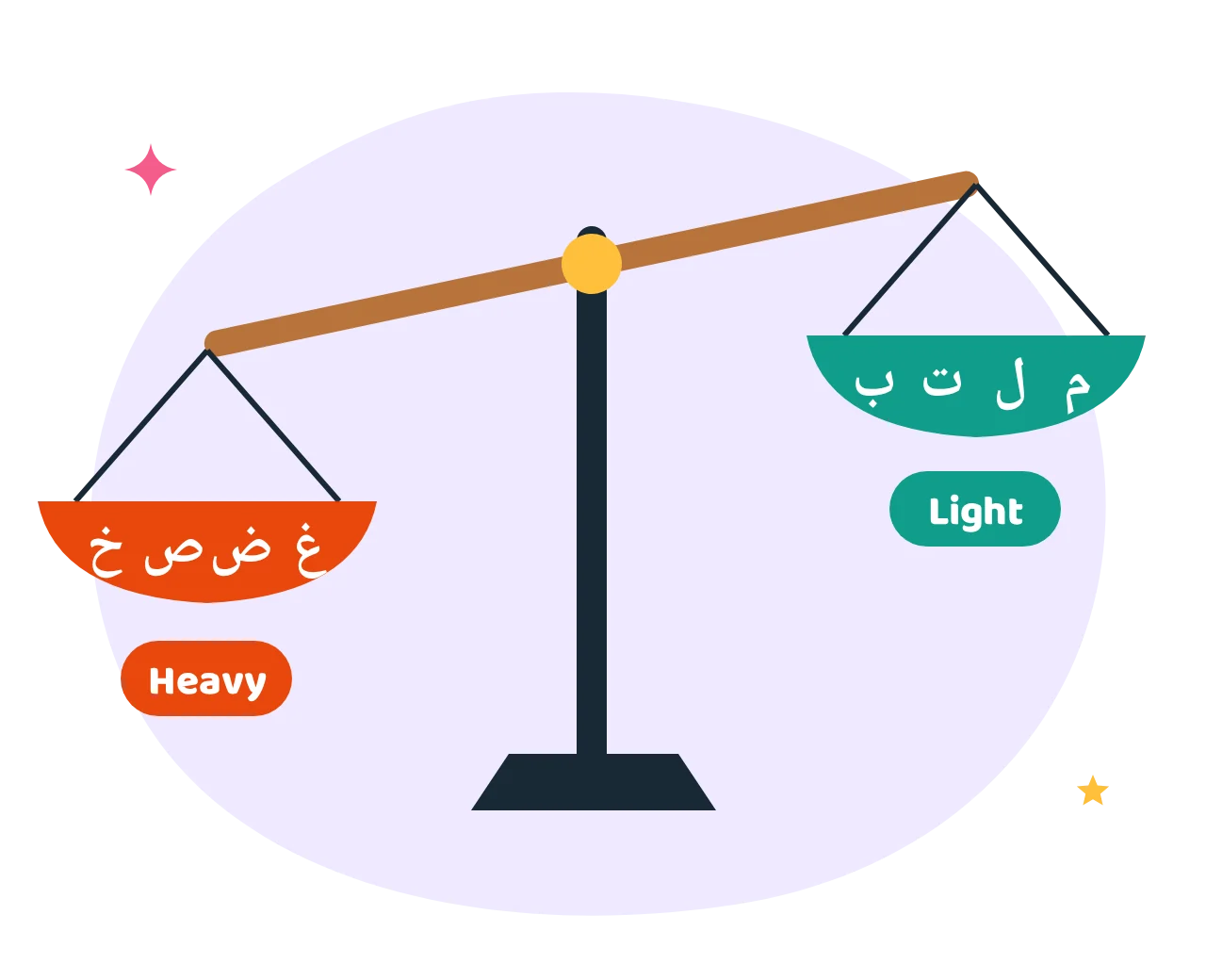
What are heavy and light letters?
Arabic letters are either heavy (tafkheem: a full, deep sound made by raising the back of the tongue) or light (tarqeeq: a thin sound with the tongue low). A few letters change between heavy and light depending on where they are.
| Group | Letters | Rule |
|---|---|---|
| Always heavy | خ ص ض غ ط ق ظ | Always full and deep |
| Sometimes heavy | ر, the ل of “Allah”, ا | Depends on the vowels around them |
| Always light | All the other letters | Always thin |
The seven always-heavy letters
Remember them with خُصَّ ضَغْطٍ قِظْ (khuṣṣa ḍaghṭin qiẓ).
| Example | Where | What happens |
|---|---|---|
| الصِّرَاطَ | Al-Fatihah 1:6 | Heavy saad and ṭaa |
| غَيْرِ الْمَغْضُوبِ | Al-Fatihah 1:7 | Heavy ghain and ḍaad |
| ظُلُمَاتٍ | Al-Baqarah 2:17 | Heavy ẓaa |
| خَالِدُونَ | Al-Baqarah 2:25 | Heavy khaa |
When is Ra heavy, and when is it light?
| Ra is… | When | Example | Where |
|---|---|---|---|
| Heavy | It has a fatha | رَبِّ | Al-Fatihah 1:2 |
| Heavy | It has a damma | رُزِقُوا | Al-Baqarah 2:25 |
| Heavy | Sukoon after a fatha or damma (here when stopping) | الْقَدْرِ | Al-Qadr 97:1 |
| Heavy | Sukoon after a kasra that is only there to start the word | ارْجِعُوا | Yusuf 12:81 |
| Heavy | Sukoon after kasra, but followed by a heavy letter in the same word | مِرْصَادًا | An-Naba' 78:21 |
| Light | It has a kasra | رِجَالٌ | An-Nur 24:37 |
| Light | Sukoon after a kasra in the same word | فِرْعَوْنَ | Al-Baqarah 2:49 |
| Light | Stopping on Ra after a yaa sakin | قَدِيرٌ | Al-Baqarah 2:20 |
A few words, such as فِرْقٍ (Ash-Shu‘ara 26:63), may be read either way. Your teacher will show you the exceptions as you meet them.
The Lam in the name “Allah”
| Example | Where | Heavy or light |
|---|---|---|
| نَصْرُ اللَّهِ | An-Nasr 110:1 | After damma: heavy |
| قَالَ اللَّهُ | Al-Maidah 5:110 | After fatha: heavy |
| بِسْمِ اللَّهِ | Al-Fatihah 1:1 | After kasra: light |
| لِلَّهِ | Al-Fatihah 1:2 | After kasra: light |
Alif follows the letter before it
Alif has no weight of its own. After a heavy letter it sounds heavy, as in قَالَ; after a light letter it sounds light, as in كَانَ.
Practise heavy and light letters
Short surahs are the easiest place to practise. Read these with a teacher or alongside a recitation you trust:
| Example | Where | Listen for |
|---|---|---|
| الصِّرَاطَ | Al-Fatihah 1:6 | Heavy saad and ṭaa; the raa has a fatha, so it is heavy too |
| الْقَدْرِ | Al-Qadr 97:1 | Heavy qaaf and a heavy raa when you stop |
| وَالْعَصْرِ | Surah 103 103:1 | Heavy saad, heavy raa when you stop |
Common mistakes
- Making light letters heavy, for example a heavy س or ت next to a heavy letter.
- Thin heavy letters, so ص sounds like س and ط like ت.
- A heavy Ra with kasra, as in رِجال.
- A heavy Lam in بسم الله. After a kasra it is light.
Frequently asked questions
Which letters are always heavy?
Seven: خ ص ض غ ط ق ظ, remembered by the phrase خُصَّ ضَغْطٍ قِظْ.
Is Ra heavy or light?
It depends on its vowel and the letters around it. With fatha or damma it is heavy; with kasra it is light. A Ra with sukoon follows the vowel before it, with some exceptions.
When is the Lam in “Allah” heavy?
After a fatha or damma it is heavy, as in نصرُ الله. After a kasra it is light, as in بسمِ الله.
Is alif heavy or light?
Alif always follows the letter before it: heavy after a heavy letter (قال) and light after a light letter (كان) (Faizan-e-Tajweed, p. 29).
What do tafkheem and tarqeeq mean?
Tafkheem means making a letter heavy (full, with the back of the tongue raised). Tarqeeq means making it light (thin, with the tongue low).
Sources
- al-Muqaddimah al-Jazariyyah, Imam Ibn al-Jazari, verses 22 and 45 (heavy letters), 41–43 (Ra), 35 and 44 (Lam of Allah).
- Faizan-e-Tajweed, Dawat-e-Islami (Al-Madinah-tul-Ilmiyyah), p. 20, p. 28, p. 29.
- Quran examples: the Tanzil Quran text (Hafs), each with its surah and verse.
Learn Tajweed with a teacher who listens to you
Reading about a rule is the first step. Hearing it corrected in your own recitation is what makes it stick. Try three free one-to-one classes.
More Tajweed rules
Last updated: October 2026