
Makharij al-Huruf: Where Each Arabic Letter Comes From
The makharij are the exit points of the Arabic letters. Learn the five areas and seventeen points, which letters come from each and how to find any letter’s makhraj.
What are the makharij?
Makharij (مخارج الحروف) are the points where each Arabic letter is made. Many letters that sound alike to an English or Urdu speaker, like س and ص, come from different places or with different qualities. Learning the makharij is the first step in Tajweed.
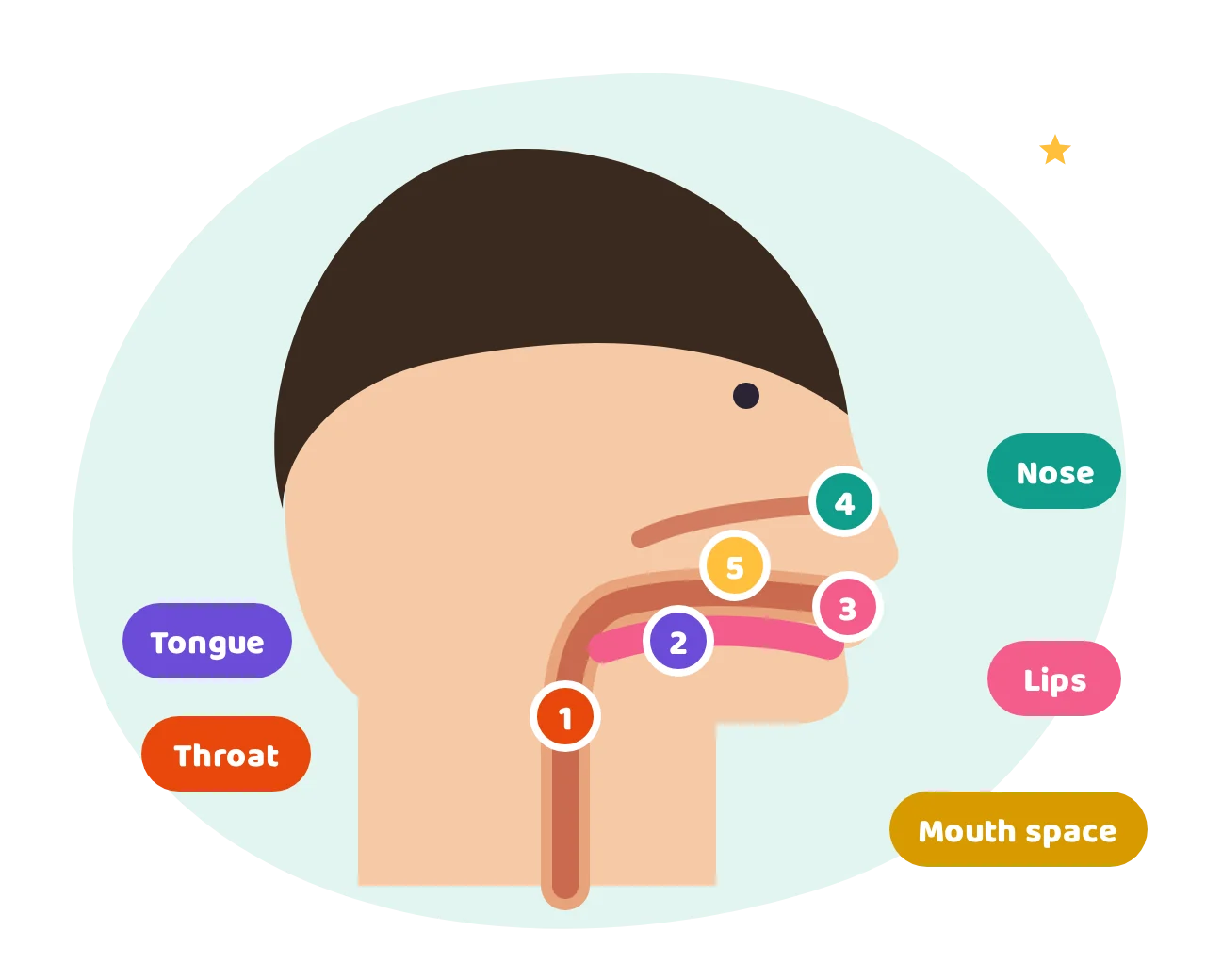
The letters come from five areas, divided into seventeen points (al-Jazariyyah, verses 9–19; Faizan-e-Tajweed, pp. 16–17).
The five areas
1. The mouth and throat space (al-jawf)
The three madd letters: alif, waw and yaa when stretched.
2. The throat (al-halq)
Six letters from three depths: ء ه, then ع ح, then غ خ.
3. The tongue (al-lisan)
Eighteen letters from ten points along the tongue.
4. The lips (ash-shafatan)
ف from the lower lip and upper teeth; ب م و from both lips.
5. The nose (al-khayshum)
The ghunnah of noon and meem.
All 17 makharij in one table
| Area | Point | Letters |
|---|---|---|
| Mouth space | The empty space of the mouth and throat | Madd letters ا و ي |
| Throat | Deepest part | ء ه |
| Throat | Middle | ع ح |
| Throat | Top, nearest the mouth | غ خ |
| Tongue | Back of the tongue and the soft palate | ق |
| Tongue | Back of the tongue, a little further forward | ك |
| Tongue | Middle of the tongue and the roof of the mouth | ج ش ي |
| Tongue | Side of the tongue and the upper molars | ض |
| Tongue | Front edges of the tongue and the upper gums | ل |
| Tongue | Tip of the tongue and the gum, slightly below ل | ن |
| Tongue | Tip of the tongue, a little behind ن | ر |
| Tongue | Tip of the tongue and the roots of the upper front teeth | ط د ت |
| Tongue | Tip of the tongue near the front teeth (whistling letters) | ص ز س |
| Tongue | Tip of the tongue and the edges of the upper front teeth | ظ ذ ث |
| Lips | Inside of the lower lip and the edges of the upper teeth | ف |
| Lips | Both lips | ب م و |
| Nose | The nasal passage | Ghunnah of ن and م |
How to find the makhraj of any letter
Practise with sound
Open the free Arabic alphabet with sound: tap any letter to hear it and see a diagram of where it comes from, then use the “Similar letters” drill for pairs like س ص, ذ ز ظ and ح ه.
Frequently asked questions
What does makharij mean?
Makharij al-huruf means “the exit points of the letters”: the exact places in the throat, mouth, lips and nose where each Arabic letter is made.
How many makharij are there?
Seventeen, the view of Imam Khalil ibn Ahmad and most scholars, which Imam Ibn al-Jazari also chose (al-Jazariyyah, verse 9). Sibawayh counted sixteen and al-Farra fourteen (Faizan-e-Tajweed, p. 16).
Why are makharij important?
Two letters from different makharij can change the meaning of a word. Saying each letter from its own place is the foundation of Tajweed.
How can I find the makhraj of a letter?
Put a hamzah with a fatha before the letter and give the letter a sukoon, for example أَبْ or أَقْ. Where the sound stops is its makhraj.
Can I practise makharij online?
Yes. Our free Arabic alphabet tool lets you hear each letter and see where it comes from, and a teacher in a Tajweed class can check you.
Sources
- al-Muqaddimah al-Jazariyyah, Imam Ibn al-Jazari, verses 9–19 (seventeen makharij).
- Faizan-e-Tajweed, Dawat-e-Islami (Al-Madinah-tul-Ilmiyyah), p. 16, p. 17.
- Madani Qa‘idah, Dawat-e-Islami, English edition: seventeen makharij.
Learn Tajweed with a teacher who listens to you
Reading about a rule is the first step. Hearing it corrected in your own recitation is what makes it stick. Try three free one-to-one classes.
More Tajweed rules
Last updated: October 2026