
Noon Sakin and Tanween Rules
The four rules for noon sakin and tanween, izhar, idgham, iqlab and ikhfa, explained simply with the letters for each and real examples from the Quran.
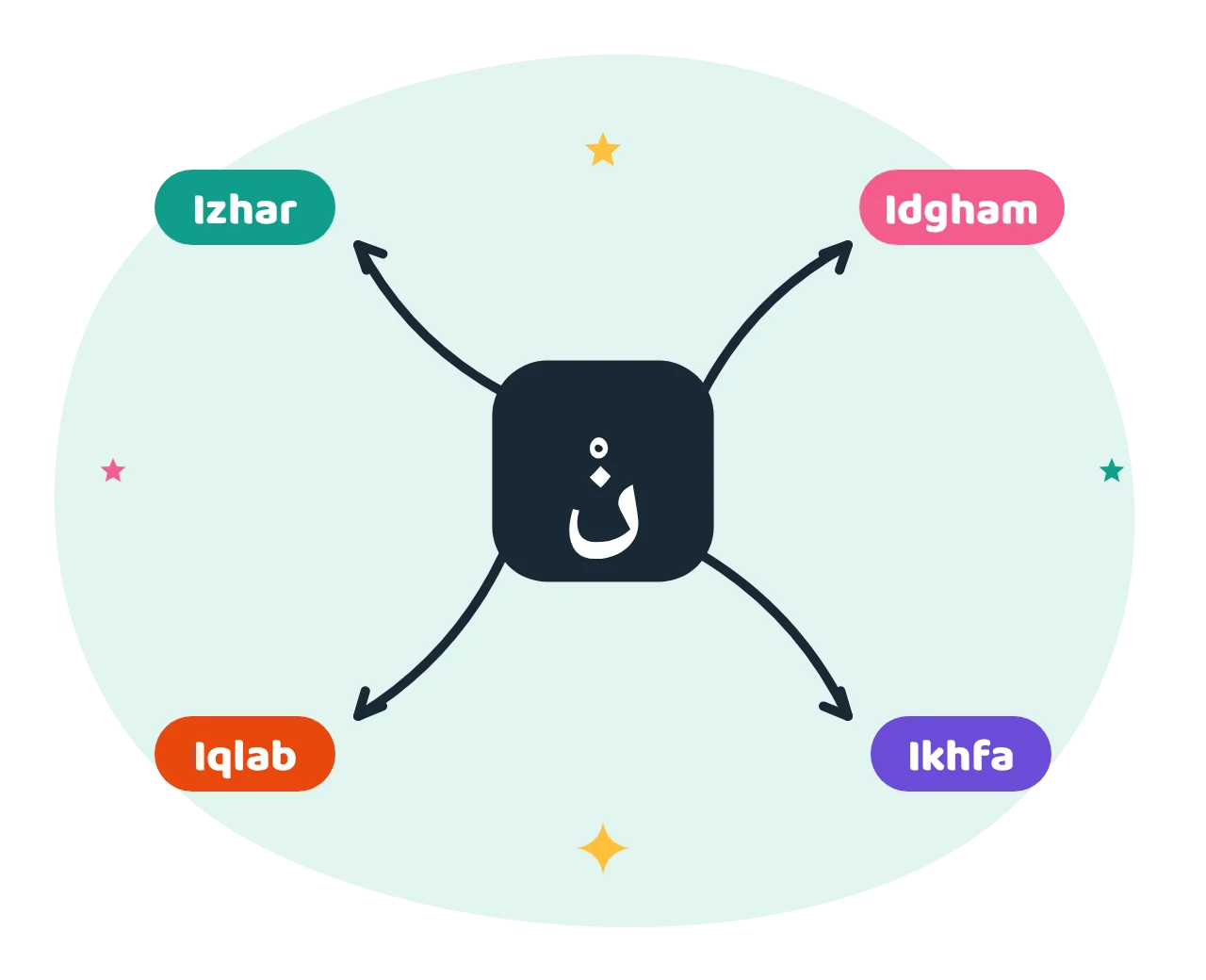
What are noon sakin and tanween?
Noon sakin is a noon with no vowel (نْ). Tanween is the double vowel at the end of a word (ـًـ ـٍـ ـٌـ), which is pronounced as an extra noon. Because they sound the same, they follow the same four rules, and the rule is decided by the letter that comes straight after.
| Rule | Next letter | What you do | Ghunnah |
|---|---|---|---|
| Izhar | ء ه ع ح غ خ (6 throat letters) | Say the noon clearly | No extra ghunnah |
| Idgham | ي ر م ل و ن (يرملون) | Merge it into the next letter | With ghunnah in ي ن م و, without in ل ر |
| Iqlab | ب | Turn it into a hidden meem | 2 counts |
| Ikhfa | The other 15 letters | Hide it | 2 counts |
1. Izhar: say it clearly
Izhar means “to make clear”. When noon sakin or tanween comes before one of the six throat letters, pronounce the noon clearly from its normal place, without stretching the ghunnah. The throat letters are far from the noon, so there is nothing to merge or hide.
| Example | Where | What happens |
|---|---|---|
| مَنْ آمَنَ | Al-Baqarah 2:62 | Noon sakin, then hamzah: clear noon |
| أَنْعَمْتَ | Al-Fatihah 1:7 | Noon sakin, then ain, in the same word |
| مِنْ خَوْفٍ | Quraysh 106:4 | Noon sakin, then khaa |
| عَذَابٌ أَلِيمٌ | Al-Baqarah 2:10 | Tanween, then hamzah: clear “un” |
2. Idgham: merge it
Idgham means “to merge”. Before the six letters of يَرْمَلُون, the noon disappears into the next letter, which is then read as if it had a shaddah. Before ي ن م و keep a ghunnah of two counts; before ل ر there is no ghunnah.
| Example | Where | What happens |
|---|---|---|
| مَنْ يَقُولُ | Al-Baqarah 2:8 | With ghunnah: “may-yaqool” |
| مِنْ مَاءٍ | Al-Baqarah 2:164 | With ghunnah: “mim-maa’” |
| مِنْ رَبِّهِمْ | Al-Baqarah 2:5 | Without ghunnah: “mir-rabbihim” |
| هُدًى لِلْمُتَّقِينَ | Al-Baqarah 2:2 | Without ghunnah: “hudal-lil…” |
Idgham only happens between two words. See the full idgham guide for the exceptions.
3. Iqlab: change it to meem
Iqlab means “to change”. Before the letter ب, the noon sakin or tanween changes into a meem, which is hidden with a ghunnah of two counts. Many mushafs print a small meem (ۢ) above the noon to remind you. Close your lips lightly, without pressing.
| Example | Where | What happens |
|---|---|---|
| مِنْ بَعْدِ | Al-Baqarah 2:27 | “mim-ba‘d” |
| أَنْبِئْهُمْ | Al-Baqarah 2:33 | Inside one word: “am-bi’hum” |
| سَمِيعٌ بَصِيرٌ | Al-Mujadila 58:1 | Tanween: “samee‘um-baseer” |
4. Ikhfa: hide it
Ikhfa means “to hide”. Before the remaining 15 letters, the noon is not fully pronounced and not fully merged: the tongue does not press on the noon’s place, and a ghunnah of two counts is heard while the mouth gets ready for the next letter.
| Example | Where | What happens |
|---|---|---|
| يُنْفِقُونَ | Al-Baqarah 2:3 | Before faa, inside one word |
| مِنْ قَبْلِكَ | Al-Baqarah 2:4 | Before qaaf |
| مَنْ ذَا | Al-Baqarah 2:255 | Before dhaal |
| عَنْ صَلَاتِهِمْ | Al-Ma'un 107:5 | Before saad |
The ikhfa guide lists all 15 letters with an easy way to remember them.
Practise in short surahs
Short surahs are the easiest place to practise. Read these with a teacher or alongside a recitation you trust:
| Example | Where | Listen for |
|---|---|---|
| يَكُنْ لَهُ | Al-Ikhlas 112:4 | Idgham without ghunnah: “yakul-lahu” |
| مِنْ جُوعٍ | Quraysh 106:4 | Ikhfa before jeem |
| مِنْ خَوْفٍ | Quraysh 106:4 | Izhar before khaa |
| شَرًّا يَرَهُ | Az-Zalzalah 99:8 | Idgham with ghunnah: “sharray-yarah” |
Exceptions to remember
Izhar mutlaq: in these four words the noon sakin comes before ي or و in the same word, so it is read clearly, not merged.
| Example | Where | What happens |
|---|---|---|
| الدُّنْيَا | Al-Baqarah 2:85 | Clear noon before ي |
| بُنْيَانٌ | As-Saff 61:4 | Clear noon before ي |
| قِنْوَانٌ | Al-An'am 6:99 | Clear noon before و |
| صِنْوَانٌ | Ar-Ra'd 13:4 | Clear noon before و |
In the recitation of Hafs, the noon at the end of يس (Ya-Sin 36:1) and of ن ۚ وَالْقَلَمِ (Al-Qalam 68:1) is also read clearly.
Frequently asked questions
What is noon sakin?
A noon with a sukoon on it (نْ), or a noon with no vowel at all. It can come in the middle or at the end of a word.
What is tanween?
Tanween is the double vowel at the end of a noun: ـًـ ـٍـ ـٌـ. It is pronounced as an extra noon sakin, which is why it follows the same four rules.
What are the four rules of noon sakin and tanween?
Izhar (say it clearly), idgham (merge it), iqlab (change it to a meem) and ikhfa (hide it). Which one applies depends only on the letter that comes next.
How long is the ghunnah in idgham, iqlab and ikhfa?
About two counts, roughly the time it takes to fold two fingers at a steady pace.
Are there exceptions?
Yes. In four words the noon is read clearly even before ي or و because both letters are in the same word: الدنيا، بنيان، قنوان، صنوان. In Hafs the noon of يس and ن at the start of their surahs is also read clearly.
Sources
- Tuhfat al-Atfal, Shaikh Sulayman al-Jamzuri, verses 6–16.
- al-Muqaddimah al-Jazariyyah, Imam Ibn al-Jazari, verses 65–68.
- Faizan-e-Tajweed, Dawat-e-Islami (Al-Madinah-tul-Ilmiyyah), p. 24.
- Madani Qa‘idah, Dawat-e-Islami, English edition, lessons 12 and 14.
- Quran examples: the Tanzil Quran text (Hafs), each with its surah and verse.
Learn Tajweed with a teacher who listens to you
Reading about a rule is the first step. Hearing it corrected in your own recitation is what makes it stick. Try three free one-to-one classes.
More Tajweed rules
Last updated: October 2026