
Noorani Qaida Page 18 - Lesson 09 Conclusion & Lesson 10: Sukoon (Jazm)
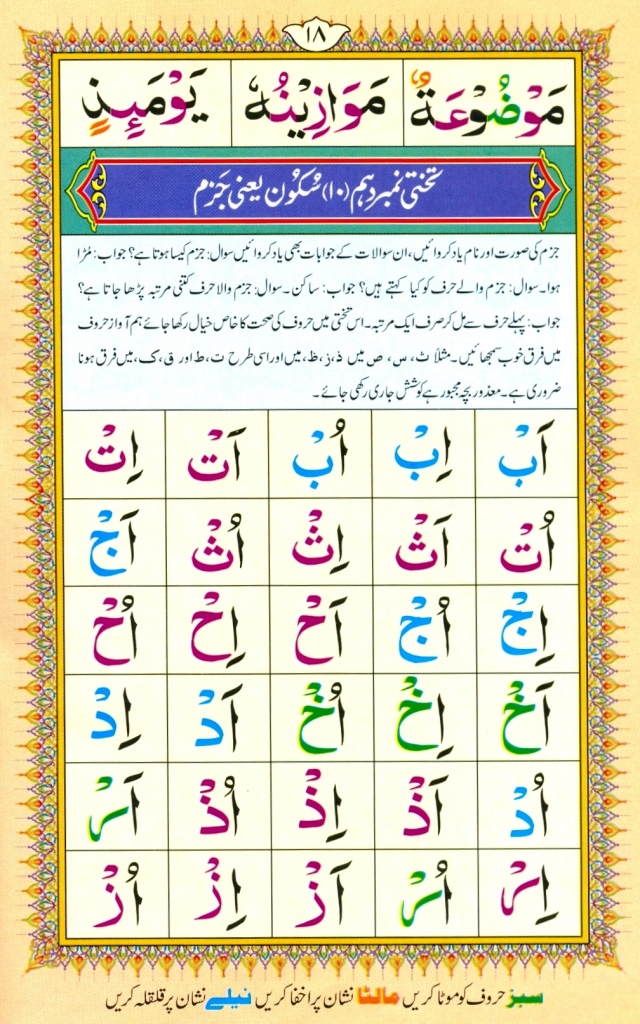
Welcome to Noorani Qaida Page 18 at Learning Quraan. This page marks an important transition in learning Quranic recitation. It begins by concluding the final words of Lesson 09 and officially introduces Takhti Number 10 (تختی نمبر دہم: سکون یعنی جزم), which focuses on the sign of rest or vowellessness known as Sukoon (Jazm).
Understanding Sukoon is essential for connecting letters correctly and applying fundamental Tajweed rules such as Qalqalah and Tafkheem/Tarqeeq. Help your child or yourself master these crucial foundational steps with our personalized Online Noorani Qaida for Kids, or explore all tailored learning modules on our Courses page.
What is Covered in Noorani Qaida Page 18?
Page 18 is divided into two primary sections:
- Final Practice Words of Lesson 09:
- Mawdoo’atun (مَوْضُوْعَةٌ): Practice combining Waw Leen, Damma with Waw Maddah, Fatha, and Dammatain.
- Mawaazeenuhoo (مَوَازِيْنُهۥ): Practice with Alif Maddah, Ya Maddah, Damma, and Inverted Damma (Ulta Pesh).
- Yawma’idhin (يَوْمَئِذٍ): Practice combining Waw Leen with Kasra and Kasratain.
- Introduction to Lesson 10 – Sukoon / Jazm (سکون یعنی جزم):
- Definition: The small crescent or head-of-kha symbol (`ْ`) above a letter is called a Jazm or Sukoon. A letter bearing a Jazm is termed Majzoom.
- How to Read: A Majzoom letter cannot be pronounced independently; it must be joined with the active voweled letter (carrying Fatha, Kasra, or Damma) preceding it.
- Basic Sukoon Exercises on Page 18:
- Hamza with Ba (ب): أَبْ (Ab), إِبْ (Ib), أُبْ (Ub).
- Hamza with Ta (ت): أَتْ (At), إِتْ (It), أُتْ (Ut).
- Hamza with Tha (ث): أَثْ (Ath), إِثْ (Ith), أُثْ (Uth).
- Hamza with Jeem (ج): أَجْ (Aj), إِجْ (Ij), أُجْ (Uj).
- Hamza with Ha (ح): أَحْ (Ah), إِحْ (Ih), أُحْ (Uh).
- Hamza with Kha (خ): أَخْ (Akh), إِخْ (Ikh), أُخْ (Ukh).
- Hamza with Dal (د): أَدْ (Ad), إِدْ (Id), أُدْ (Ud).
- Hamza with Dhal (ذ): أَذْ (Adh), إِذْ (Idh), أُذْ (Udh).
- Hamza with Ra (ر): أَرْ (Ar), إِرْ (Ir), أُرْ (Ur).
- Hamza with Zay (ز): أَزْ (Az), إِزْ (Iz), أُزْ (Uz).
Key Tajweed Rules for Page 18
When practicing the Sukoon combinations on this page, pay special attention to the following fundamental rules:
- Qalqalah (Echoing Sound): Among the letters practiced on this page, Ba (ب), Jeem (ج), and Dal (د) belong to the Qalqalah group (ق، ط، ب، ج، د). When these letters carry a Sukoon, produce a distinct bouncing or echoing sound (e.g., Ab, Aj, Ad).
- Rules of Ra (ر): When Ra (ر) has a Sukoon, its pronunciation depends on the preceding vowel:
- If preceded by a Fatha or Damma (أَرْ / أُرْ), it is pronounced with a full, heavy voice (Tafkheem).
- If preceded by a Kasra (إِرْ), it is pronounced with a light, thin voice (Tarqeeq).
- Throat Letters (Huroof-e-Halqi): Ensure Ha (ح) and Kha (خ) with Sukoon are articulated clearly from their correct throat origin without echoing.
Complete Page-by-Page Lesson Directory
Easily navigate to any page in our complete online Noorani Qaida guide:
Page 03
Page 04
Page 05
Page 06
Page 07
Page 08
Page 09
Page 10
Page 11
Page 12
Page 13
Page 14
Page 15
Page 16
Page 17
Page 18
Page 19
Page 20
Page 21
Page 22
Page 23
Page 24
Page 25
Page 26
Page 27
Page 28
Page 29
Page 30
Page 31
Page 32
Explore Our Free Islamic Utility Tools
Enhance your everyday Islamic learning and practice with our free web tools on the Islamic Tools page:
- Count your daily supplications with the Digital Tasbih Counter.
- Locate the exact direction for prayer using the Qibla Finder.
- Convert dates between Gregorian and Islamic calendars with the Hijri Date Converter.
- Find beautiful Islamic names for children using the Islamic Names Finder.
- Manage financial obligations with the Zakat Calculator and Islamic Inheritance Calculator.
Get Personalized Quranic Mentorship
Meet our experienced tutors on the About Us page, review our transparent Fee details, or visit the Contact Us page to book a free trial class today.