
Madni Qaida in English Page 07 – Translator's Note
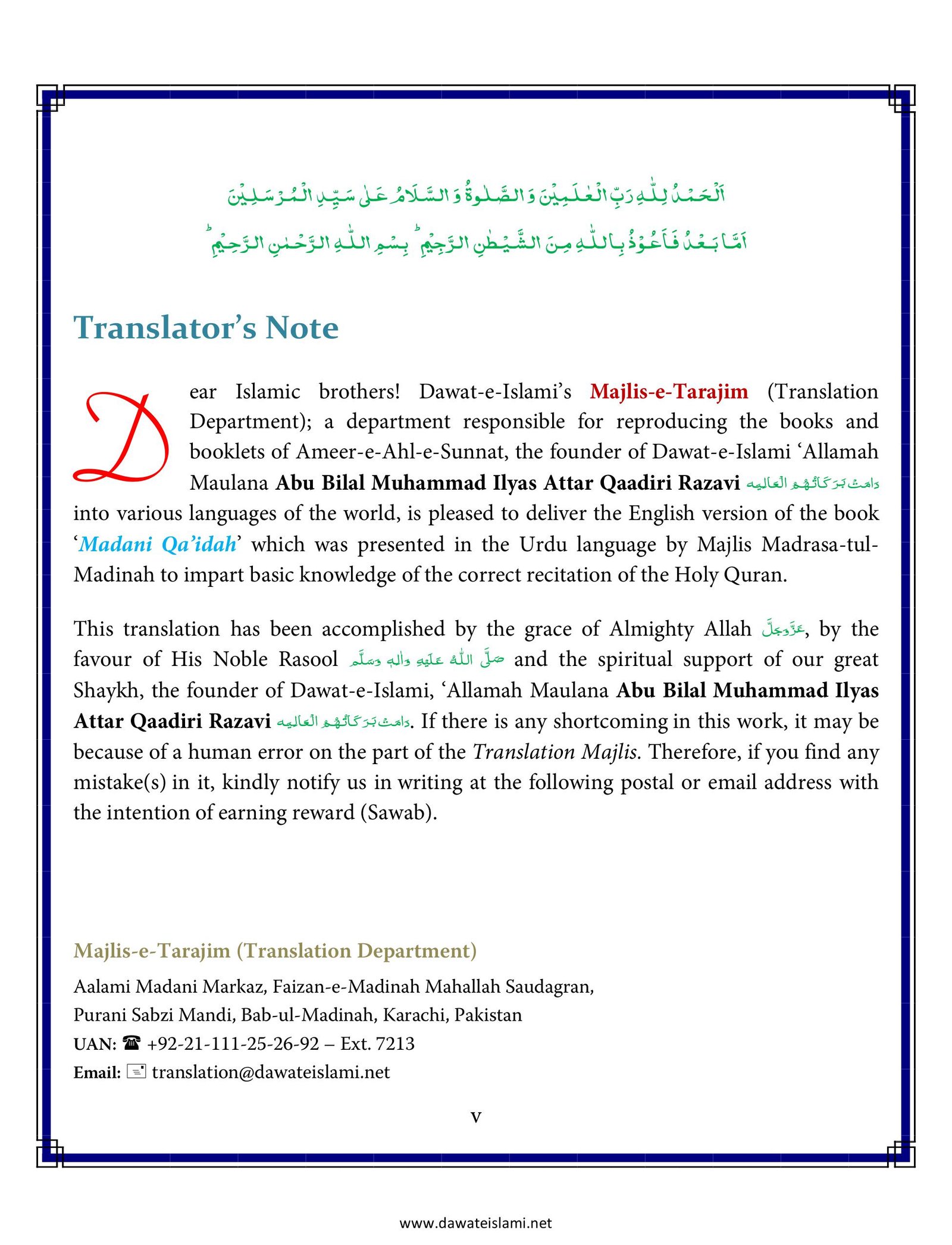
Welcome to Madni Qaida in English Page 07 at Learning Quraan. The translator’s note explains that the English version of Madani Qa’idah was prepared by Majlis-e-Tarajim, the translation department of Dawat-e-Islami, from the Urdu book presented by Majlis Madrasa-tul-Madinah, and gives contact details for reporting any mistakes.
This page is part of the opening pages of the book. See every page on the Madni Qaida in English index, or learn with a teacher in our online Quran courses.
What is on Madni Qaida in English Page 07?
- Why the book was translated: to teach the basics of correct Quran recitation to English speakers.
- Who the translation department is and how to contact them.
- A reminder that feedback on errors is welcomed.
How to Practise This Page
- Read the opening pages once with your child before starting Lesson 1, so they know what the book is for.
- Keep the Makharij chart and the articulation diagram nearby: you will come back to them in almost every lesson.
- Recite the du’a for study and Salat upon the Prophet ﷺ before each class to build a good routine.
About the English Edition
The translator’s note explains that this English version was produced by Majlis-e-Tarajim, the translation department of Dawat-e-Islami, from the Urdu original presented by Majlis Madrasa-tul-Madinah. The department asks readers to report any mistake they find, for the sake of reward.
Because the book was written for Urdu speakers, the English edition keeps many Urdu and Arabic terms, often side by side: “Fathah [Zabar]”, “Kasrah [Zayr]”. Learners who did not grow up with Urdu may not know these words, so here is a short glossary of the terms used throughout the book.
Glossary of Terms Used in the Book
| Arabic term | Urdu name | Meaning |
|---|---|---|
| Fathah | Zabar | The short “a” mark above a letter |
| Kasrah | Zer (Zayr) | The short “i” mark below a letter |
| Dammah | Pesh (Paysh) | The short “u” mark above a letter |
| Sukoon | Jazm | The mark of a silent letter |
| Tanween | Do Zabar, Do Zer, Do Pesh | A doubled vowel with an “n” sound |
| Tashdeed | Shadd | The mark of a doubled letter |
| Makhraj | Makhraj | The place where a letter is made |
| Hijjay | Hijje | Spelling a word letter by letter |
| Rawan | Rawan | Reading fluently, without spelling |
| Ghunnah | Ghunnah | The nasal sound of Noon and Meem |
| Madd | Madd | Stretching a vowel |
| Waqf | Waqf | Stopping at the end of a word |
A Note on Transliteration
On our pages we give simple English guides to sounds, such as “ba”, “bi”, “bu”. A dot under a letter (ḥ, ṣ, ḍ, ṭ, ẓ) marks a sound that English does not have, and ‘ stands for Ain. These guides help with practice, but they are no substitute for hearing a teacher read.
Source: the page shown above is the translator’s note in the Madani Qa‘idah (English edition), book page v, by Majlis-e-Tarajim, published by Maktaba-tul-Madinah (Dawat-e-Islami). The glossary is ours. Notes written by Learning Quraan.
Madni Qaida in English: Page Directory
Jump to any page of the English edition, or go back to the full page index.
Explore Our Free Islamic Tools
Enhance your daily Islamic practices with our online interactive Islamic Tools:- Count daily recitations on our Digital Tasbih Counter.
- Find the Qibla direction with our Qibla Finder.
- Convert dates with the Hijri Date Converter.
- Search meaningful names with our Islamic Names Finder.
- Calculate obligations with the Zakat Calculator and Islamic Inheritance Calculator.
Get One-on-One Tutoring Support
Learn more about our qualified Quran teachers on our About Us page, review pricing on our Fee structure page, or visit our Contact Us page to book a free trial class.
← Previous: Page 06👉 Proceed to Page 08 – First Read This
Page images: Madani Qa’idah, published by Maktaba-tul-Madinah (Dawat-e-Islami), shown here as a study reference.
