
Madni Qaida in English Page 54 – Lesson 20 Examples and Lesson 21: Waqf (Pausing)
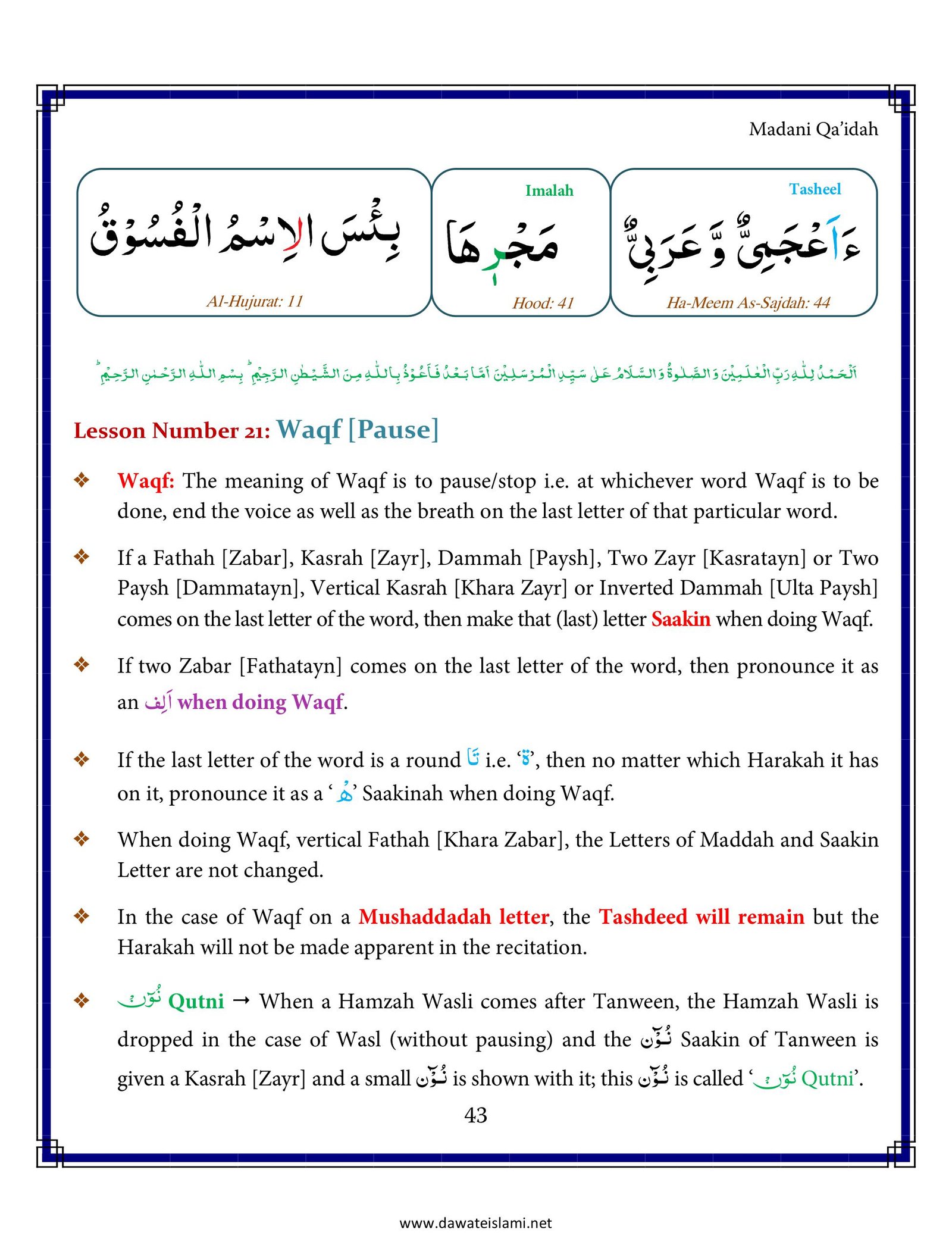
Welcome to Madni Qaida in English Page 54 at Learning Quraan. Page 54 gives the verse references for Tasheel, Imalah and بئس الاسم, then starts Lesson 21 on Waqf: how to end a word when you pause.
This page is part of Lesson 21: Waqf (Pausing) and Its Signs. See every page on the Madni Qaida in English index, or learn with a teacher in our online Quran courses.
What is on Madni Qaida in English Page 54?
- Pausing makes the last letter Saakin; two Zabar becomes an Alif.
- A round Taa (ة) is read as Haa Saakinah when pausing.
- Noon Qutni: the small Noon that joins Tanween to a following Hamzah Wasli.
How to Practise This Page
- When you pause, make the last letter Saakin; two Zabar becomes an Alif and a round Taa becomes Haa.
- Learn what each sign above the text means: O, م, ط, ج, ز, ص and لا.
- After a pause, restart from a sensible earlier word (I’adah).
The Three Special Words
The top row gives the Quranic place of each special reading from page 53:
| Word | How it is read | Where it occurs |
|---|---|---|
| ءَاَعْجَمِیٌّ وَّعَرَبِیٌّ | Tasheel: the second Hamzah is softened | Surah Fussilat 41:44 |
| مَجْرٖىهَا | Imalah: “majrehaa” | Surah Hud 11:41 |
| بِئْسَ الِاسْمُ الْفُسُوْقُ | “bi’sa-lismul-fusooq” | Surah al-Hujurat 49:11 |
Lesson 21: Waqf (Stopping)
Waqf means stopping. When you stop on a word, both the voice and the breath end on its last letter. The page gives these rules for how the last letter changes:
| If the last letter has… | When you stop | Example |
|---|---|---|
| Fathah, Kasrah, Dammah, Kasratayn, Dammatayn, Khari Zer or Ulta Pesh | It becomes Saakin | نَسْتَعِيْنُ → نَسْتَعِيْنْ |
| Fathatayn | It becomes an Alif | اَحَدًا → اَحَدَا |
| A round Ta (ة), whatever its vowel | It is read as a Saakin Ha | رَحْمَةٌ → رَحْمَهْ |
| Khara Zabar, a Letter of Maddah, or a Sukoon | No change | مُوْسٰى |
| A Tashdeed | The Tashdeed stays; the vowel is not sounded | وَتَبَّ → “wa tabb” |
The examples are ours: نَسْتَعِيْنُ is from Surah al-Fatihah 1:5, اَحَدًا from Surah al-Kahf 18:110, and وَتَبَّ from Surah al-Masad 111:1.
Noon Qutni
The last rule on the page is for joining, not stopping. When a Tanween is followed by a word that starts with a Hamzah Wasli (an Alif that is not read when joining), the Hamzah drops and the hidden Noon of the Tanween is given a Kasrah so the two words can join. The Quran shows this with a small Noon, called Noon Qutni. For example, نُوْحُ ۨابْنَهٗ (Surah Hud 11:42) is read “nooḥu-nibnahu”.
Mistakes to Watch For
- Stopping on a vowel. نَسْتَعِيْنُ at a stop is “nasta‘een”, not “nasta‘eenu”.
- Keeping the Tanween at a stop. اَحَدًا becomes “aḥadaa”; رَحْمَةٌ becomes “raḥmah”.
- Dropping the Tashdeed. وَتَبَّ at a stop still has the doubled Ba.
A Five-Minute Practice Plan
- Minute 1: read the three special words.
- Minute 2: read the examples in the Waqf table, first joined, then stopping.
- Minute 3: stop on the last word of each verse of Surah al-Ikhlas.
- Minute 4: read نُوْحُ ۨابْنَهٗ with the Noon Qutni.
- Minute 5: read the Check Yourself line below, stopping on each word.
Check Yourself
Read each word as if stopping on it:
الرَّحِيْمِ · اَحَدًا · رَحْمَةٌ · مُوْسٰى · وَتَبَّ · الْعٰلَمِيْنَ
Source: the page shown above is from the Madani Qa‘idah (English edition), Lessons 20 and 21, book page 43, published by Maktaba-tul-Madinah (Dawat-e-Islami). Quran references are given as surah and verse. Lesson notes written by Learning Quraan.
Madni Qaida in English: Page Directory
Jump to any page of the English edition, or go back to the full page index.
Explore Our Free Islamic Tools
Enhance your daily Islamic practices with our online interactive Islamic Tools:- Count daily recitations on our Digital Tasbih Counter.
- Find the Qibla direction with our Qibla Finder.
- Convert dates with the Hijri Date Converter.
- Search meaningful names with our Islamic Names Finder.
- Calculate obligations with the Zakat Calculator and Islamic Inheritance Calculator.
Get One-on-One Tutoring Support
Learn more about our qualified Quran teachers on our About Us page, review pricing on our Fee structure page, or visit our Contact Us page to book a free trial class.
← Previous: Page 53👉 Proceed to Page 55 – Lesson 21: Waqf Signs
Page images: Madani Qa’idah, published by Maktaba-tul-Madinah (Dawat-e-Islami), shown here as a study reference.
