
Madni Qaida in English Page 14 – Lesson 2: Compound Letters Practice Chart
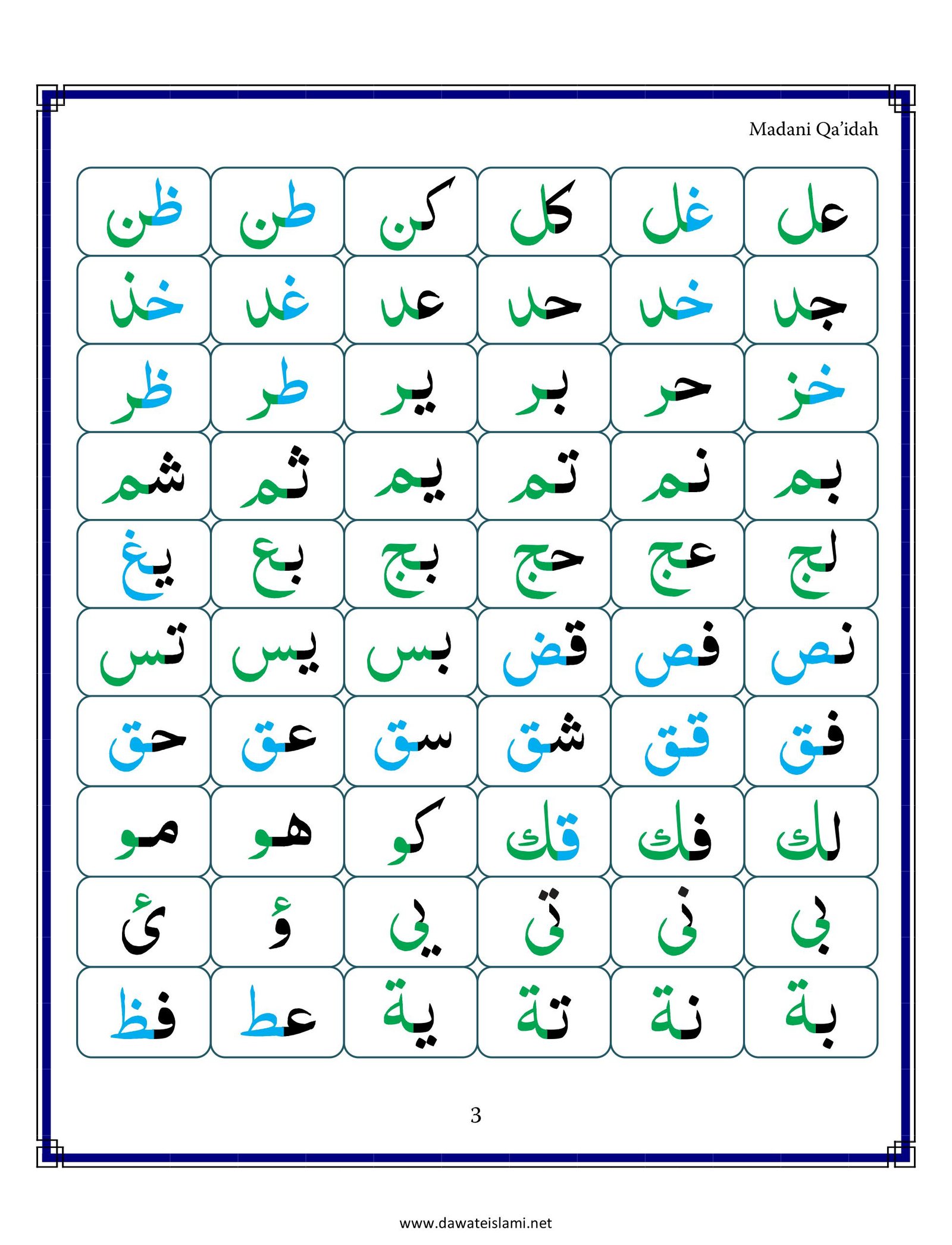
Welcome to Madni Qaida in English Page 14 at Learning Quraan. Page 14 is a full practice chart of two-letter compounds, mixing letters from every part of the alphabet so the learner recognises joined shapes quickly.
This page is part of Lesson 2: Huroof Murakkabat (Compound Letters). See every page on the Madni Qaida in English index, or learn with a teacher in our online Quran courses.
What is on Madni Qaida in English Page 14?
- Joins with ع, غ, ح, خ and ج at the start and in the middle.
- Compounds with heavy letters such as صا, ضا, طا, ظا and قا.
- Joins that end in round Taa (ة) and in Ya.
How to Practise This Page
- Name each joined letter separately, exactly as you did in Lesson 1.
- Use the dots to tell look-alike shapes apart (ب ت ث ن ي at the start of a word look almost the same).
- Point to each letter with a finger while reading so none is skipped.
How to Read This Page
Page 14 is the second practice chart of Lesson 2. Every box holds two joined letters, and, as on page 13, each letter is still read by its name: جد is “jeem, daal” and حق is “ḥaa, qaaf”. The new skill on this page is the end shape of each letter: what the second letter looks like when it finishes a join.
End Shapes on This Page
| Example | What to notice |
|---|---|
| جد | Dal at the end: a small open curve. |
| خذ | Dhal at the end: the same curve with a dot. |
| بر | Ra at the end drops below the line. |
| بم | Meem at the end: a small loop with a tail. |
| كن | Noon at the end: a bowl with one dot. |
| قض | Dad at the end keeps its full body. |
| فق | Qaf at the end: a deep round bowl with two dots. |
| لك | Kaf at the end: its full shape, with the small mark inside. |
| هو | Waw at the end: a loop with a tail. |
| بى | Ya at the end, written here without dots under it. |
| بة | Ta Marbutah: the round Ta found at the end of words. |
| ؤ | Hamzah sitting on a Waw. |
| ئ | Hamzah sitting on a Ya with no dots. |
Letters That Never Join Forward
Six letters never join to the letter after them: ا د ذ ر ز و. They can be joined to from the right (جد, حر, هو), but whatever comes next starts fresh. Spotting them helps a child see where one join ends in longer words later.
Mistakes to Watch For
- Reading Ta Marbutah as Ha. ة has two dots; it is a Ta. Without dots it would be Ha.
- Losing the Hamzah. In ؤ and ئ the letter is Hamzah; the Waw and the dotless Ya are only its seat.
- Mixing the heavy pairs. طر and ظر, عط and فظ: check the dot before reading.
- Mixing Fa and Qaf at the end. فق and قق: at the end, Qaf sits deeper below the line.
A Five-Minute Practice Plan
- Minute 1: read the first three rows, naming both letters.
- Minute 2: read only the second letter in each box of the next four rows, to train the eye on end shapes.
- Minute 3: read the last two rows slowly; they hold the special shapes ى ؤ ئ ة.
- Minute 4: find all the boxes that contain a heavy letter (blue).
- Minute 5: ask your child to point to every letter that does not join forward.
Check Yourself
خذ · ظر · يغ · قض · قك · ية · ئ
Source: the page shown above is from the Madani Qa‘idah (English edition), Lesson 2, book page 3, published by Maktaba-tul-Madinah (Dawat-e-Islami). Lesson notes written by Learning Quraan.
Madni Qaida in English: Page Directory
Jump to any page of the English edition, or go back to the full page index.
Explore Our Free Islamic Tools
Enhance your daily Islamic practices with our online interactive Islamic Tools:- Count daily recitations on our Digital Tasbih Counter.
- Find the Qibla direction with our Qibla Finder.
- Convert dates with the Hijri Date Converter.
- Search meaningful names with our Islamic Names Finder.
- Calculate obligations with the Zakat Calculator and Islamic Inheritance Calculator.
Get One-on-One Tutoring Support
Learn more about our qualified Quran teachers on our About Us page, review pricing on our Fee structure page, or visit our Contact Us page to book a free trial class.
← Previous: Page 13👉 Proceed to Page 15 – Lesson 3: Harakaat
Page images: Madani Qa’idah, published by Maktaba-tul-Madinah (Dawat-e-Islami), shown here as a study reference.
