
Madni Qaida in English Page 73 – Questions and Answers (Questions 77-82)
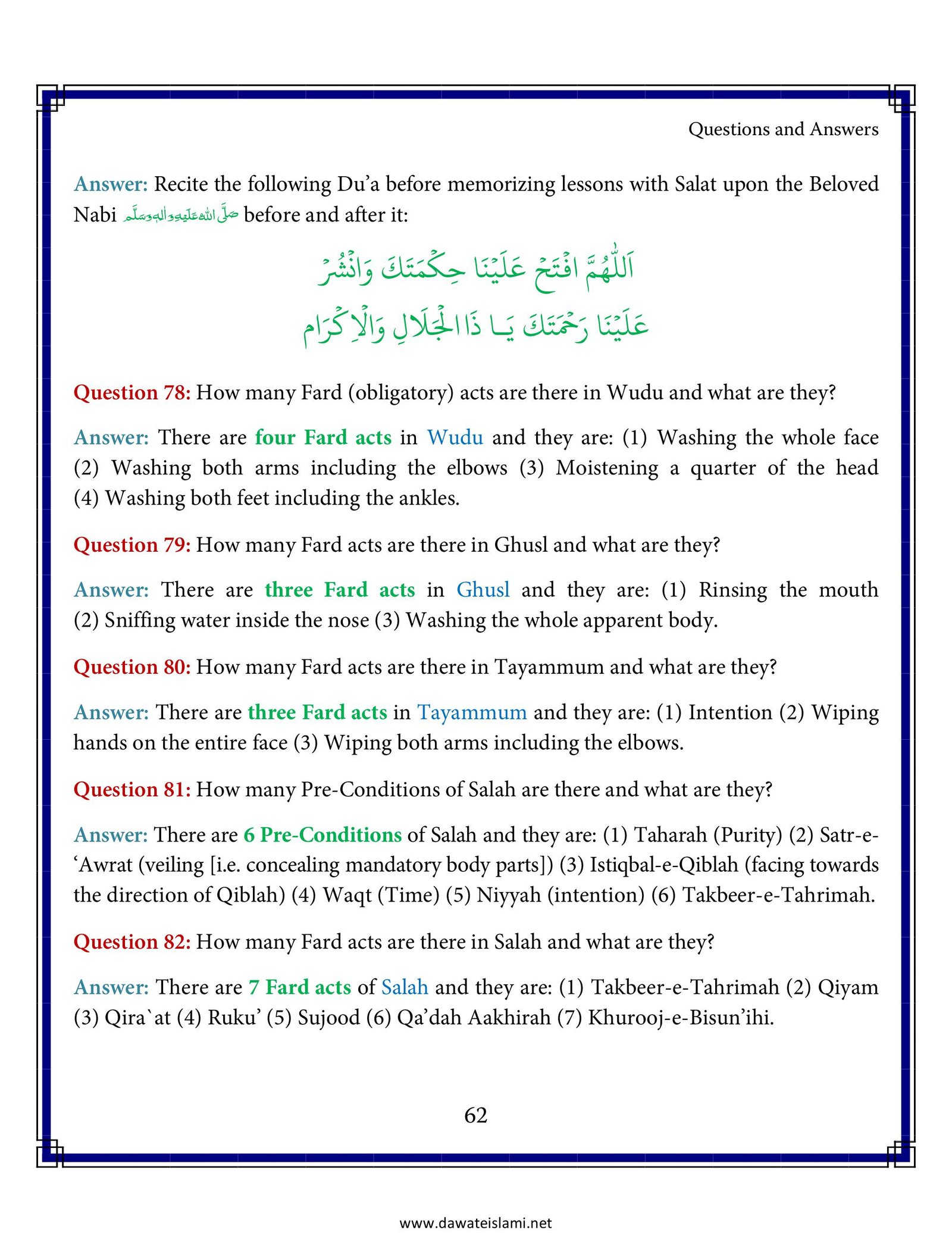
Welcome to Madni Qaida in English Page 73 at Learning Quraan. The last questions cover the du’a before studying and the basic Fard acts of worship every student should know.
This page is part of the Questions and Answers revision section. See every page on the Madni Qaida in English index, or learn with a teacher in our online Quran courses.
What is on Madni Qaida in English Page 73?
- The du’a to recite before memorising lessons.
- The Fard acts of Wudu (4), Ghusl (3) and Tayammum (3).
- The 6 pre-conditions of Salah and its 7 Fard acts.
How to Practise This Page
- Cover the answer, read the question aloud and try to answer from memory.
- Each question names its lesson: go back to that lesson if an answer is shaky.
- Revise ten questions a day until the whole section is easy.
What Questions 77 to 82 Revise
Page 73 continues the revision section with questions 77 to 82. Each topic is explained below in our own words, with an example and a link back to the lesson. Use the page as a quiz: ask the question, let your child answer, then check.
The du‘a before studying
Before a lesson, recite this du‘a with Salat upon the Holy Prophet ﷺ before and after it:
اَللّٰهُمَّ افْتَحْ عَلَيْنَا حِكْمَتَكَ وَانْشُرْ عَلَيْنَا رَحْمَتَكَ يَا ذَا الْجَلَالِ وَالْاِكْرَامِ
It asks Allah to open His wisdom to us and spread His mercy over us. The book cites it from al-Mustatraf, vol. 1, p. 40. Reading it is also good Tajweed practice: the Hamzah Wasli in افْتَحْ and وَانْشُرْ is not read when joining.
Fard acts of Wudu
The four Fard acts of Wudu are: washing the whole face; washing both arms including the elbows; wiping (Masah) a quarter of the head; and washing both feet including the ankles. They come from Surah al-Ma’idah 5:6.
Fard acts of Ghusl
In Hanafi fiqh Ghusl has three Fard acts: rinsing the whole mouth; taking water into the soft part of the nose; and washing the whole outer body so that no part is left dry.
Fard acts of Tayammum
Tayammum has three Fard acts: the intention (Niyyah); wiping the whole face with the hands; and wiping both arms including the elbows.
Conditions (Shara’it) of Salah
Six conditions must be met for Salah to be valid: purity (Taharah), covering the Awrah (Satr), facing the Qiblah, the correct time (Waqt), the intention (Niyyah), and Takbeer-e-Tahrimah.
Fard acts of Salah
Seven Fard acts: Takbeer-e-Tahrimah, Qiyam (standing), Qira’at (recitation), Ruku‘, the two Sajdahs, the final sitting (Qa‘dah Akhirah), and ending the prayer by one’s own act (Khurooj bi-Sun‘ihi).
For the full Hanafi method, see our guides to Wudu and how to pray.
Quick Quiz for Your Child
- How many Fard acts does Wudu have?
- How much of the head must be wiped in Wudu?
- How many Fard acts does Tayammum have?
- Name the six conditions of Salah.
- What is the last Fard act of Salah?
Answers: 1) four · 2) a quarter · 3) three · 4) Taharah, Satr, Qiblah, Waqt, Niyyah, Takbeer-e-Tahrimah · 5) Khurooj bi-Sun‘ihi (ending the prayer by one’s own act)
Source: the page shown above is from the Madani Qa‘idah (English edition), Questions and Answers, book page 62, published by Maktaba-tul-Madinah (Dawat-e-Islami). The rulings on Wudu, Ghusl, Tayammum and Salah follow Bahar-e-Shariat (parts 2 and 3) and Nur al-Idah. Explanations written by Learning Quraan.
Madni Qaida in English: Page Directory
Jump to any page of the English edition, or go back to the full page index.
Explore Our Free Islamic Tools
Enhance your daily Islamic practices with our online interactive Islamic Tools:- Count daily recitations on our Digital Tasbih Counter.
- Find the Qibla direction with our Qibla Finder.
- Convert dates with the Hijri Date Converter.
- Search meaningful names with our Islamic Names Finder.
- Calculate obligations with the Zakat Calculator and Islamic Inheritance Calculator.
Get One-on-One Tutoring Support
Learn more about our qualified Quran teachers on our About Us page, review pricing on our Fee structure page, or visit our Contact Us page to book a free trial class.
← Previous: Page 72👉 Proceed to Page 74 – Table of Contents
Page images: Madani Qa’idah, published by Maktaba-tul-Madinah (Dawat-e-Islami), shown here as a study reference.
