
Madni Qaida in English Page 24 – Lesson 7: Maddah Practice Chart
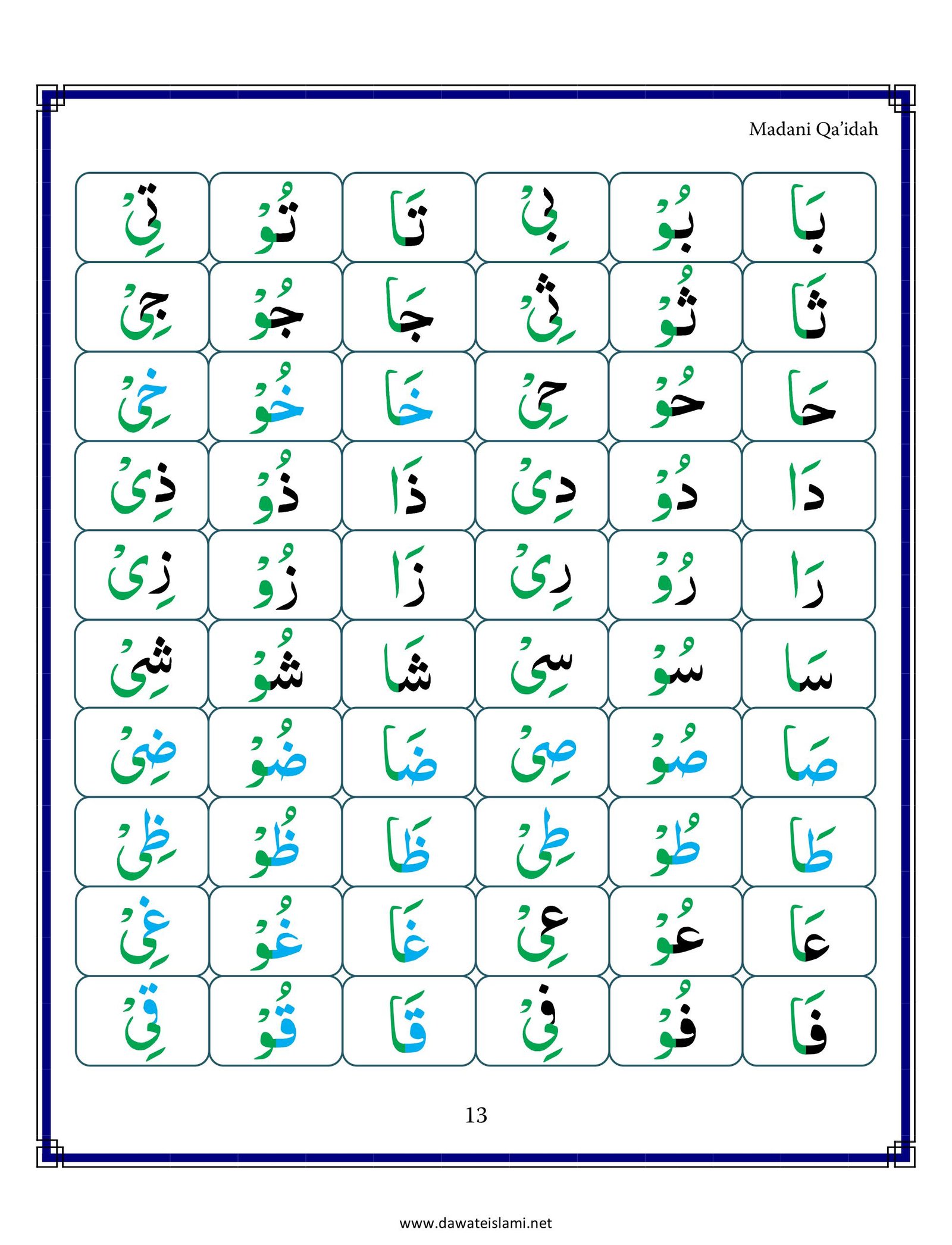
Welcome to Madni Qaida in English Page 24 at Learning Quraan. Page 24 is a Maddah chart: each letter with Alif Maddah, Waw Maddah and Ya Maddah, so the learner practises an even two-count stretch.
This page is part of Lesson 7: Huroof-e-Maddah (Letters of Maddah). See every page on the Madni Qaida in English index, or learn with a teacher in our online Quran courses.
What is on Madni Qaida in English Page 24?
- Patterns like بَا, بُو, بِي for every letter.
- Heavy letters with Maddah such as صَا, طُو and قِي.
- A steady rhythm drill for the length of one Alif.
How to Practise This Page
- Stretch the Letters of Maddah for one Alif (two counts), no more and no less.
- Alif after Fathah, Waw Saakin after Dammah and Ya Saakin after Kasrah make the Maddah.
- Tap two steady counts on the table to keep the length even.
All 60 Maddah Sounds on This Page
Page 24 takes 20 letters, from Ba (ب) to Qaf (ق), and joins each one to all three Letters of Maddah. Each row of the page holds two letters. Read it from right to left: first the Alif sound (aa), then the Waw sound (oo), then the Ya sound (ee). The table shows every box on the page with a simple English guide to the sound.
| Letter | With Alif (aa) | With Waw (oo) | With Ya (ee) |
|---|---|---|---|
| Ba ب | بَا baa | بُو boo | بِي bee |
| Ta ت | تَا taa | تُو too | تِي tee |
| Tha ث | ثَا thaa | ثُو thoo | ثِي thee |
| Jeem ج | جَا jaa | جُو joo | جِي jee |
| Ha ح | حَا ḥaa | حُو ḥoo | حِي ḥee |
| Kha خ | خَا khaa | خُو khoo | خِي khee |
| Dal د | دَا daa | دُو doo | دِي dee |
| Dhal ذ | ذَا dhaa | ذُو dhoo | ذِي dhee |
| Ra ر | رَا raa | رُو roo | رِي ree |
| Zay ز | زَا zaa | زُو zoo | زِي zee |
| Seen س | سَا saa | سُو soo | سِي see |
| Sheen ش | شَا shaa | شُو shoo | شِي shee |
| Sad ص | صَا ṣaa | صُو ṣoo | صِي ṣee |
| Dad ض | ضَا ḍaa | ضُو ḍoo | ضِي ḍee |
| Ta (heavy) ط | طَا ṭaa | طُو ṭoo | طِي ṭee |
| Za (heavy) ظ | ظَا ẓaa | ظُو ẓoo | ظِي ẓee |
| Ain ع | عَا ‘aa | عُو ‘oo | عِي ‘ee |
| Ghayn غ | غَا ghaa | غُو ghoo | غِي ghee |
| Fa ف | فَا faa | فُو foo | فِي fee |
| Qaf ق | قَا qaa | قُو qoo | قِي qee |
A dot under a letter (ḥ, ṣ, ḍ, ṭ, ẓ) and the mark ‘ for Ain stand for sounds that English does not have. Listen to your teacher for these.
The Rule in Simple Words
There are three Letters of Maddah (Huroof-e-Maddah): Alif with a Fathah before it, Waw saakin with a Dammah before it, and Ya saakin with a Kasrah before it. When you meet one, stretch the sound for one Alif, which is about two counts. This natural stretch is called Madd Tabee‘i (also Madd Asli). It is the shortest Madd and the base for the longer ones in Lesson 17. For all the Madd rules, see our Madd in Tajweed guide.
Why Some Letters Are Blue
Seven letters on this page are printed in blue: Kha (خ), Sad (ص), Dad (ض), Ta (ط), Za (ظ), Ghayn (غ) and Qaf (ق). These are the heavy letters (Huroof-e-Musta‘liyah), remembered together as خُصَّ ضَغْطٍ قِظْ. Read them with a full, heavy sound and keep that sound through the stretch: صَا is a deep “ṣaa”, not a thin “saa”. Compare these pairs from the page: سَا and صَا, تَا and طَا, ذَا and ظَا, دَا and ضَا. See Heavy and Light Letters.
Ra (ر) is not blue, but it changes: it is read heavy in رَا and رُو and light in رِي. Lesson 16 explains the rules of Ra.
Mistakes to Watch For
- Cutting the stretch short. “ba” instead of “baa” turns a long vowel into a short one, and in the Quran that can change a word.
- Over-stretching. Four or five counts belong to the longer Madd of Lesson 17. Here, keep it to two.
- Adding an English glide. بُو is a pure “boo”, not “bow”, and بِي is a pure “bee”, not “bay”.
- Thinning the heavy letters. Reading صَا like سَا, or طُو like تُو.
- Losing the throat letters. عَا is not a plain “aa” and حَا is not an English “ha”. Practise them again on page 19.
A Five-Minute Practice Plan
- Minute 1: read the first five rows slowly, tapping two even beats on the table for every long vowel.
- Minute 2: read the last four rows, where most letters are blue, and listen for the full, heavy sound.
- Minute 3: read down one column instead of across, so the page cannot be read from memory.
- Minute 4: point to boxes at random and let your child read them.
- Minute 5: read the light and heavy pairs: سَا then صَا, تُو then طُو, ذِي then ظِي, دَا then ضَا.
Check Yourself
Your child is ready for Lesson 8 when they can read these boxes from the page evenly and without help:
طُو · غِي · ذَا · حُو · قِي · ثَا · ضِي
Source: the page shown above is from the Madani Qa‘idah (English edition), Lesson 7, book page 13, published by Maktaba-tul-Madinah (Dawat-e-Islami). The rules of Madd Tabee‘i and the heavy letters follow Faizan-e-Tajweed (Dawat-e-Islami), pp. 20 and 30–31. Lesson notes written by Learning Quraan.
Madni Qaida in English: Page Directory
Jump to any page of the English edition, or go back to the full page index.
Explore Our Free Islamic Tools
Enhance your daily Islamic practices with our online interactive Islamic Tools:- Count daily recitations on our Digital Tasbih Counter.
- Find the Qibla direction with our Qibla Finder.
- Convert dates with the Hijri Date Converter.
- Search meaningful names with our Islamic Names Finder.
- Calculate obligations with the Zakat Calculator and Islamic Inheritance Calculator.
Get One-on-One Tutoring Support
Learn more about our qualified Quran teachers on our About Us page, review pricing on our Fee structure page, or visit our Contact Us page to book a free trial class.
← Previous: Page 23👉 Proceed to Page 25 – Lesson 8: Khari Harakaat
Page images: Madani Qa’idah, published by Maktaba-tul-Madinah (Dawat-e-Islami), shown here as a study reference.
