
Madni Qaida in English Page 22 – Lesson 6: Words With Harakaat and Tanween
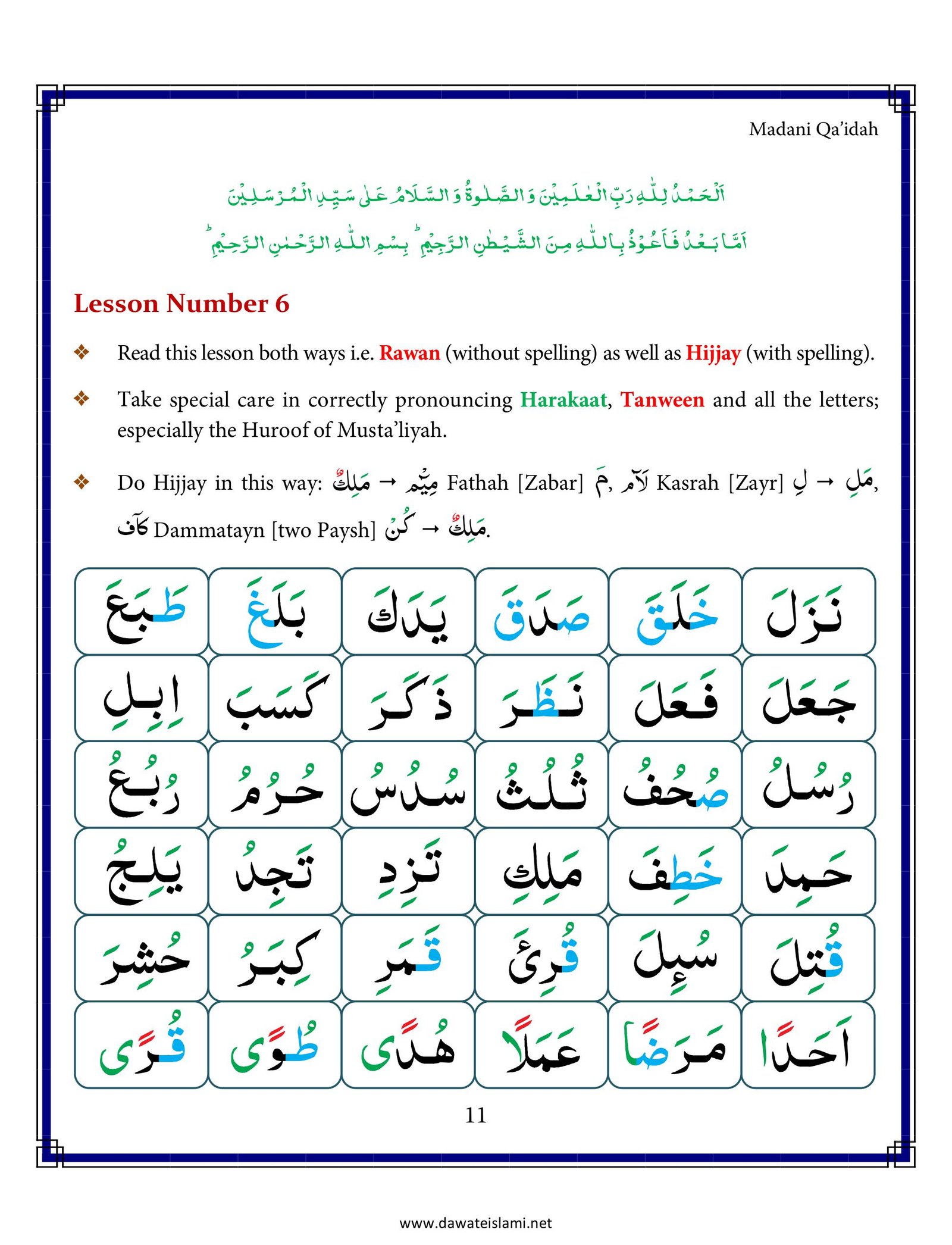
Welcome to Madni Qaida in English Page 22 at Learning Quraan. Lesson 6 is the first lesson of complete words. The learner reads each word both with Hijjay (spelling) and Rawan (fluently), taking special care with the heavy letters.
This page is part of Lesson 6: Words With Harakaat and Tanween. See every page on the Madni Qaida in English index, or learn with a teacher in our online Quran courses.
What is on Madni Qaida in English Page 22?
- How to spell a word such as ملكٌ letter by letter.
- Three-letter words such as نزل, خلق and صدق.
- Words ending in Tanween, such as أحدًا, عملًا and هدًى.
How to Practise This Page
- Read each word twice: first with Hijjay (spelling), then Rawan (fluently).
- Give the heavy letters their full sound even inside a word.
- Do not add a vowel that is not written, and do not drop one that is.
What Is New in Lesson 6
Lesson 6 is the first lesson of whole words. Every box holds a word of three letters, and every letter carries a Harakah or a Tanween from Lessons 3 to 5. The page asks for three things:
- Read each word both ways: first Hijjay (spelling it out), then Rawan (fluently, in one go).
- Keep every mark exact: the Harakaat, the Tanween and every letter’s sound.
- Take extra care with the Huroof-e-Musta‘liyah, the seven heavy letters (خ ص ض غ ط ق ظ). In the words on this page they are printed in blue, so you can see exactly where the heavy sound falls.
Hijjay: How the Book Spells a Word
The page spells مَلِكٌ as its model. Each letter is named with its mark, and the sounds are added one at a time:
| Step | Say | Sound so far |
|---|---|---|
| 1 | Meem, Zabar: “ma” | مَ |
| 2 | Lam, Zer: “li” | مَلِ “mali” |
| 3 | Kaf, two Pesh: “kun” | مَلِكٌ “malikun” |
Once the child can spell a word, the same word is read Rawan: مَلِكٌ “malikun”, with no pause between the syllables.
All 36 Words on Page 22
The hyphens show the syllables. Each row trains one thing: row 1 is all Fathah, row 3 all Dammah, rows 4 and 5 mix the marks, and row 6 ends in Fathatayn.
| Word | Read | Word | Read | Word | Read |
|---|---|---|---|---|---|
| نَزَلَ | na-za-la | خَلَقَ | kha-la-qa | صَدَقَ | ṣa-da-qa |
| يَدَكَ | ya-da-ka | بَلَغَ | ba-la-gha | طَبَعَ | ṭa-ba-‘a |
| جَعَلَ | ja-‘a-la | فَعَلَ | fa-‘a-la | نَظَرَ | na-ẓa-ra |
| ذَكَرَ | dha-ka-ra | كَسَبَ | ka-sa-ba | اِبِلِ | i-bi-li |
| رُسُلُ | ru-su-lu | صُحُفُ | ṣu-ḥu-fu | ثُلُثُ | thu-lu-thu |
| سُدُسُ | su-du-su | حُرُمُ | ḥu-ru-mu | رُبُعُ | ru-bu-‘u |
| حَمِدَ | ḥa-mi-da | خَطِفَ | kha-ṭi-fa | مَلِكِ | ma-li-ki |
| تَزِدِ | ta-zi-di | تَجِدُ | ta-ji-du | يَلِجُ | ya-li-ju |
| قُتِلَ | qu-ti-la | سُئِلَ | su-’i-la | قُرِئَ | qu-ri-’a |
| قَمَرِ | qa-ma-ri | كِبَرُ | ki-ba-ru | حُشِرَ | ḥu-shi-ra |
| اَحَدًا | a-ḥa-dan | مَرَضًا | ma-ra-ḍan | عَمَلًا | ‘a-ma-lan |
| هُدًى | hu-dan | طُوًى | ṭu-wan | قُرًى | qu-ran |
In the last row the Alif in اَحَدًا, مَرَضًا and عَمَلًا, and the Ya in هُدًى, طُوًى and قُرًى, are silent, as Lesson 5 taught.
Found in the Quran
Many of these practice words are words of the Quran. A few of them, with where they occur:
| Word | Where it occurs |
|---|---|
| نَزَلَ | Surah ash-Shu‘ara 26:193 |
| خَلَقَ | Surah al-‘Alaq 96:1 |
| تَزِدِ | Surah Nuh 71:24 |
| قُتِلَ | Surah ‘Abasa 80:17 |
| هُدًى | Surah al-Baqarah 2:2 |
| مَرَضًا | Surah al-Baqarah 2:10 |
| طُوًى | Surah Ta-Ha 20:12 |
| عَمَلًا · اَحَدًا | Surah al-Kahf 18:110 |
| قُرًى | Surah al-Hashr 59:14 |
Inside a verse, later rules (such as stopping, and the rules of Noon Saakin and Tanween) can change how a word ends. Here each word is read on its own, exactly as written.
Mistakes to Watch For
- Skipping Hijjay. A child who guesses نَظَرَ from its shape has not read it. Spell first, then read.
- Uneven syllables. In خَلَقَ all three sounds are equally short; “khalaaqa” is wrong.
- Losing the heavy sound mid-word. The blue ط in خَطِفَ stays heavy even with a Kasrah.
- Reading the silent letters in row 6. هُدًى is “hudan”, not “hudaa”.
A Five-Minute Practice Plan
- Minute 1: spell three words from row 1 the book’s way, then read them Rawan.
- Minute 2: read row 3 (all Dammah) and row 4 (Kasrah in the middle).
- Minute 3: read the blue-letter words: خَلَقَ then صَدَقَ then طَبَعَ then نَظَرَ then خَطِفَ.
- Minute 4: read row 5, where all three marks meet in one word.
- Minute 5: read the Check Yourself line below.
Check Yourself
صَدَقَ · نَظَرَ · صُحُفُ · خَطِفَ · قُرِئَ · مَرَضًا · طُوًى
Source: the page shown above is from the Madani Qa‘idah (English edition), Lesson 6, book page 11, published by Maktaba-tul-Madinah (Dawat-e-Islami). Quran references are given as surah and verse. Lesson notes written by Learning Quraan.
Madni Qaida in English: Page Directory
Jump to any page of the English edition, or go back to the full page index.
Explore Our Free Islamic Tools
Enhance your daily Islamic practices with our online interactive Islamic Tools:- Count daily recitations on our Digital Tasbih Counter.
- Find the Qibla direction with our Qibla Finder.
- Convert dates with the Hijri Date Converter.
- Search meaningful names with our Islamic Names Finder.
- Calculate obligations with the Zakat Calculator and Islamic Inheritance Calculator.
Get One-on-One Tutoring Support
Learn more about our qualified Quran teachers on our About Us page, review pricing on our Fee structure page, or visit our Contact Us page to book a free trial class.
← Previous: Page 21👉 Proceed to Page 23 – Lesson 7: Maddah Letters
Page images: Madani Qa’idah, published by Maktaba-tul-Madinah (Dawat-e-Islami), shown here as a study reference.
