
Madni Qaida in English Page 61 – Questions and Answers (Questions 1-7)
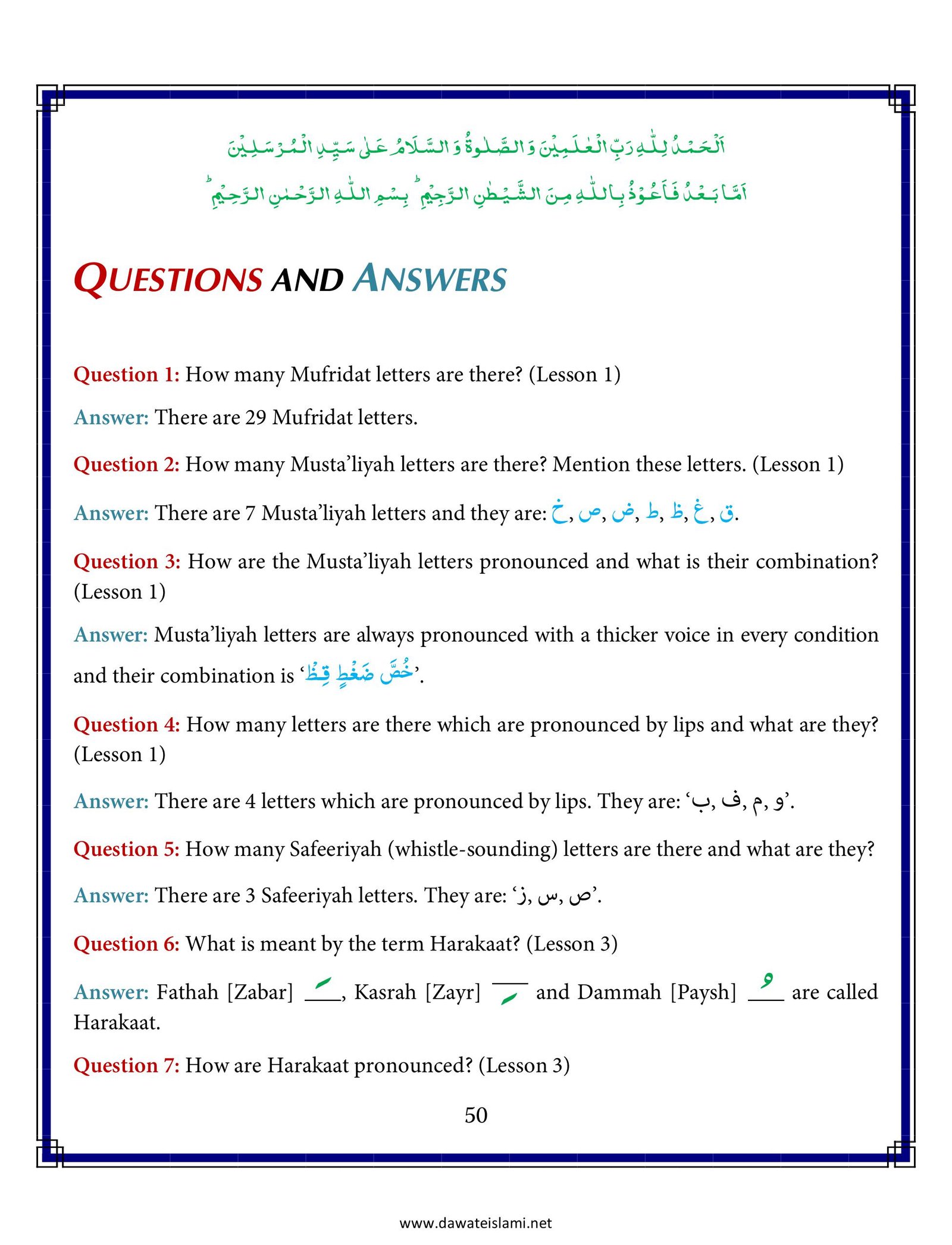
Welcome to Madni Qaida in English Page 61 at Learning Quraan. The revision section begins here. Questions 1 to 7 test the basics from Lessons 1 and 3: letters and short vowels.
This page is part of the Questions and Answers revision section. See every page on the Madni Qaida in English index, or learn with a teacher in our online Quran courses.
What is on Madni Qaida in English Page 61?
- How many Mufridat letters there are.
- The Musta’liyah letters, the lip letters and the Safeeriyah letters.
- What Harakaat are and how they are pronounced.
How to Practise This Page
- Cover the answer, read the question aloud and try to answer from memory.
- Each question names its lesson: go back to that lesson if an answer is shaky.
- Revise ten questions a day until the whole section is easy.
What These Seven Questions Revise
Page 61 opens the revision section of the Qaida. Its seven questions go back over Lesson 1 (the single letters and their groups) and Lesson 3 (the short vowels). Use it as a quiz: cover the answers, ask the question, and let your child answer before you check. Below, each topic is explained in our own words with an example your child can point to.
1. The single letters (Huroof-e-Mufradat)
The Qaida counts 29 single letters in Lesson 1, from Alif to Ya. Your child should be able to name each one and say it from its correct place in the mouth. If any letter is shaky, go back to page 12.
2 and 3. The heavy letters (Huroof-e-Musta‘liyah)
Seven letters are always read with a full, heavy sound: خ ص ض غ ط ق ظ. They are remembered together as خُصَّ ضَغْطٍ قِظْ. The back of the tongue rises towards the roof of the mouth, which fills the sound. The quickest test is a pair: سَ is light, صَ is heavy. More on this in Heavy and Light Letters.
4. The lip letters
Four letters come from the lips: ب ف م و. Ba and Meem close the lips fully (Ba from the wet inner part, Meem from the dry outer part). Fa touches the tips of the upper front teeth to the inside of the lower lip. Waw rounds the lips without closing them. Ask your child to watch their lips in a mirror while reading بَ مَ فَ وَ.
5. The whistling letters (Safeeriyah)
Three letters carry a light whistle: ز س ص. The sound comes from the tip of the tongue near the lower front teeth. Keep the whistle gentle, and keep Sad heavy so it does not turn into Seen.
6 and 7. The short vowels (Harakaat)
Fathah (Zabar), Kasrah (Zer) and Dammah (Pesh) are the three short vowels, giving the sounds “a”, “i” and “u”: بَ بِ بُ. Each is said quickly, with no stretch. For Fathah the mouth opens, for Kasrah the jaw drops a little, and for Dammah the lips round. The answer to question 7 continues on page 62, and the full lesson is on page 15.
Quick Quiz for Your Child
- Which one is heavy: س or ص?
- Which letter is made with the lips: ق or م?
- Name the three whistling letters.
- Read دَ دِ دُ. Which mark gives the “u” sound?
- Say the heavy-letter phrase from memory.
Answers: 1) ص · 2) م · 3) ز, س and ص · 4) the Dammah (Pesh) · 5) خُصَّ ضَغْطٍ قِظْ
How to Use the Revision Pages
- Do one revision page a day, after the normal lesson, not instead of it.
- Note every question your child misses, then go back to that lesson page the next day.
- Repeat the page until every answer comes quickly; speed shows the rule has settled.
Source: the page shown above is from the Madani Qa‘idah (English edition), Questions and Answers, book page 50, published by Maktaba-tul-Madinah (Dawat-e-Islami). The places of the letters and the heavy and whistling letters follow Faizan-e-Tajweed (Dawat-e-Islami), pp. 16–17 and 20, and al-Muqaddimah al-Jazariyyah of Imam Ibn al-Jazari. Explanations written by Learning Quraan.
Madni Qaida in English: Page Directory
Jump to any page of the English edition, or go back to the full page index.
Explore Our Free Islamic Tools
Enhance your daily Islamic practices with our online interactive Islamic Tools:- Count daily recitations on our Digital Tasbih Counter.
- Find the Qibla direction with our Qibla Finder.
- Convert dates with the Hijri Date Converter.
- Search meaningful names with our Islamic Names Finder.
- Calculate obligations with the Zakat Calculator and Islamic Inheritance Calculator.
Get One-on-One Tutoring Support
Learn more about our qualified Quran teachers on our About Us page, review pricing on our Fee structure page, or visit our Contact Us page to book a free trial class.
← Previous: Page 60👉 Proceed to Page 62 – Q&A: Questions 7-13
Page images: Madani Qa’idah, published by Maktaba-tul-Madinah (Dawat-e-Islami), shown here as a study reference.
