
Madni Qaida in English Page 55 – Lesson 21: The Signs of Waqf and I'adah
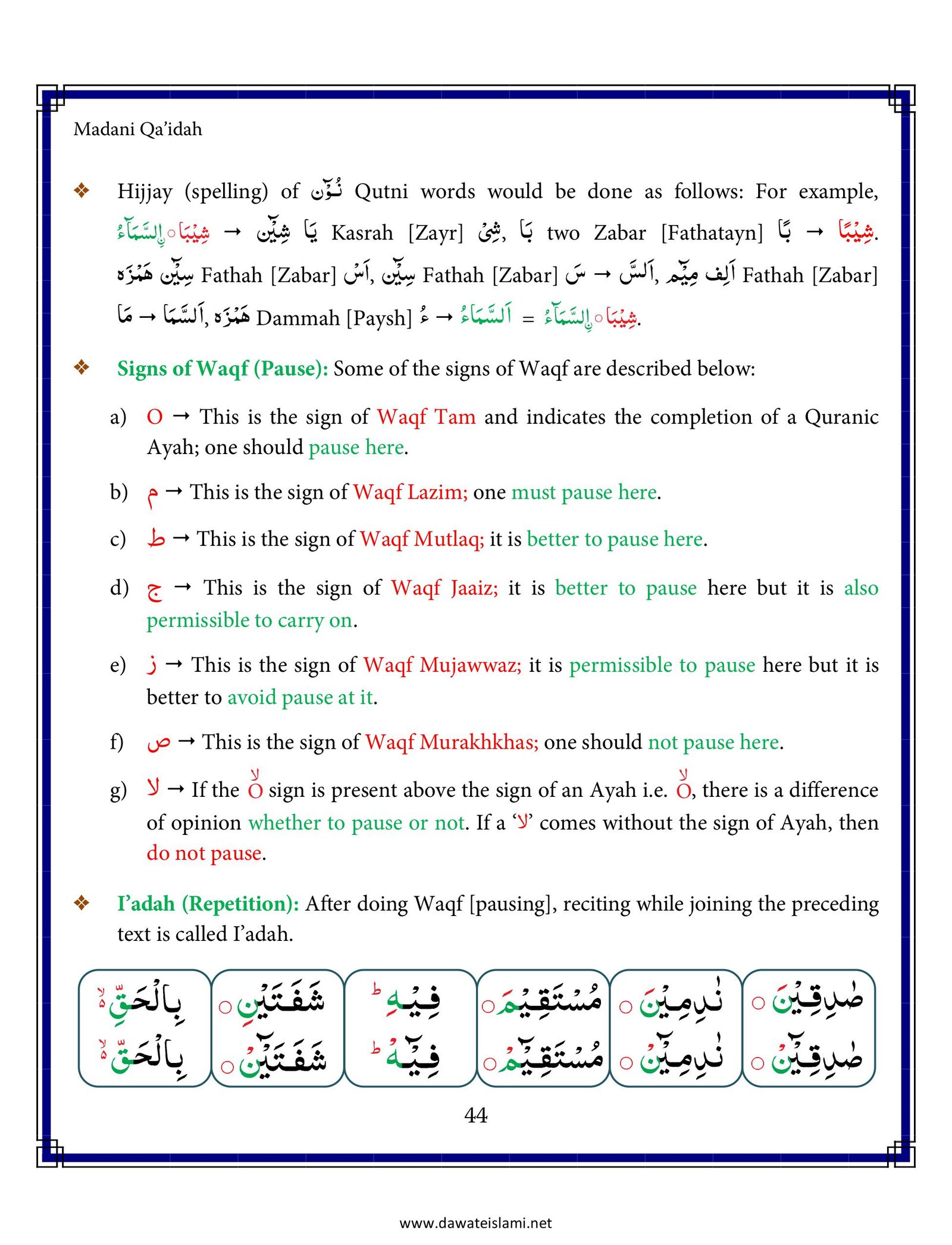
Welcome to Madni Qaida in English Page 55 at Learning Quraan. This page explains how to spell Noon Qutni words and lists the main signs of Waqf written above the Quranic text.
This page is part of Lesson 21: Waqf (Pausing) and Its Signs. See every page on the Madni Qaida in English index, or learn with a teacher in our online Quran courses.
What is on Madni Qaida in English Page 55?
- O for Waqf Tam, م for Waqf Lazim and ط for Waqf Mutlaq.
- ج for Waqf Jaaiz, ز for Waqf Mujawwaz and ص for Waqf Murakhkhas.
- The meaning of لا, and I’adah: re-joining the earlier text after a pause.
How to Practise This Page
- When you pause, make the last letter Saakin; two Zabar becomes an Alif and a round Taa becomes Haa.
- Learn what each sign above the text means: O, م, ط, ج, ز, ص and لا.
- After a pause, restart from a sensible earlier word (I’adah).
Spelling a Noon Qutni
The page first shows how to spell a Noon Qutni word, using شِيْبَاۨ السَّمَآءُ (Surah al-Muzzammil 73:17–18). The Tanween of شِيْبًا is spelled as usual, then the small Noon takes a Kasrah and joins the next word: “sheeba-nis-samaa’u”. The Alif of السَّمَآءُ is a Hamzah Wasli and is not read when joining.
The Signs of Waqf
The Quran prints small signs above the words to show where to stop and where to carry on. The page explains seven of them:
| Sign | Name | Meaning |
|---|---|---|
| ○ | Waqf Tam | The end of a verse. Stop here. |
| م | Waqf Lazim | You must stop here. |
| ط | Waqf Mutlaq | It is better to stop. |
| ج | Waqf Jaaiz | Better to stop, but you may carry on. |
| ز | Waqf Mujawwaz | You may stop, but it is better not to. |
| ص | Waqf Murakhkhas | Carry on; do not stop here. |
| لا | La (no) | Above a verse-end circle: scholars differ on stopping. On its own, without the circle: do not stop. |
I‘adah (repeating): after stopping, if the sense needs it, you go back a little and read on from there, joining it to what follows. This is called I‘adah.
The Examples: Written, Then Read at a Stop
Each box shows the word twice: on top as it is written, underneath as it is read when you stop on it. The small sign beside each tells you what kind of stop it is:
| Written | Read at a stop | What changes | Where it occurs |
|---|---|---|---|
| صٰدِقِيْنَ | صٰدِقِيْنْ | Madd ‘Aarid | |
| نٰدِمِيْنَ | نٰدِمِيْنْ | Madd ‘Aarid | |
| مُسْتَقِيْمَ | مُسْتَقِيْمْ | Madd ‘Aarid | |
| فِيْهِ | فِيْهْ | vowel dropped | |
| شَفَتَيْنِ | شَفَتَيْنْ | Madd Leen ‘Aarid | Surah al-Balad 90:9 |
| بِالْحَقِّ | بِالْحَقّْ | Tashdeed stays | Surah al-‘Asr 103:3 |
Mistakes to Watch For
- Stopping at a لا without the verse circle. Carry on.
- Not stopping at م. A stop is required there.
- Losing the Tashdeed at a stop. بِالْحَقِّ still ends with a doubled Qaf.
A Five-Minute Practice Plan
- Minute 1: learn the seven signs from the table.
- Minute 2: read each example twice: joined, then stopping.
- Minute 3: open Surah al-Fatihah and point to each verse circle.
- Minute 4: read شِيْبَاۨ السَّمَآءُ with the Noon Qutni.
- Minute 5: read the Check Yourself line below, stopping on each word.
Check Yourself
صٰدِقِيْنَ · مُسْتَقِيْمَ · فِيْهِ · شَفَتَيْنِ · بِالْحَقِّ
Source: the page shown above is from the Madani Qa‘idah (English edition), Lesson 21, book page 44, published by Maktaba-tul-Madinah (Dawat-e-Islami). Quran references are given as surah and verse. Lesson notes written by Learning Quraan.
Madni Qaida in English: Page Directory
Jump to any page of the English edition, or go back to the full page index.
Explore Our Free Islamic Tools
Enhance your daily Islamic practices with our online interactive Islamic Tools:- Count daily recitations on our Digital Tasbih Counter.
- Find the Qibla direction with our Qibla Finder.
- Convert dates with the Hijri Date Converter.
- Search meaningful names with our Islamic Names Finder.
- Calculate obligations with the Zakat Calculator and Islamic Inheritance Calculator.
Get One-on-One Tutoring Support
Learn more about our qualified Quran teachers on our About Us page, review pricing on our Fee structure page, or visit our Contact Us page to book a free trial class.
← Previous: Page 54👉 Proceed to Page 56 – Lesson 21: Waqf Practice
Page images: Madani Qa’idah, published by Maktaba-tul-Madinah (Dawat-e-Islami), shown here as a study reference.
