
Madni Qaida in English Page 27 – Lesson 8 Chart and Lesson 9: Letters of Leen
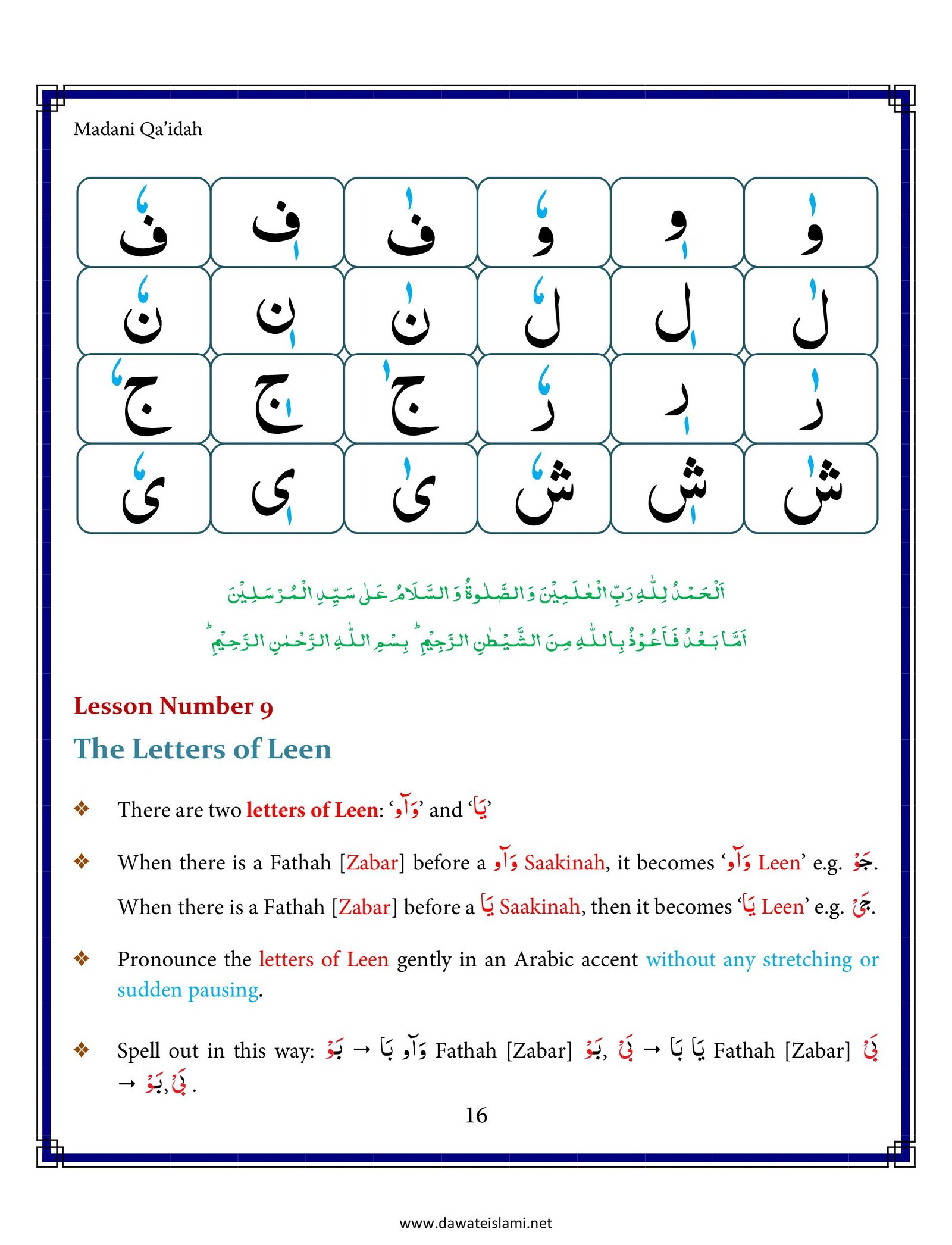
Welcome to Madni Qaida in English Page 27 at Learning Quraan. Page 27 finishes the vertical vowels chart and introduces Lesson 9, the two Letters of Leen: Waw and Ya.
This page is part of Lesson 9: Huroof-e-Leen (Soft Letters). See every page on the Madni Qaida in English index, or learn with a teacher in our online Quran courses.
What is on Madni Qaida in English Page 27?
- The last rows of Khari Harakaat practice with و, ف, ل, ن, ر, ج, ش and ى.
- When Waw Saakin or Ya Saakin after a Fathah becomes Leen.
- Leen is read softly, without stretching or a sudden pause.
How to Practise This Page
- Waw Saakin or Ya Saakin after a Fathah becomes Leen.
- Read Leen gently and softly, with no stretching and no jerk.
- Compare Leen with Maddah on the same letter so the difference is clear.
The Last Rows of Lesson 8
The four rows at the top complete the Khari Harakaat chart from page 26. Every box is stretched for two counts:
| Letter | Khara Zabar | Khari Zer | Ulta Pesh |
|---|---|---|---|
| و Waw | وٰ waa | وٖ wee | وٗ woo |
| ف Fa | فٰ faa | فٖ fee | فٗ foo |
| ل Lam | لٰ laa | لٖ lee | لٗ loo |
| ن Noon | نٰ naa | نٖ nee | نٗ noo |
| ر Ra | رٰ raa | رٖ ree | رٗ roo |
| ج Jeem | جٰ jaa | جٖ jee | جٗ joo |
| ش Sheen | شٰ shaa | شٖ shee | شٗ shoo |
| ی Ya | یٰ yaa | یٖ yee | یٗ yoo |
Watch Ra: with Khara Zabar and Ulta Pesh (رٰ, رٗ) it is heavy; with Khari Zer (رٖ) it is light, just as with the short vowels. And Waw keeps rounded lips with no teeth: وٰ is “waa”, never “vaa”.
Lesson 9: The Letters of Leen
Lesson 9 introduces a softer sound. There are two Letters of Leen: Waw and Ya. The rule depends on the mark before them:
| Letter of Leen | When | Example | Sound |
|---|---|---|---|
| و Waw Saakin | A Fathah comes before it | بَوْ | “baw”, close to “ow” in “now” |
| ی Ya Saakin | A Fathah comes before it | بَیْ | “bay”, close to “y” in “my” |
Compare this with Lesson 7. A Waw Saakin after a Dammah is a Letter of Maddah (بُوْ “boo”); after a Fathah it is a Letter of Leen (بَوْ “baw”). The same is true of Ya: بِیْ “bee” is Maddah, بَیْ “bay” is Leen.
The page gives two instructions for reading them: say them gently, in an Arabic accent, without stretching and without a sudden stop. The book spells them as “Ba, Waw, Zabar: baw” and “Ba, Ya, Zabar: bay”.
Mistakes to Watch For
- Stretching Leen like Maddah. بَوْ is not “baaw”. It glides and stops.
- Urdu-style vowels. Saying بَوْ as “bo” or بَیْ as “be” (as in Urdu “ب” + “ے”). Keep the “a” and the glide.
- A jerk at the end. The Sukoon closes the sound softly.
A Five-Minute Practice Plan
- Minute 1: read the four Lesson 8 rows, two counts each.
- Minute 2: Maddah against Leen: بُوْ then بَوْ; بِیْ then بَیْ.
- Minute 3: try other letters: جَوْ then جَیْ; خَوْ then خَیْ.
- Minute 4: spell three Leen sounds the book’s way, then read them Rawan.
- Minute 5: read the Check Yourself line below.
Check Yourself
وٰ · فٖ · لٗ · نٰ · رٖ · رٗ · بَوْ · بَیْ · جَوْ
Source: the page shown above is from the Madani Qa‘idah (English edition), Lessons 8 and 9, book page 16, published by Maktaba-tul-Madinah (Dawat-e-Islami). Lesson notes written by Learning Quraan.
Madni Qaida in English: Page Directory
Jump to any page of the English edition, or go back to the full page index.
Explore Our Free Islamic Tools
Enhance your daily Islamic practices with our online interactive Islamic Tools:- Count daily recitations on our Digital Tasbih Counter.
- Find the Qibla direction with our Qibla Finder.
- Convert dates with the Hijri Date Converter.
- Search meaningful names with our Islamic Names Finder.
- Calculate obligations with the Zakat Calculator and Islamic Inheritance Calculator.
Get One-on-One Tutoring Support
Learn more about our qualified Quran teachers on our About Us page, review pricing on our Fee structure page, or visit our Contact Us page to book a free trial class.
← Previous: Page 26👉 Proceed to Page 28 – Lesson 9: Leen Chart
Page images: Madani Qa’idah, published by Maktaba-tul-Madinah (Dawat-e-Islami), shown here as a study reference.
