
Madni Qaida in English Page 58 – Lesson 22: Surah Al-Fatihah, Al-Ikhlas and Tasbihat
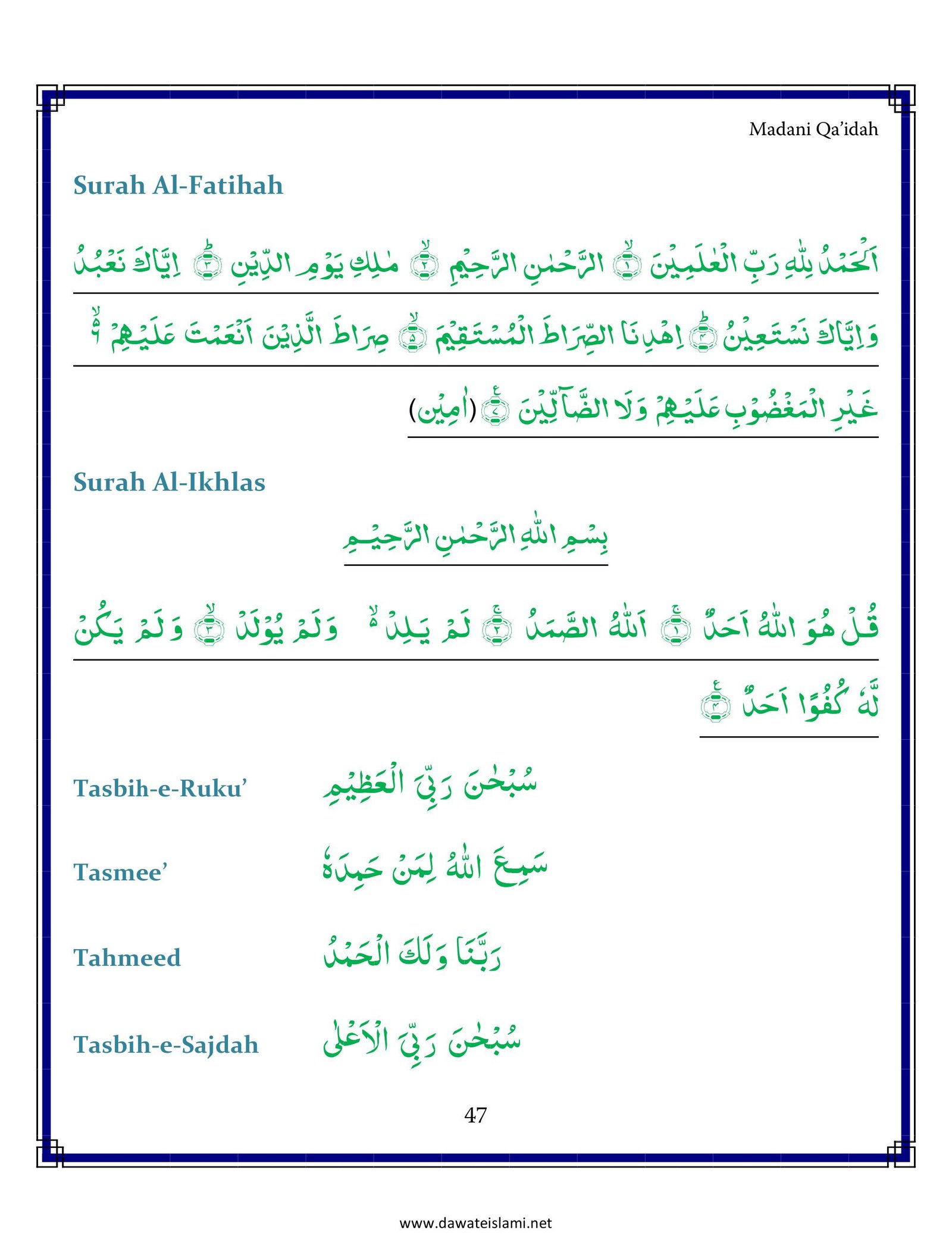
Welcome to Madni Qaida in English Page 58 at Learning Quraan. Page 58 contains Surah Al-Fatihah and Surah Al-Ikhlas, then the short phrases recited in Ruku’ and Sajdah.
This page is part of Lesson 22: Salah (Recitations of the Prayer). See every page on the Madni Qaida in English index, or learn with a teacher in our online Quran courses.
What is on Madni Qaida in English Page 58?
- Surah Al-Fatihah, ending with Ameen.
- Surah Al-Ikhlas with Bismillah.
- Tasbih of Ruku’, Tasmee’, Tahmeed and Tasbih of Sajdah.
How to Practise This Page
- Read every line with Hijjay and Rawan, applying all the earlier rules.
- Take extra care with similar-sounding letters: a change of letter can change the meaning.
- Memorise one section at a time and recite it to your teacher.
Recitation and the Words of Ruku‘ and Sajdah
Page 58 continues Lesson 22 with Surah al-Fatihah, Surah al-Ikhlas and the four short phrases of ruku‘ and sajdah. Every rule from the Qa‘idah appears here: Madd at the verse ends, Qalqalah, Idgham and the heavy letters. The verse-end circles show where to stop.
Surah al-Fatihah: اَلْحَمْدُ لِلّٰهِ رَبِّ الْعٰلَمِيْنَ
In Hanafi fiqh reciting it is Wajib for the imam and for someone praying alone; the follower listens silently.
- اَلْحَمْدُ: Ḥa, not Ha.
- الْعٰلَمِيْنَ: Ain, not Alif.
- اِيَّاكَ: Keep the Tashdeed on the Ya.
- الصِّرَاطَ: Ṣad heavy, not Seen.
- الْمَغْضُوْبِ: Ḍad from the side of the tongue; Ghayn heavy.
- وَلَا الضَّآلِّيْنَ: Madd Lazim: six counts.
Surah al-Ikhlas: قُلْ هُوَ اللّٰهُ اَحَدٌ
An example of the surah added after al-Fatihah, which is Wajib in the first two rak‘ahs of a fard prayer and in every rak‘ah of witr, sunnah and nafl.
- اَحَدٌ: At the stop, a clear Qalqalah on the Dal.
- الصَّمَدُ: Ṣad heavy.
- يَلِدْ · يُوْلَدْ: Qalqalah on the Saakin Dal.
Tasbih-e-Ruku‘: سُبْحٰنَ رَبِّيَ الْعَظِيْمِ
Said in ruku‘, at least three times (Sunnah).
- الْعَظِيْمِ: Ẓa, not Za: the letter must stay heavy and come from between the teeth.
Tasmee‘: سَمِعَ اللّٰهُ لِمَنْ حَمِدَهٗ
Said while rising from ruku‘ by the imam and by someone praying alone.
- سَمِعَ: Ain pressed.
- حَمِدَهٗ: Ḥa from the middle of the throat; Ulta Pesh two counts.
Tahmeed: رَبَّنَا وَلَكَ الْحَمْدُ
Said by the follower and by someone praying alone.
- الْحَمْدُ: Ḥa, not Ha.
Tasbih-e-Sajdah: سُبْحٰنَ رَبِّيَ الْاَعْلٰى
Said in sajdah, at least three times (Sunnah).
- الْاَعْلٰى: Ain pressed; Khara Zabar two counts.
For the full Hanafi method of prayer, step by step, see our How to Pray guide.
Mistakes to Watch For
- الْعَظِيْمِ with a Za. Saying it with ز changes the word; keep the heavy ظ.
- A short Madd Lazim. وَلَا الضَّآلِّيْنَ needs six counts.
- No Qalqalah at the end of Surah al-Ikhlas. Each Dal at a stop must bounce.
A Five-Minute Practice Plan
- Minute 1: Surah al-Fatihah verse by verse, stopping at each circle.
- Minute 2: the heavy letters of al-Fatihah: الصِّرَاطَ, الْمَغْضُوْبِ, الضَّآلِّيْنَ.
- Minute 3: Surah al-Ikhlas with Qalqalah at each stop.
- Minute 4: the four phrases of ruku‘ and sajdah.
- Minute 5: read the page from start to end, Rawan.
Check Yourself
مٰلِكِ يَوْمِ الدِّيْنِ · اِيَّاكَ نَعْبُدُ · اَللّٰهُ الصَّمَدُ · سُبْحٰنَ رَبِّيَ الْعَظِيْمِ · سَمِعَ اللّٰهُ لِمَنْ حَمِدَهٗ
Source: the page shown above is from the Madani Qa‘idah (English edition), Lesson 22, book page 47, published by Maktaba-tul-Madinah (Dawat-e-Islami). Hanafi rulings follow Bahar-e-Shariat (part 3, the chapter on prayer) and Nur al-Idah (the chapter on the description of the prayer). Quran references are given as surah and verse. Lesson notes written by Learning Quraan.
Madni Qaida in English: Page Directory
Jump to any page of the English edition, or go back to the full page index.
Explore Our Free Islamic Tools
Enhance your daily Islamic practices with our online interactive Islamic Tools:- Count daily recitations on our Digital Tasbih Counter.
- Find the Qibla direction with our Qibla Finder.
- Convert dates with the Hijri Date Converter.
- Search meaningful names with our Islamic Names Finder.
- Calculate obligations with the Zakat Calculator and Islamic Inheritance Calculator.
Get One-on-One Tutoring Support
Learn more about our qualified Quran teachers on our About Us page, review pricing on our Fee structure page, or visit our Contact Us page to book a free trial class.
← Previous: Page 57👉 Proceed to Page 59 – Lesson 22: Tashahhud
Page images: Madani Qa’idah, published by Maktaba-tul-Madinah (Dawat-e-Islami), shown here as a study reference.
