
Madni Qaida in English Page 13 – Lesson 2: Huroof Murakkabat (Compound Letters)
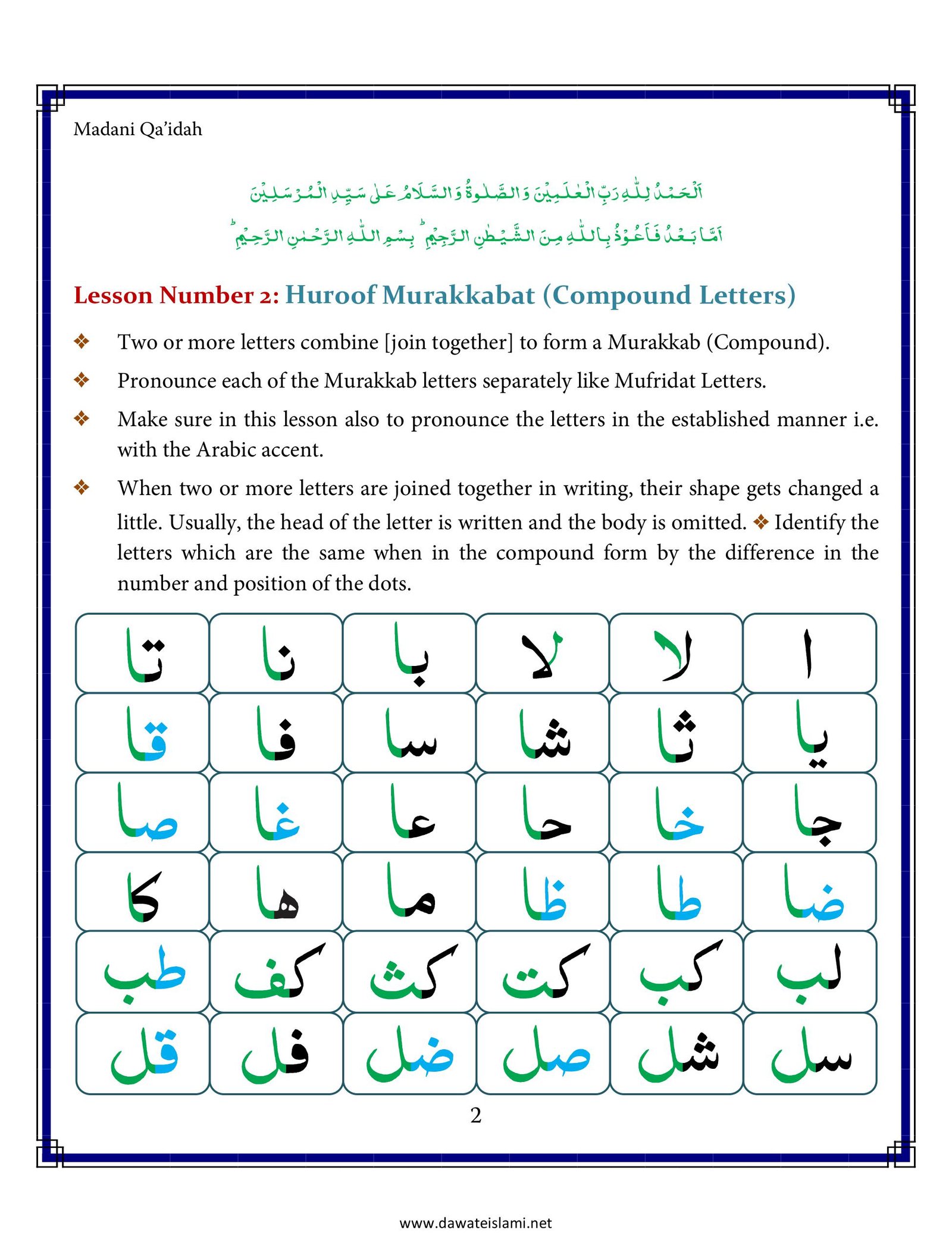
Welcome to Madni Qaida in English Page 13 at Learning Quraan. Lesson 2 shows what happens when two or more letters join together. The shapes change, usually keeping the head of the letter and dropping the body, so the dots become the key to recognising each one.
This page is part of Lesson 2: Huroof Murakkabat (Compound Letters). See every page on the Madni Qaida in English index, or learn with a teacher in our online Quran courses.
What is on Madni Qaida in English Page 13?
- The rules of the lesson: name each joined letter separately with an Arabic accent.
- A chart of two-letter joins such as لا, با, تا and سل.
- How to tell look-alike joined letters apart by their dots.
How to Practise This Page
- Name each joined letter separately, exactly as you did in Lesson 1.
- Use the dots to tell look-alike shapes apart (ب ت ث ن ي at the start of a word look almost the same).
- Point to each letter with a finger while reading so none is skipped.
What Changes When Letters Join
Lesson 2 moves from single letters to joined letters (Huroof-e-Murakkabat). When letters are written together, most of them keep only their “head” and drop the tail they have when written alone. That is why ب becomes a small tooth in با, and ك becomes a slanted stroke in كب.
The page also asks for something that surprises many parents: in this lesson each letter in a join is still read separately, by its name. So با is read “baa, alif” and لب is read “laam, baa”. Joining the sounds into one syllable comes later, from Lesson 3 onwards.
Three Things to Notice on This Page
- Alif never joins forward. In the first four rows the letters are joined to an Alif (تا, شا, ظا), so the child sees each letter’s joining shape next to the same partner.
- Lam and Alif make a new shape. لا is Lam followed by Alif. The first row shows it written two ways, so the child recognises both.
- Each letter has its own colour. Inside every box the first letter is printed in black (or blue, for a heavy letter) and the second in green, so you can see exactly where one letter ends and the next begins.
Same Shape, Different Dots
The page tells the learner to recognise look-alike letters “by the number and position of the dots”. These are the groups to check on this page:
| Letters | How to tell them apart |
|---|---|
| ب ت ث ن ي | The same tooth shape; one dot below (Ba), two above (Ta), three above (Tha), one above (Noon), two below (Ya). |
| ج ح خ | One dot below (Jeem), no dot (Ḥa), one dot above (Kha). |
| س ش | No dots (Seen), three dots above (Sheen). |
| ص ض | No dot (Sad), one dot above (Dad). |
| ط ظ | No dot (Ṭa), one dot above (Ẓa). |
| ع غ | No dot (Ain), one dot above (Ghayn). |
| ف ق | One dot above (Fa), two dots above (Qaf); at the start of a join they look almost the same. |
Mistakes to Watch For
- Joining the sounds too early. Reading با as “baa” (one syllable) instead of “baa, alif”.
- Guessing from the shape. نا, تا, با and يا differ only in their dots. Ask your child to count the dots aloud.
- Missing the Kaf. At the start of a join Kaf is written as a slanted stroke (كت, كف) and can be read as Lam.
- Mixing Fa and Qaf. In فل and قل the heads are the same size; only the dots differ.
A Five-Minute Practice Plan
- Minute 1: read the first row, naming each letter: “alif”, “laam alif”, “baa alif”.
- Minute 2: read rows 2 to 4, counting the dots on every first letter.
- Minute 3: read the last two rows (لب to قل), naming both letters in each box.
- Minute 4: cover a box, say the two letter names, and ask your child to find it.
- Minute 5: read the look-alike groups from the table above.
Check Yourself
Your child should be able to name both letters in each of these boxes:
ثا · ضا · ظا · قا · كث · ضل
Source: the page shown above is from the Madani Qa‘idah (English edition), Lesson 2, book page 2, published by Maktaba-tul-Madinah (Dawat-e-Islami). Lesson notes written by Learning Quraan.
Madni Qaida in English: Page Directory
Jump to any page of the English edition, or go back to the full page index.
Explore Our Free Islamic Tools
Enhance your daily Islamic practices with our online interactive Islamic Tools:- Count daily recitations on our Digital Tasbih Counter.
- Find the Qibla direction with our Qibla Finder.
- Convert dates with the Hijri Date Converter.
- Search meaningful names with our Islamic Names Finder.
- Calculate obligations with the Zakat Calculator and Islamic Inheritance Calculator.
Get One-on-One Tutoring Support
Learn more about our qualified Quran teachers on our About Us page, review pricing on our Fee structure page, or visit our Contact Us page to book a free trial class.
← Previous: Page 12👉 Proceed to Page 14 – Lesson 2: Practice Chart
Page images: Madani Qa’idah, published by Maktaba-tul-Madinah (Dawat-e-Islami), shown here as a study reference.
