
Madni Qaida in English Page 18 – Lesson 4: Similar-Sounding Letters
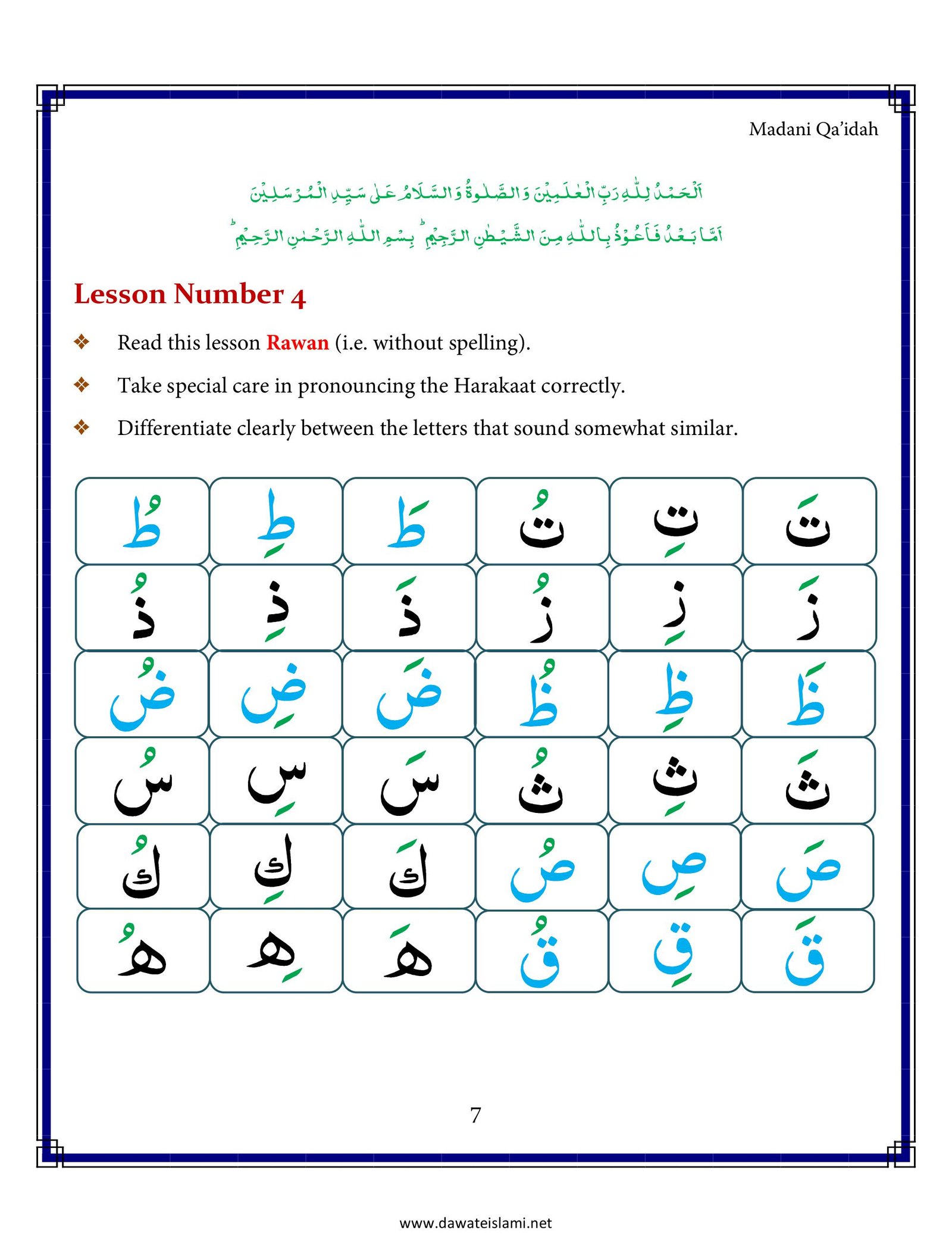
Welcome to Madni Qaida in English Page 18 at Learning Quraan. Lesson 4 is read fluently (Rawan), without spelling. It groups letters that sound alike so the learner hears and says the difference clearly.
This page is part of Lesson 4: Similar-Sounding Letters (Rawan Reading). See every page on the Madni Qaida in English index, or learn with a teacher in our online Quran courses.
What is on Madni Qaida in English Page 18?
- The three instructions: read Rawan, pronounce the Harakaat correctly, separate similar sounds.
- Pairs such as ت/ط and ث/س/ص with each vowel.
- Pairs such as ذ/ز/ظ/ض and ك/ق.
How to Practise This Page
- Read the rows fluently (Rawan) without spelling each letter out.
- Contrast the pairs out loud: ت/ط, س/ث/ص, ذ/ز/ظ/ض, ك/ق, ه/ح, ء/ع.
- If a sound is unclear, go back to the Makharij chart before moving on.
What Lesson 4 Asks For
Lesson 4 uses no new marks. It takes the Harakaat from Lesson 3 and gives three instructions:
- Read it Rawan, which means fluently, without spelling. Each box is said straight off as one sound: تَ is “ta”, not “Ta, Zabar, ta”.
- Keep every Harakah correct. Open the mouth for Fathah, drop the voice for Kasrah and round the lips for Dammah, all short.
- Separate the letters that sound alike. This is the real work of the lesson.
Why the Letters Are Arranged This Way
The chart is not in alphabetical order. Each row holds two letters, and the rows put letters that sound alike next to each other: ت beside ط, ز beside ذ, ظ beside ض, ث beside س. Read side by side, the child has to make the difference audible. As before, the heavy letters are printed in blue.
The Sound-Alike Sets on This Page
| Letters | Where the sound is made | The difference |
|---|---|---|
| ت ط | Tip of the tongue against the roots of the upper front teeth | Same place. Ta is light; Ṭa is heavy, with the back of the tongue raised. |
| ز ذ ظ | Za: tongue tip near the lower front teeth. Dhal and Ẓa: tongue tip against the edges of the upper front teeth | Za whistles. Dhal is soft and light; Ẓa is the same as Dhal but heavy. |
| ض | Side of the tongue against the upper back teeth (molars) | Heavy. It is neither “z” nor “d”; the side of the tongue does the work. |
| ث س ص | Tha: tongue tip against the edges of the upper front teeth. Seen and Sad: tongue tip near the lower front teeth | Tha has no whistle. Seen whistles and is light; Sad whistles and is heavy. |
| ك ق | Back of the tongue against the roof of the mouth; Qaf further back than Kaf | Kaf is light and crisp; Qaf is heavy and deep. |
| ه | The deepest part of the throat | A soft breath. Its partner, Ḥa, is at the top of the next page. |
Mistakes to Watch For
- Still spelling. Saying “Ṭa, Zabar, ṭa” instead of طَ “ṭa”. In this lesson, each box is said as one sound.
- Going fast and guessing. Rawan means fluent, not rushed. Slow down at every blue letter.
- One “z” for four letters. Urdu and English speakers often say ز, ذ, ظ and ض the same way. Each has its own place.
- One “s” for three letters. ثَ is not سَ, and صَ must stay heavy.
- Light Qaf. قِ keeps its deep sound even with a Kasrah.
A Five-Minute Practice Plan
- Minute 1: read each row across, Rawan, at a steady pace.
- Minute 2: read the pairs: تَ then طَ; سَ then صَ; كَ then قَ.
- Minute 3: read the “z” family: زَ then ذَ then ظَ then ضَ.
- Minute 4: say a sound and ask your child to point to its box.
- Minute 5: read the Check Yourself line below.
Check Yourself
طَ · تُ · ذِ · ظَ · ضُ · ثِ · صَ · قِ · هُ
Source: the page shown above is from the Madani Qa‘idah (English edition), Lesson 4, book page 7, published by Maktaba-tul-Madinah (Dawat-e-Islami). The places of the letters follow Faizan-e-Tajweed (Dawat-e-Islami), pp. 16–17 and 20. Lesson notes written by Learning Quraan.
Madni Qaida in English: Page Directory
Jump to any page of the English edition, or go back to the full page index.
Explore Our Free Islamic Tools
Enhance your daily Islamic practices with our online interactive Islamic Tools:- Count daily recitations on our Digital Tasbih Counter.
- Find the Qibla direction with our Qibla Finder.
- Convert dates with the Hijri Date Converter.
- Search meaningful names with our Islamic Names Finder.
- Calculate obligations with the Zakat Calculator and Islamic Inheritance Calculator.
Get One-on-One Tutoring Support
Learn more about our qualified Quran teachers on our About Us page, review pricing on our Fee structure page, or visit our Contact Us page to book a free trial class.
← Previous: Page 17👉 Proceed to Page 19 – Lesson 4: Throat Letters
Page images: Madani Qa’idah, published by Maktaba-tul-Madinah (Dawat-e-Islami), shown here as a study reference.
