
Madni Qaida in English Page 57 – Lesson 22: Salah (Takbeer to Tasmiyah)
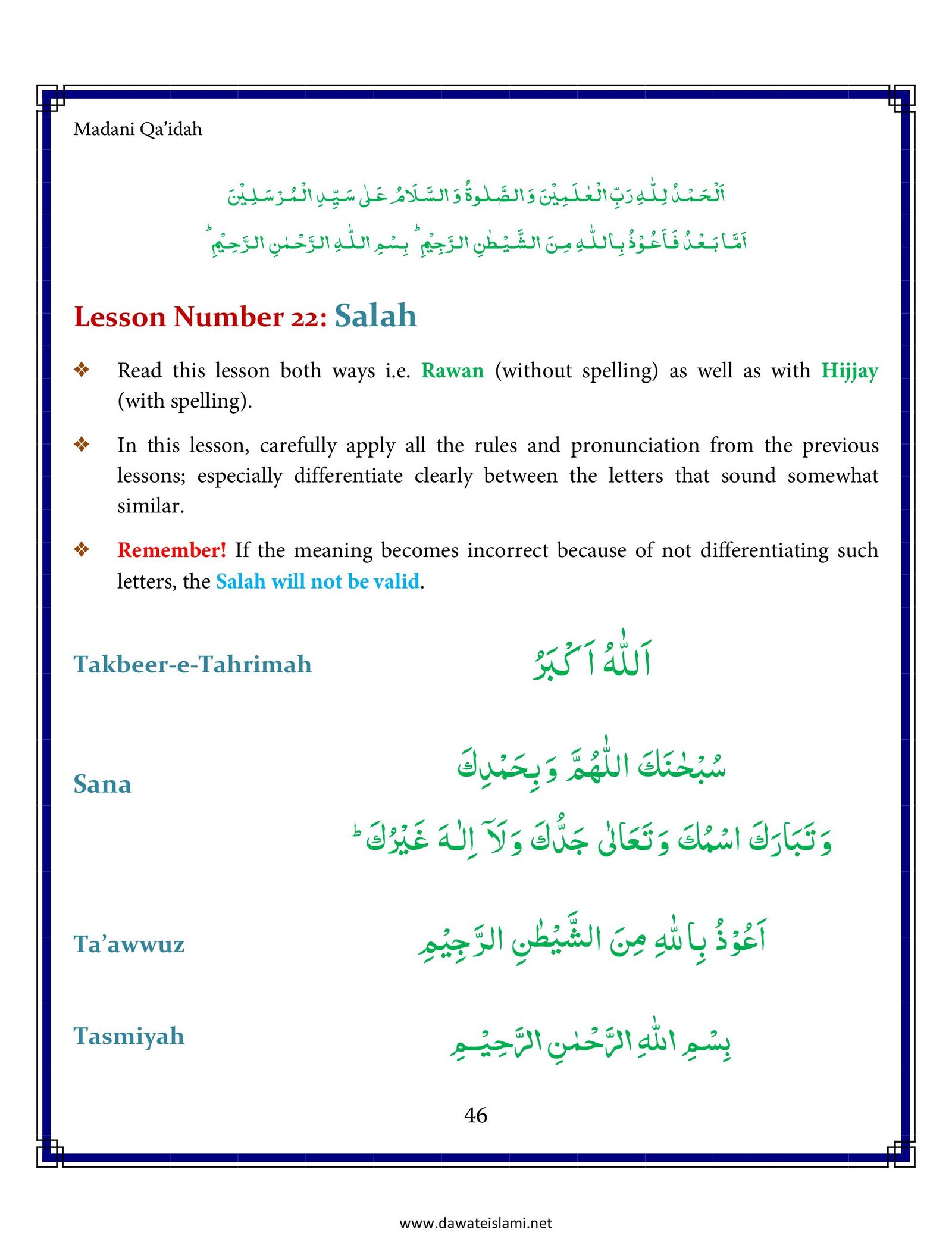
Welcome to Madni Qaida in English Page 57 at Learning Quraan. Lesson 22 applies every rule to the recitations of Salah. The book warns that if a mispronounced letter changes the meaning, the Salah is not valid.
This page is part of Lesson 22: Salah (Recitations of the Prayer). See every page on the Madni Qaida in English index, or learn with a teacher in our online Quran courses.
What is on Madni Qaida in English Page 57?
- Takbeer-e-Tahrimah: Allahu Akbar.
- Sana: Subhanakallahumma wa bihamdika.
- Ta’awwuz and Tasmiyah.
How to Practise This Page
- Read every line with Hijjay and Rawan, applying all the earlier rules.
- Take extra care with similar-sounding letters: a change of letter can change the meaning.
- Memorise one section at a time and recite it to your teacher.
Lesson 22: Salah
The last lesson of the Qa‘idah puts everything into practice with the words of Salah. The page asks for three things: read it both Hijjay and Rawan; apply every rule from the earlier lessons; and above all keep the sound-alike letters apart. It ends with a warning: if the meaning changes because such letters are not kept apart, the Salah is not valid.
The Opening of the Prayer
This page gives the four things said at the start of the prayer, in order. For each, here is when it is said in Hanafi fiqh and the letters that need the most care:
Takbeer-e-Tahrimah: اَللّٰهُ اَكْبَرُ
Opens the prayer. In Hanafi fiqh it is a condition (Shart) of Salah.
- اَللّٰهُ: The Lam is thick here (a Fathah comes before it at the start).
- اَكْبَرُ: Do not stretch the Ba (“akbaar”); Ra is thick.
Sana: سُبْحٰنَكَ اللّٰهُمَّ
Read quietly at the start of the first rak‘ah, after Takbeer-e-Tahrimah.
- سُبْحٰنَكَ: Ḥa from the middle of the throat, not “ha”; Khara Zabar stretched two counts.
- وَتَعٰلٰى: Ain pressed in the throat.
- جَدُّكَ: Dal with Tashdeed: “jad-duka”.
- غَيْرُكَ: Ghayn heavy, Ya Leen without stretching.
Ta‘awwuz: اَعُوْذُ بِاللّٰهِ
Read quietly after Sana by the imam and by someone praying alone. In Hanafi fiqh the follower does not read it, because he does not recite behind the imam.
- اَعُوْذُ: Dhal, not Za.
- الشَّيْطٰنِ: Silent Lam, doubled Sheen; Ṭa heavy.
Tasmiyah: بِسْمِ اللّٰهِ الرَّحْمٰنِ الرَّحِيْمِ
Read quietly before Surah al-Fatihah.
- بِسْمِ اللّٰهِ: The Lam of Allah is thin after the Kasrah.
- الرَّحِيْمِ: At a stop: Madd ‘Aarid on the Ya.
For the full Hanafi method of prayer, step by step, see our How to Pray guide.
Mistakes to Watch For
- Ha for Ḥa. In سُبْحٰنَكَ the Ḥa must not become a soft “h”.
- Za for Dhal. اَعُوْذُ is not “a‘oozu”.
- Reading the silent Lam. الشَّيْطٰنِ is “ash-shayṭaan”.
A Five-Minute Practice Plan
- Minute 1: spell اَللّٰهُ اَكْبَرُ Hijjay, then read it Rawan.
- Minute 2: Sana, slowly, word by word.
- Minute 3: Sana Rawan, listening for the Ḥa and the Ain.
- Minute 4: Ta‘awwuz and Tasmiyah.
- Minute 5: read all four in order, as at the start of a prayer.
Check Yourself
اَللّٰهُ اَكْبَرُ · سُبْحٰنَكَ اللّٰهُمَّ · وَتَعٰلٰى جَدُّكَ · اَعُوْذُ بِاللّٰهِ
Source: the page shown above is from the Madani Qa‘idah (English edition), Lesson 22, book page 46, published by Maktaba-tul-Madinah (Dawat-e-Islami). Hanafi rulings follow Bahar-e-Shariat (part 3, the chapter on prayer) and Nur al-Idah (the chapter on the description of the prayer). Lesson notes written by Learning Quraan.
Madni Qaida in English: Page Directory
Jump to any page of the English edition, or go back to the full page index.
Explore Our Free Islamic Tools
Enhance your daily Islamic practices with our online interactive Islamic Tools:- Count daily recitations on our Digital Tasbih Counter.
- Find the Qibla direction with our Qibla Finder.
- Convert dates with the Hijri Date Converter.
- Search meaningful names with our Islamic Names Finder.
- Calculate obligations with the Zakat Calculator and Islamic Inheritance Calculator.
Get One-on-One Tutoring Support
Learn more about our qualified Quran teachers on our About Us page, review pricing on our Fee structure page, or visit our Contact Us page to book a free trial class.
← Previous: Page 56👉 Proceed to Page 58 – Lesson 22: Fatihah and Ikhlas
Page images: Madani Qa’idah, published by Maktaba-tul-Madinah (Dawat-e-Islami), shown here as a study reference.
