
Madni Qaida in English Page 31 – Lesson 10 Words and Lesson 11: Sukoon and Qalqalah
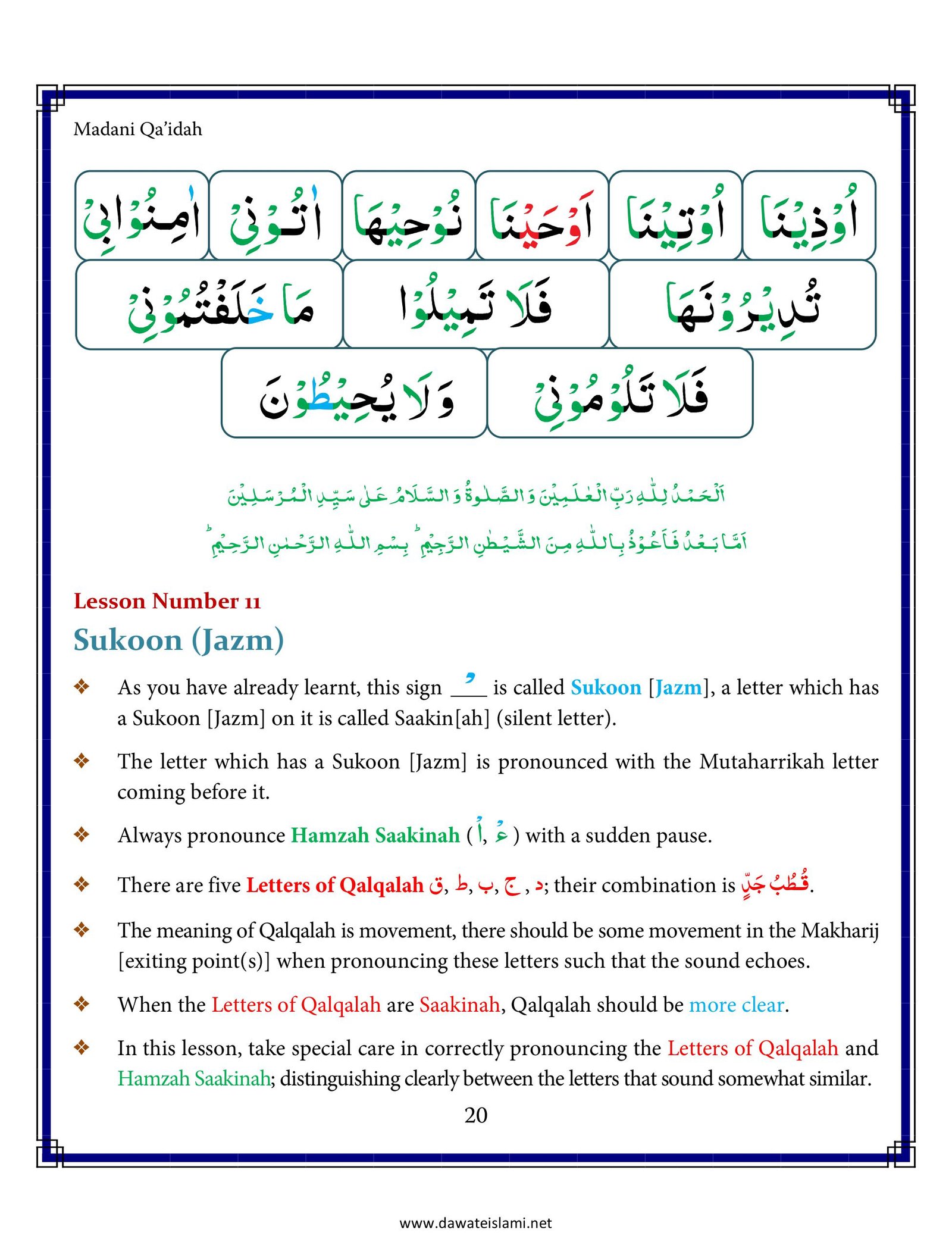
Welcome to Madni Qaida in English Page 31 at Learning Quraan. Page 31 ends Lesson 10 with longer Quranic words and starts Lesson 11 on Sukoon (Jazm), Hamzah Saakinah and the Letters of Qalqalah.
This page is part of Lesson 11: Sukoon (Jazm) and Qalqalah. See every page on the Madni Qaida in English index, or learn with a teacher in our online Quran courses.
What is on Madni Qaida in English Page 31?
- A Saakin letter is read by joining it to the moving letter before it.
- Hamzah Saakinah is pronounced with a sudden pause.
- The five Qalqalah letters ق ط ب ج د (qutbu jad) and what Qalqalah means.
How to Practise This Page
- Join a Saakin letter to the moving letter before it.
- Stop the sound sharply on Hamzah Saakinah.
- Let the five Qalqalah letters (qutbu jad) bounce clearly when they are Saakin.
The Last Words of Lesson 10
The top of the page finishes Lesson 10 with longer words and short phrases, every one taken from the Quran. Spell them the joined way, then read them Rawan:
| Word | Read | Where it occurs |
|---|---|---|
| اُوْذِيْنَا | oo-dhee-naa | Surah al-A‘raf 7:129 |
| اُوْتِيْنَا | oo-tee-naa | Surah an-Naml 27:42 |
| اَوْحَيْنَا | aw-ḥay-naa | Surah Yusuf 12:3 |
| نُوْحِيْهَا | noo-ḥee-haa | Surah Hud 11:49 |
| اٰتُوْنِيْ | aa-too-nee | Surah al-Kahf 18:96 |
| اٰمِنُوْا بِيْ | aa-mi-noo bee | Surah al-Ma’idah 5:111 |
| تُدِيْرُوْنَهَا | tu-dee-roo-na-haa | Surah al-Baqarah 2:282 |
| فَلَا تَمِيْلُوْا | fa-laa ta-mee-loo | Surah an-Nisa 4:129 |
| فَلَا تَلُوْمُوْنِيْ | fa-laa ta-loo-moo-nee | Surah Ibrahim 14:22 |
| وَلَا يُحِيْطُوْنَ | wa-laa yu-ḥee-ṭoo-na | Surah al-Baqarah 2:255 |
Two things to notice: the Alif after the Waw in تَمِيْلُوْا is silent, as in Lesson 10’s كَانُوْا; and اٰتُوْنِيْ and اٰمِنُوْا begin with a Khara Zabar on the Alif, so they open with a long “aa”.
Lesson 11: Sukoon and Qalqalah
Lesson 11 returns to the Sukoon (Jazm) and adds two rules:
- Sukoon: a Saakin letter has no vowel of its own and is read together with the moving letter before it, as Lesson 7 showed.
- Hamzah Saakinah (أْ, ءْ) is always read with a clean, sudden stop in the throat, so it does not melt into the next letter. An example is يُؤْمِنُوْنَ “yu’-mi-noo-na” (Surah al-Baqarah 2:3).
- Qalqalah means movement. Five letters, ق ط ب ج د, remembered together as قُطْبُ جَدٍّ, are made with a slight movement at their point of articulation so that the sound bounces or echoes. When these letters are Saakin, the Qalqalah must be clearer.
| Letter | Saakin | Sound |
|---|---|---|
| ق | اَقْ | aq: a deep, heavy bounce |
| ط | اَطْ | aṭ: a heavy bounce |
| ب | اَبْ | ab: the lips part with a small echo |
| ج | اَجْ | aj: a small echo |
| د | اَدْ | ad: a small echo |
A short surah full of Qalqalah is Surah al-Ikhlas: لَمْ يَلِدْ وَلَمْ يُوْلَدْ (112:3) ends two words on a Saakin Dal.
Mistakes to Watch For
- Adding a vowel to Qalqalah. اَبْ is “ab” with a small echo, not “abu” or “aba”.
- No bounce at all. A flat اَقْ sounds like a swallowed Kaf. Let the Qaf release.
- Soft Hamzah Saakinah. يُؤْمِنُوْنَ must not become “yoominoona”.
A Five-Minute Practice Plan
- Minute 1: read the ten Lesson 10 words from the table.
- Minute 2: say the five Qalqalah letters with Sukoon: اَقْ then اَطْ then اَبْ then اَجْ then اَدْ.
- Minute 3: compare with letters that do not bounce: اَدْ then اَتْ; اَقْ then اَكْ.
- Minute 4: read لَمْ يَلِدْ وَلَمْ يُوْلَدْ slowly.
- Minute 5: read the Check Yourself line below.
Check Yourself
اُوْتِيْنَا · نُوْحِيْهَا · تُدِيْرُوْنَهَا · اَقْ · اَطْ · اَبْ · اَجْ · اَدْ
Source: the page shown above is from the Madani Qa‘idah (English edition), Lessons 10 and 11, book page 20, published by Maktaba-tul-Madinah (Dawat-e-Islami). Quran references are given as surah and verse. Lesson notes written by Learning Quraan.
Madni Qaida in English: Page Directory
Jump to any page of the English edition, or go back to the full page index.
Explore Our Free Islamic Tools
Enhance your daily Islamic practices with our online interactive Islamic Tools:- Count daily recitations on our Digital Tasbih Counter.
- Find the Qibla direction with our Qibla Finder.
- Convert dates with the Hijri Date Converter.
- Search meaningful names with our Islamic Names Finder.
- Calculate obligations with the Zakat Calculator and Islamic Inheritance Calculator.
Get One-on-One Tutoring Support
Learn more about our qualified Quran teachers on our About Us page, review pricing on our Fee structure page, or visit our Contact Us page to book a free trial class.
← Previous: Page 30👉 Proceed to Page 32 – Lesson 11: Sukoon Chart
Page images: Madani Qa’idah, published by Maktaba-tul-Madinah (Dawat-e-Islami), shown here as a study reference.
