
Madni Qaida in English Page 51 – Lesson 19: Za'id (Additional) Alif
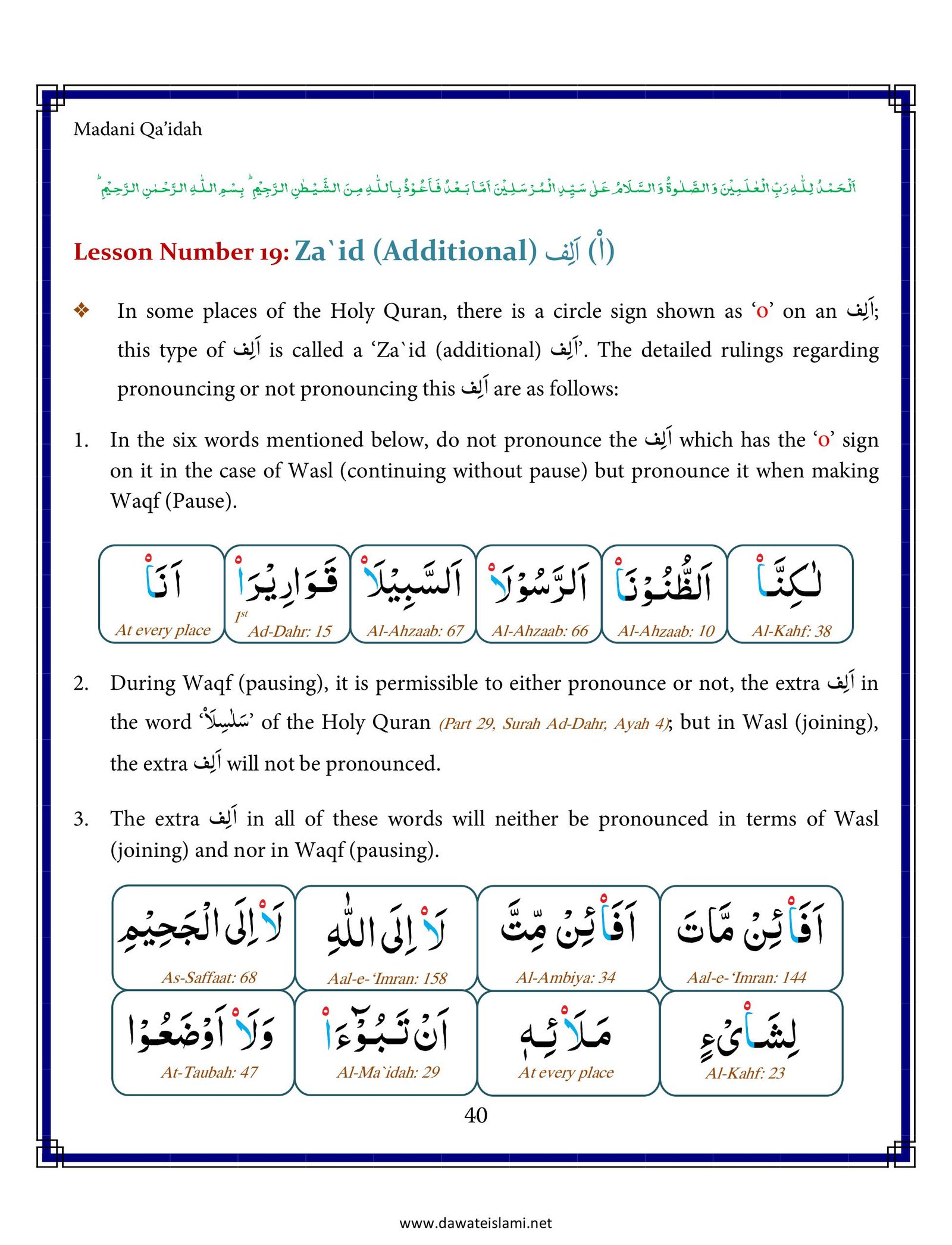
Welcome to Madni Qaida in English Page 51 at Learning Quraan. Lesson 19 explains the extra Alif marked with a small circle in some places of the Quran, and when it is or is not pronounced.
This page is part of Lesson 19: Za’id (Additional) Alif. See every page on the Madni Qaida in English index, or learn with a teacher in our online Quran courses.
What is on Madni Qaida in English Page 51?
- Six words where the extra Alif is skipped when joining but read when pausing, such as انا and الظنونا.
- The word سلاسلا, where both options are allowed when pausing.
- Words where the extra Alif is never pronounced, such as افائن مات.
How to Practise This Page
- An Alif with a small circle is extra and is usually not pronounced.
- In the six listed words, skip it when joining but say it when you stop.
- Learn the listed words by heart with their Surah references.
Lesson 19: The Za’id (Extra) Alif
In some places the Quran writes an Alif with a small circle on it (ا۟). This is a Za’id (extra) Alif: it is part of the spelling but is not always read. The page gives the rules in groups.
1. Read Only When Stopping
In these six words the Alif is not read when you continue (Wasl) but is read when you stop (Waqf) on the word:
| Word | Where it occurs |
|---|---|
| لٰكِنَّا۟ | Surah al-Kahf 18:38 |
| الظُّنُوْنَا۟ | Surah al-Ahzab 33:10 |
| الرَّسُوْلَا۟ | Surah al-Ahzab 33:66 |
| السَّبِيْلَا۟ | Surah al-Ahzab 33:67 |
| قَوَارِيْرَا۟ | Surah ad-Dahr 76:15 (first) |
| اَنَا۟ | Everywhere it occurs |
So اَنَا۟ is read “ana” in the middle of a sentence and “anaa” when you stop on it.
2. One Word With a Choice
In سَلٰسِلَا۟ (Surah ad-Dahr 76:4), the Alif may be read or left when stopping; when continuing it is not read.
3. Never Read
In these words the extra Alif is not read at all, whether you stop or continue:
| Word | Where it occurs |
|---|---|
| اَفَا۟ئِنْ مَّاتَ | Surah Al ‘Imran 3:144 |
| اَفَا۟ئِنْ مِّتَّ | Surah al-Anbiya 21:34 |
| لَا۟ اِلَى اللّٰهِ | Surah Al ‘Imran 3:158 |
| لَا۟ اِلَى الْجَحِيْمِ | Surah as-Saffat 37:68 |
| لِشَا۟ئْءٍ | Surah al-Kahf 18:23 |
| مَلَا۟ئِهٖ | Everywhere it occurs |
| اَنْ تَبُوْٓءَا۟ | Surah al-Ma’idah 5:29 |
| وَلَا۟ اَوْضَعُوْا | Surah at-Tawbah 9:47 |
For example, لَا۟ اِلَى اللّٰهِ is read “la-ilallaahi”, and اَفَا۟ئِنْ مَّاتَ is read “afa’im-maata”.
Mistakes to Watch For
- Reading the circled Alif in Wasl. لٰكِنَّا۟ هُوَ اللّٰهُ is read “laakinna huwallaahu” when joined.
- Reading it in Group 3. لَا۟ اِلَى الْجَحِيْمِ is never “laa ilal-jaḥeem”.
- Missing it when stopping. Stopping on السَّبِيْلَا۟ gives “as-sabeelaa”.
A Five-Minute Practice Plan
- Minute 1: read Group 1 twice: once as if continuing, once stopping.
- Minute 2: read سَلٰسِلَا۟ both ways when stopping.
- Minute 3: read Group 3, never sounding the Alif.
- Minute 4: find اَنَا۟ in a page of the Quran and read it.
- Minute 5: read the Check Yourself line below.
Check Yourself
الظُّنُوْنَا۟ · اَنَا۟ · اَفَا۟ئِنْ مِّتَّ · لِشَا۟ئْءٍ · مَلَا۟ئِهٖ
Source: the page shown above is from the Madani Qa‘idah (English edition), Lesson 19, book page 40, published by Maktaba-tul-Madinah (Dawat-e-Islami). The page gives each reference by surah and verse; they are repeated here. Lesson notes written by Learning Quraan.
Madni Qaida in English: Page Directory
Jump to any page of the English edition, or go back to the full page index.
Explore Our Free Islamic Tools
Enhance your daily Islamic practices with our online interactive Islamic Tools:- Count daily recitations on our Digital Tasbih Counter.
- Find the Qibla direction with our Qibla Finder.
- Convert dates with the Hijri Date Converter.
- Search meaningful names with our Islamic Names Finder.
- Calculate obligations with the Zakat Calculator and Islamic Inheritance Calculator.
Get One-on-One Tutoring Support
Learn more about our qualified Quran teachers on our About Us page, review pricing on our Fee structure page, or visit our Contact Us page to book a free trial class.
← Previous: Page 50👉 Proceed to Page 52 – Lesson 20: Special Rules
Page images: Madani Qa’idah, published by Maktaba-tul-Madinah (Dawat-e-Islami), shown here as a study reference.
