
Madni Qaida in English Page 03 – Title Page of Madani Qa'idah
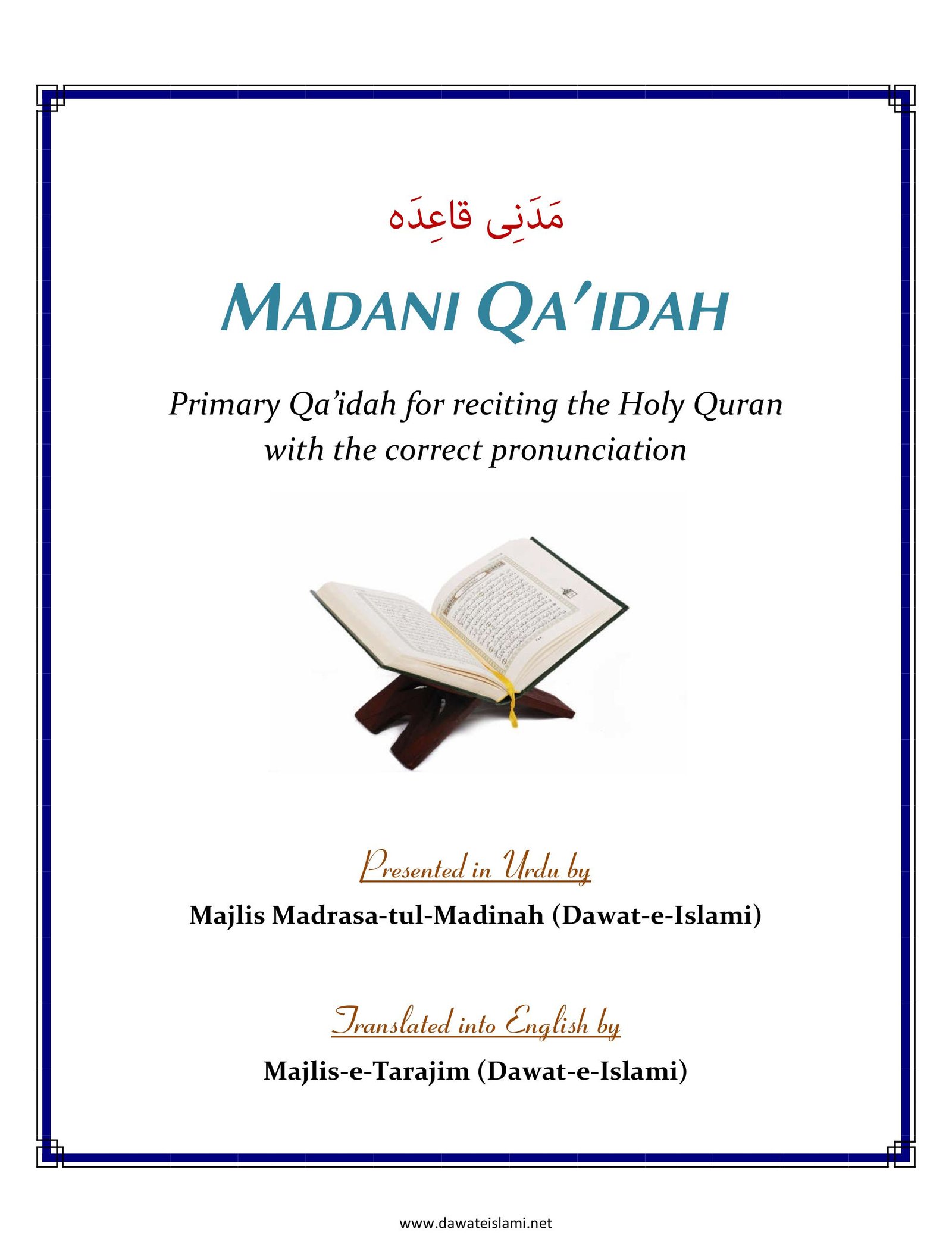
Welcome to Madni Qaida in English Page 03 at Learning Quraan. The inner title page introduces Madani Qa’idah as a primary Qa’idah for reciting the Holy Quran with correct pronunciation. It was presented in Urdu by Majlis Madrasa-tul-Madinah and translated into English by Majlis-e-Tarajim.
This page is part of the opening pages of the book. See every page on the Madni Qaida in English index, or learn with a teacher in our online Quran courses.
What is on Madni Qaida in English Page 03?
- The book’s aim: correct recitation of the Quran from the very first lesson.
- Who prepared the original Urdu book and who translated it.
- This page is a good place to talk with your child about why we learn to read the Quran properly.
How to Practise This Page
- Read the opening pages once with your child before starting Lesson 1, so they know what the book is for.
- Keep the Makharij chart and the articulation diagram nearby: you will come back to them in almost every lesson.
- Recite the du’a for study and Salat upon the Prophet ﷺ before each class to build a good routine.
The Title Page
The inner title page gives the book’s full description: a primary Qa‘idah for reciting the Holy Quran with the correct pronunciation. It names the two departments of Dawat-e-Islami behind it: Majlis Madrasa-tul-Madinah, which presented it in Urdu, and Majlis-e-Tarajim, which translated it into English.
A Sample Study Plan
Every child is different, and a good teacher moves on only when a lesson is secure. As a rough guide for a young child practising about 15 minutes a day, the 22 lessons can be spread like this:
| Time | Lessons | Focus |
|---|---|---|
| Weeks 1 to 2 | Lessons 1 and 2 | Letters and their joined shapes |
| Weeks 3 to 4 | Lessons 3 to 5 | Short vowels, fluent reading and Tanween |
| Weeks 5 to 6 | Lessons 6 to 9 | First words, Maddah, Khari Harakaat, Leen |
| Weeks 7 to 8 | Lessons 10 and 11 | Review, Sukoon and Qalqalah |
| Weeks 9 to 11 | Lessons 12 to 15 | Noon and Meem Saakinah, Tashdeed |
| Weeks 12 to 14 | Lessons 16 to 19 | Thick and thin letters, the Maddaat, Muqatta‘at, extra Alif |
| Weeks 15 to 16 | Lessons 20 to 22 | Special rules, stopping, and the words of Salah |
Older children and adults often move faster through the early lessons and need more time from Lesson 12 onwards, where the Tajweed rules begin.
Three Habits That Matter More Than Speed
- Listen before reading. A child should hear each new page read correctly before trying it.
- Little and often. A short daily session works better than one long session a week.
- Revise as you go. Start each session with the previous page, and use the question-and-answer pages as a regular check.
The full list of lessons, with links, is on page 11.
Source: the page shown above is the inner title page of the Madani Qa‘idah (English edition), presented in Urdu by Majlis Madrasa-tul-Madinah, translated by Majlis-e-Tarajim and published by Maktaba-tul-Madinah (Dawat-e-Islami). The study plan is our suggestion, not part of the book. Notes written by Learning Quraan.
Madni Qaida in English: Page Directory
Jump to any page of the English edition, or go back to the full page index.
Explore Our Free Islamic Tools
Enhance your daily Islamic practices with our online interactive Islamic Tools:- Count daily recitations on our Digital Tasbih Counter.
- Find the Qibla direction with our Qibla Finder.
- Convert dates with the Hijri Date Converter.
- Search meaningful names with our Islamic Names Finder.
- Calculate obligations with the Zakat Calculator and Islamic Inheritance Calculator.
Get One-on-One Tutoring Support
Learn more about our qualified Quran teachers on our About Us page, review pricing on our Fee structure page, or visit our Contact Us page to book a free trial class.
← Previous: Page 02👉 Proceed to Page 05 – Du’a Before Studying
Page images: Madani Qa’idah, published by Maktaba-tul-Madinah (Dawat-e-Islami), shown here as a study reference.
