
Madni Qaida in English Page 16 – Lesson 3: How to Pronounce the Harakaat
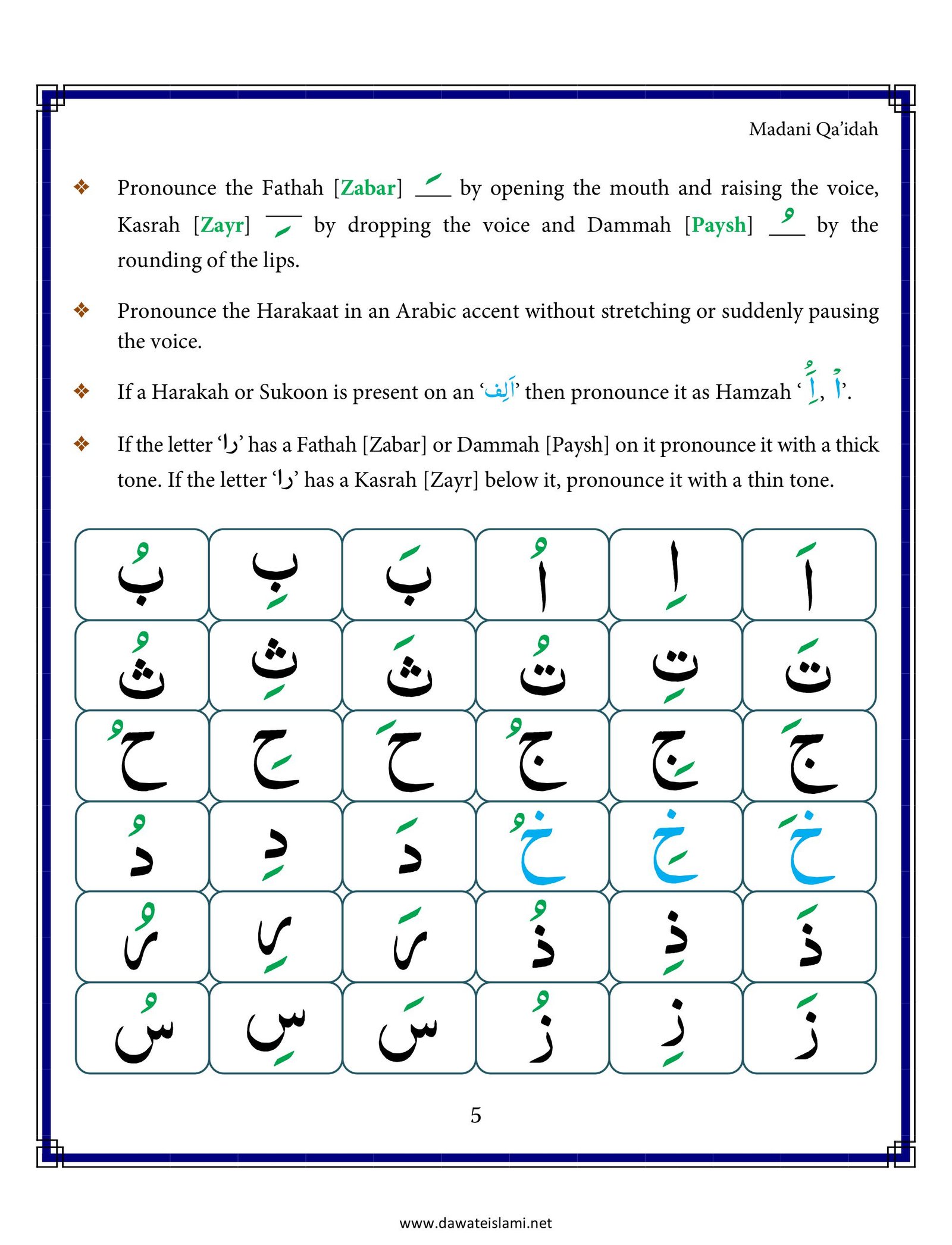
Welcome to Madni Qaida in English Page 16 at Learning Quraan. Page 16 explains how to pronounce each short vowel and gives the first chart of letters with Fathah, Kasrah and Dammah.
This page is part of Lesson 3: Harakaat (Short Vowels). See every page on the Madni Qaida in English index, or learn with a teacher in our online Quran courses.
What is on Madni Qaida in English Page 16?
- Fathah by opening the mouth, Kasrah by dropping the voice, Dammah by rounding the lips.
- An Alif carrying a vowel is read as a Hamzah.
- Ra is thick with Fathah or Dammah and thin with Kasrah.
How to Practise This Page
- Open the mouth for Fathah, drop the voice for Kasrah and round the lips for Dammah.
- Keep every vowel short: no stretching and no sudden stop.
- Read Ra with Fathah or Dammah thick, and Ra with Kasrah thin.
How Each Short Vowel Is Made
The page gives three simple instructions, one for each mark:
- Fathah (Zabar): open the mouth and lift the voice: بَ “ba”.
- Kasrah (Zer): drop the voice (the jaw lowers a little): بِ “bi”.
- Dammah (Pesh): round the lips: بُ “bu”.
Each sound is short. The page warns against two habits: stretching the vowel (“baa” instead of “ba”), and cutting it off with a jerk. Say it cleanly and move on.
Two Rules on This Page
- Alif with a vowel is Hamzah. When a Harakah (or a Sukoon) sits on an Alif, it is read as a Hamzah: اَ “a”, اِ “i”, اُ “u”, each with a small catch in the throat. A plain Alif with no mark is only a long vowel, as Lesson 7 will show.
- Ra changes with its vowel. With a Fathah or Dammah, Ra is heavy: رَ and رُ. With a Kasrah it is light: رِ. Lesson 16 gives the full rules of Ra.
Every Sound on Page 16
Twelve letters, from Alif to Seen, each with all three short vowels:
| Letter | Fathah | Kasrah | Dammah |
|---|---|---|---|
| ا Alif (Hamzah) | اَ a | اِ i | اُ u |
| ب Ba | بَ ba | بِ bi | بُ bu |
| ت Ta | تَ ta | تِ ti | تُ tu |
| ث Tha | ثَ tha | ثِ thi | ثُ thu |
| ج Jeem | جَ ja | جِ ji | جُ ju |
| ح Ḥa | حَ ḥa | حِ ḥi | حُ ḥu |
| خ Kha (heavy) | خَ kha | خِ khi | خُ khu |
| د Dal | دَ da | دِ di | دُ du |
| ذ Dhal | ذَ dha | ذِ dhi | ذُ dhu |
| ر Ra | رَ ra | رِ ri | رُ ru |
| ز Zay | زَ za | زِ zi | زُ zu |
| س Seen | سَ sa | سِ si | سُ su |
Kha (خ) is a heavy letter and stays heavy with every vowel, including Kasrah. Ḥa (ح) comes from the middle of the throat and is not an English “h”.
Mistakes to Watch For
- Stretching. دَ becomes “daa”. Keep every vowel short.
- Turning Kasrah into “ee” or “ay”. بِ is a short “bi”.
- Thin Ra with Fathah. رَ is heavy; only رِ is light.
- Merging look-alike sounds. ثَ is not سَ, and ذَ is not زَ.
A Five-Minute Practice Plan
- Minute 1: read the first row (Alif and Ba) slowly, showing the mouth movement for each vowel.
- Minute 2: read down the Fathah column only, then the Kasrah column, then the Dammah column.
- Minute 3: read the Ra row, saying “heavy, light, heavy”.
- Minute 4: read the pairs ثَ / سَ and ذَ / زَ.
- Minute 5: point to boxes at random.
Check Yourself
اِ · ثُ · حِ · خَ · ذُ · رِ · رُ
Source: the page shown above is from the Madani Qa‘idah (English edition), Lesson 3, book page 5, published by Maktaba-tul-Madinah (Dawat-e-Islami). The places of the letters follow Faizan-e-Tajweed (Dawat-e-Islami), pp. 16–17 and 20. Lesson notes written by Learning Quraan.
Madni Qaida in English: Page Directory
Jump to any page of the English edition, or go back to the full page index.
Explore Our Free Islamic Tools
Enhance your daily Islamic practices with our online interactive Islamic Tools:- Count daily recitations on our Digital Tasbih Counter.
- Find the Qibla direction with our Qibla Finder.
- Convert dates with the Hijri Date Converter.
- Search meaningful names with our Islamic Names Finder.
- Calculate obligations with the Zakat Calculator and Islamic Inheritance Calculator.
Get One-on-One Tutoring Support
Learn more about our qualified Quran teachers on our About Us page, review pricing on our Fee structure page, or visit our Contact Us page to book a free trial class.
← Previous: Page 15👉 Proceed to Page 17 – Lesson 3: Harakaat Chart
Page images: Madani Qa’idah, published by Maktaba-tul-Madinah (Dawat-e-Islami), shown here as a study reference.
