
Madni Qaida in English Page 64 – Questions and Answers (Questions 21-27)
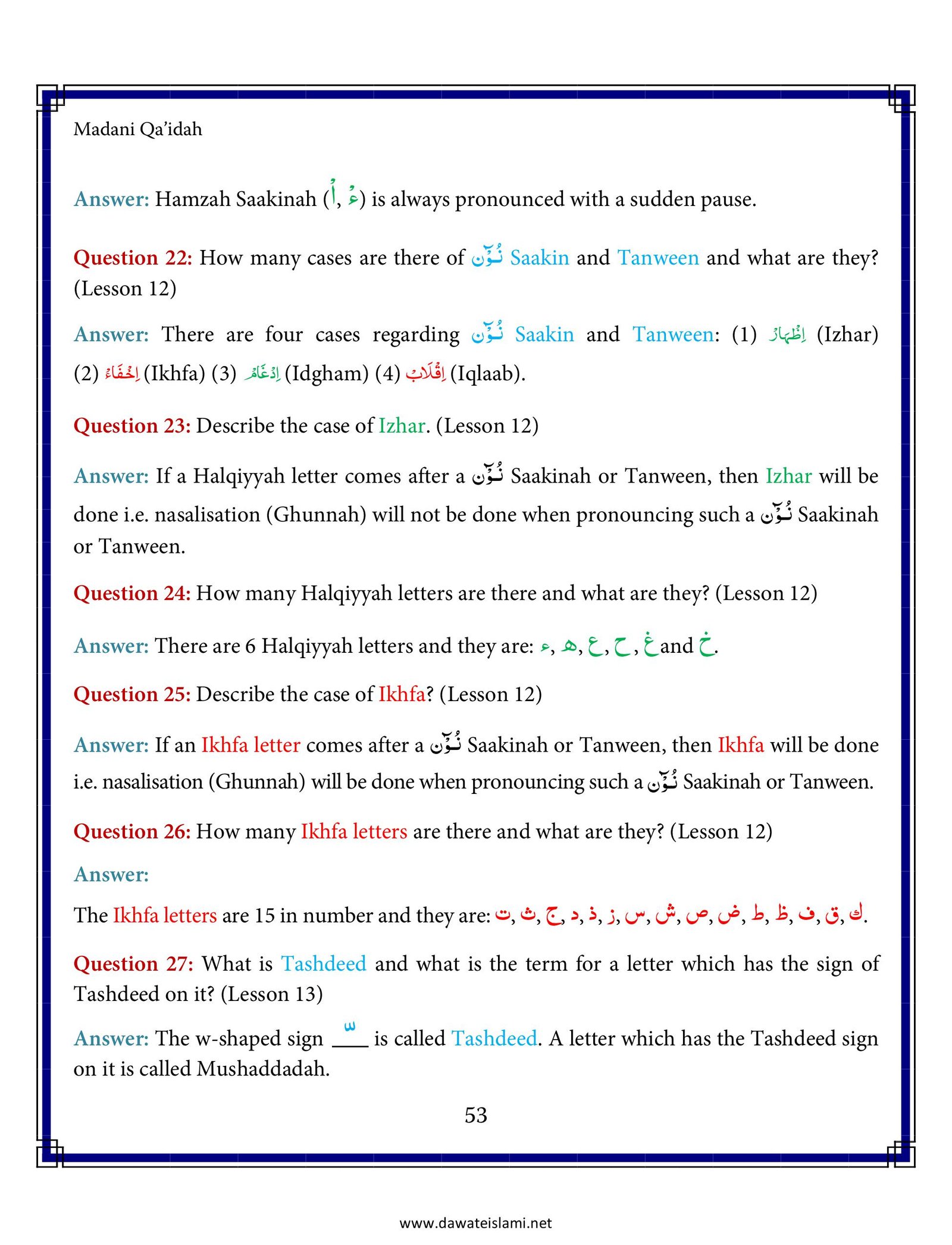
Welcome to Madni Qaida in English Page 64 at Learning Quraan. This page revises Noon Saakinah and Tanween from Lesson 12, and the definition of Tashdeed from Lesson 13.
This page is part of the Questions and Answers revision section. See every page on the Madni Qaida in English index, or learn with a teacher in our online Quran courses.
What is on Madni Qaida in English Page 64?
- The four cases of Noon Saakinah and Tanween.
- Izhar with the 6 throat letters and Ikhfa with the 15 Ikhfa letters.
- What Tashdeed is and what a Mushaddad letter is called.
How to Practise This Page
- Cover the answer, read the question aloud and try to answer from memory.
- Each question names its lesson: go back to that lesson if an answer is shaky.
- Revise ten questions a day until the whole section is easy.
What Questions 21 to 27 Revise
Page 64 continues the revision section with questions 21 to 27 on Lessons 12, 13. Each topic is explained below in our own words, with an example and a link back to the lesson. Use the page as a quiz: ask the question, let your child answer, then check.
The four rules of Noon Saakinah and Tanween
The letter that comes after the Noon decides the rule: Izhar (clear), Ikhfa (hidden), Idgham (merged) and Iqlab (changed to Meem). Izhar and Ikhfa are in Lesson 12, Idgham and Iqlab in Lesson 14. Back to Lesson 12 (page 35).
Izhar and the six throat letters
When a throat letter (ء ه ع ح غ خ) follows a Noon Saakinah or Tanween, the Noon is said clearly with no Ghunnah: مِنْ عَلَقٍ. These six letters are made far back in the throat, so the Noon is not affected by them. Back to Lesson 12 (page 35).
Ikhfa and its fifteen letters
Before the fifteen Ikhfa letters (ت ث ج د ذ ز س ش ص ض ط ظ ف ق ك) the Noon is hidden: the tongue does not press fully on its place and the sound goes through the nose with Ghunnah: مِنْ ثَمَرَةٍ. Before a heavy letter the Ghunnah also becomes heavy. Back to Lesson 12 (page 35).
Tashdeed and the Mushaddad letter
The small “w” mark (ـّ) is Tashdeed, and a letter carrying it is Mushaddad. It is read twice: once closing the syllable before it, once with its own vowel, holding it slightly: اَتَّ “at-ta”. Back to Lesson 13 (page 38).
Quick Quiz for Your Child
- Name the four rules of Noon Saakinah and Tanween.
- How many throat letters are there?
- Which rule applies in مِنْ حَكِيْمٍ?
- Which rule applies in مَنْ سَفِهَ?
- How many times is the Ta read in اَتَّ?
Answers: 1) Izhar, Ikhfa, Idgham, Iqlab · 2) six · 3) Izhar (Ḥa is a throat letter) · 4) Ikhfa (Seen) · 5) twice
Source: the page shown above is from the Madani Qa‘idah (English edition), Questions and Answers, book page 53, published by Maktaba-tul-Madinah (Dawat-e-Islami). Explanations written by Learning Quraan.
Madni Qaida in English: Page Directory
Jump to any page of the English edition, or go back to the full page index.
Explore Our Free Islamic Tools
Enhance your daily Islamic practices with our online interactive Islamic Tools:- Count daily recitations on our Digital Tasbih Counter.
- Find the Qibla direction with our Qibla Finder.
- Convert dates with the Hijri Date Converter.
- Search meaningful names with our Islamic Names Finder.
- Calculate obligations with the Zakat Calculator and Islamic Inheritance Calculator.
Get One-on-One Tutoring Support
Learn more about our qualified Quran teachers on our About Us page, review pricing on our Fee structure page, or visit our Contact Us page to book a free trial class.
← Previous: Page 63👉 Proceed to Page 65 – Q&A: Questions 28-34
Page images: Madani Qa’idah, published by Maktaba-tul-Madinah (Dawat-e-Islami), shown here as a study reference.
