
Madni Qaida in English Page 20 – Lesson 5: Tanween (Double Vowels)
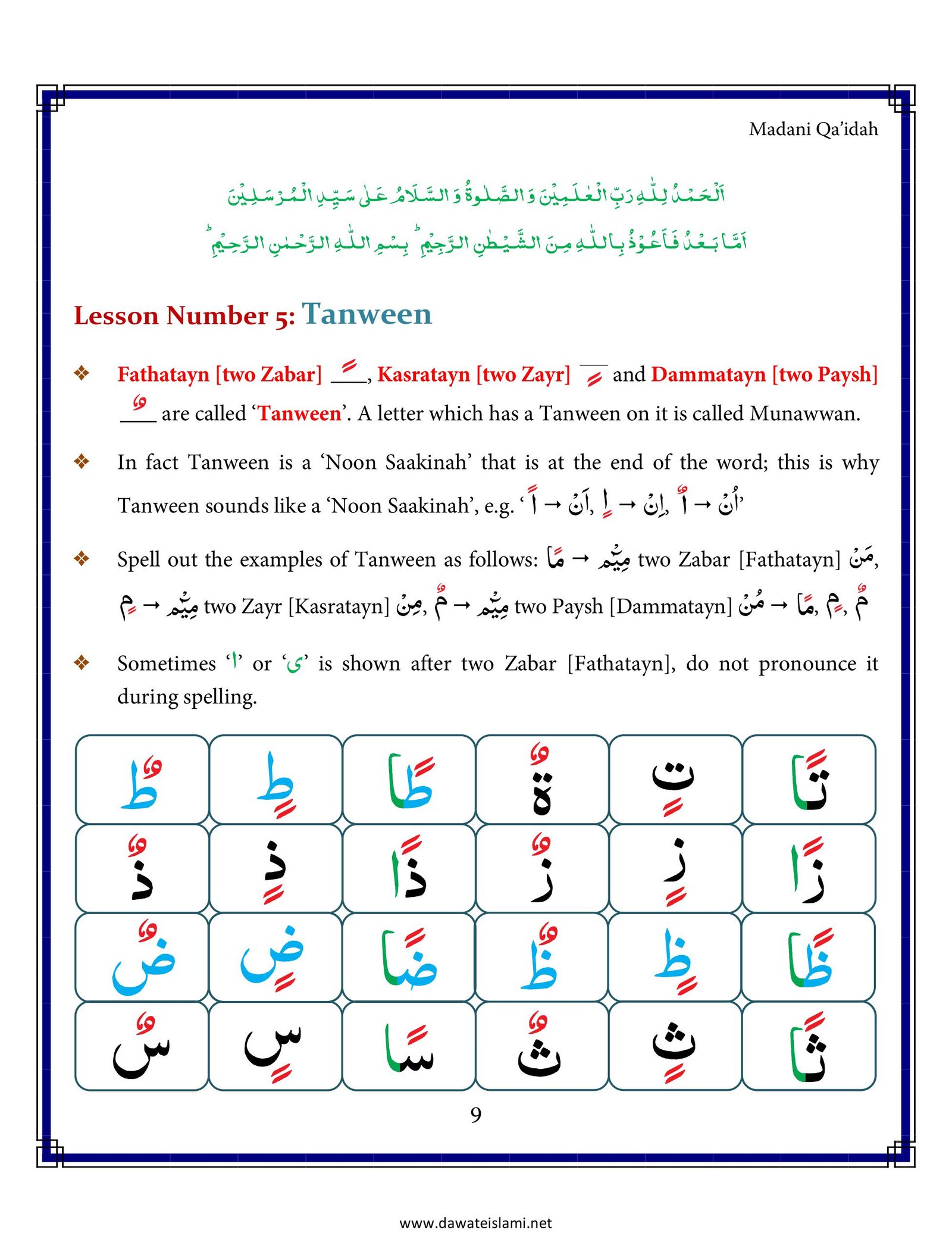
Welcome to Madni Qaida in English Page 20 at Learning Quraan. Lesson 5 introduces Tanween: two Zabar, two Zayr and two Paysh. A letter with Tanween is called Munawwan, and Tanween is really a Noon Saakin at the end of a word.
This page is part of Lesson 5: Tanween (Double Vowels). See every page on the Madni Qaida in English index, or learn with a teacher in our online Quran courses.
What is on Madni Qaida in English Page 20?
- The three forms of Tanween and why they sound like a Noon Saakin.
- How to spell a Tanween letter out loud.
- Why the Alif or Ya written after two Zabar is not pronounced.
How to Practise This Page
- Remember that Tanween sounds like a Noon Saakin at the end of the word.
- When spelling, say the letter name and then ‘two Zabar’, ‘two Zayr’ or ‘two Paysh’.
- Do not pronounce the Alif or Ya that is written after two Zabar.
What Tanween Is
Lesson 5 brings in the double marks. Two Fathahs, two Kasrahs or two Dammahs on a letter are called Tanween, and a letter carrying Tanween is called Munawwan. On this page the Tanween marks are printed in red, so they stand out from the single Harakaat of Lessons 3 and 4.
| Mark | Name | Sound | Example |
|---|---|---|---|
| ـً | Fathatayn (two Zabar) | “-an” | بًا ban |
| ـٍ | Kasratayn (two Zer) | “-in” | بٍ bin |
| ـٌ | Dammatayn (two Pesh) | “-un” | بٌ bun |
Why It Sounds Like Noon
The page explains the idea behind the mark: Tanween is really a Noon Saakinah (a Noon with no vowel) that comes at the end of a word. Instead of writing the Noon, the vowel mark is written twice. So اً sounds like اَنْ, اٍ like اِنْ, and اٌ like اُنْ.
How the Book Spells Tanween
For each box the book gives a spelling pattern: name the letter, name the double mark, then say the sound. Using Meem:
| Box | Spelled | Read |
|---|---|---|
| مًا | Meem, two Zabar | “man” |
| مٍ | Meem, two Zer | “min” |
| مٌ | Meem, two Pesh | “mun” |
Notice the Alif after the Fathatayn in مًا. The page says this Alif (and sometimes a Ya, ى) is written after two Zabar but is not pronounced when spelling. It is part of how the word is written, not part of the sound: تًا is “tan”, not “taan”.
Every Box on Page 20
Four rows, eight letters. In the first row, the Dammatayn box uses a round Ta (ةٌ), the Ta Marbutah, which is very common at the end of Quranic words.
| Letter | Fathatayn | Kasratayn | Dammatayn |
|---|---|---|---|
| ت Ta | تًا tan | تٍ tin | ةٌ tun |
| ط Ṭa (heavy) | طًا ṭan | طٍ ṭin | طٌ ṭun |
| ز Za | زًا zan | زٍ zin | زٌ zun |
| ذ Dhal | ذًا dhan | ذٍ dhin | ذٌ dhun |
| ظ Ẓa (heavy) | ظًا ẓan | ظٍ ẓin | ظٌ ẓun |
| ض Ḍad (heavy) | ضًا ḍan | ضٍ ḍin | ضٌ ḍun |
| ث Tha | ثًا than | ثٍ thin | ثٌ thun |
| س Seen | سًا san | سٍ sin | سٌ sun |
Mistakes to Watch For
- Losing the “n”. طًا is “ṭan”, not “ṭa”. Without the Noon sound, Tanween becomes a single Fathah.
- Reading the Alif. “taan” for تًا. The vowel stays short.
- Mixing the marks. Two slanted lines above is Fathatayn; two below is Kasratayn; the doubled Waw-shape above is Dammatayn.
- Thinning the heavy letters. ظٍ and ضٍ stay heavy with Kasratayn.
A Five-Minute Practice Plan
- Minute 1: spell three boxes the book’s way: “Meem, two Zabar, man”.
- Minute 2: read each row Rawan: تًا then تٍ then ةٌ.
- Minute 3: read Lesson 4 sounds against Lesson 5: زَ then زًا; ذِ then ذٍ; ثُ then ثٌ.
- Minute 4: read the heavy letters only: طًا then ظًا then ضًا.
- Minute 5: read the Check Yourself line below.
Check Yourself
ةٌ · طٍ · ذًا · زٌ · ظٌ · ضٍ · ثًا · سٌ
Source: the page shown above is from the Madani Qa‘idah (English edition), Lesson 5, book page 9, published by Maktaba-tul-Madinah (Dawat-e-Islami). Lesson notes written by Learning Quraan.
Madni Qaida in English: Page Directory
Jump to any page of the English edition, or go back to the full page index.
Explore Our Free Islamic Tools
Enhance your daily Islamic practices with our online interactive Islamic Tools:- Count daily recitations on our Digital Tasbih Counter.
- Find the Qibla direction with our Qibla Finder.
- Convert dates with the Hijri Date Converter.
- Search meaningful names with our Islamic Names Finder.
- Calculate obligations with the Zakat Calculator and Islamic Inheritance Calculator.
Get One-on-One Tutoring Support
Learn more about our qualified Quran teachers on our About Us page, review pricing on our Fee structure page, or visit our Contact Us page to book a free trial class.
← Previous: Page 19👉 Proceed to Page 21 – Lesson 5: Tanween Chart
Page images: Madani Qa’idah, published by Maktaba-tul-Madinah (Dawat-e-Islami), shown here as a study reference.
