
Madni Qaida in English Page 29 – Lesson 10: Revision of Previous Rules
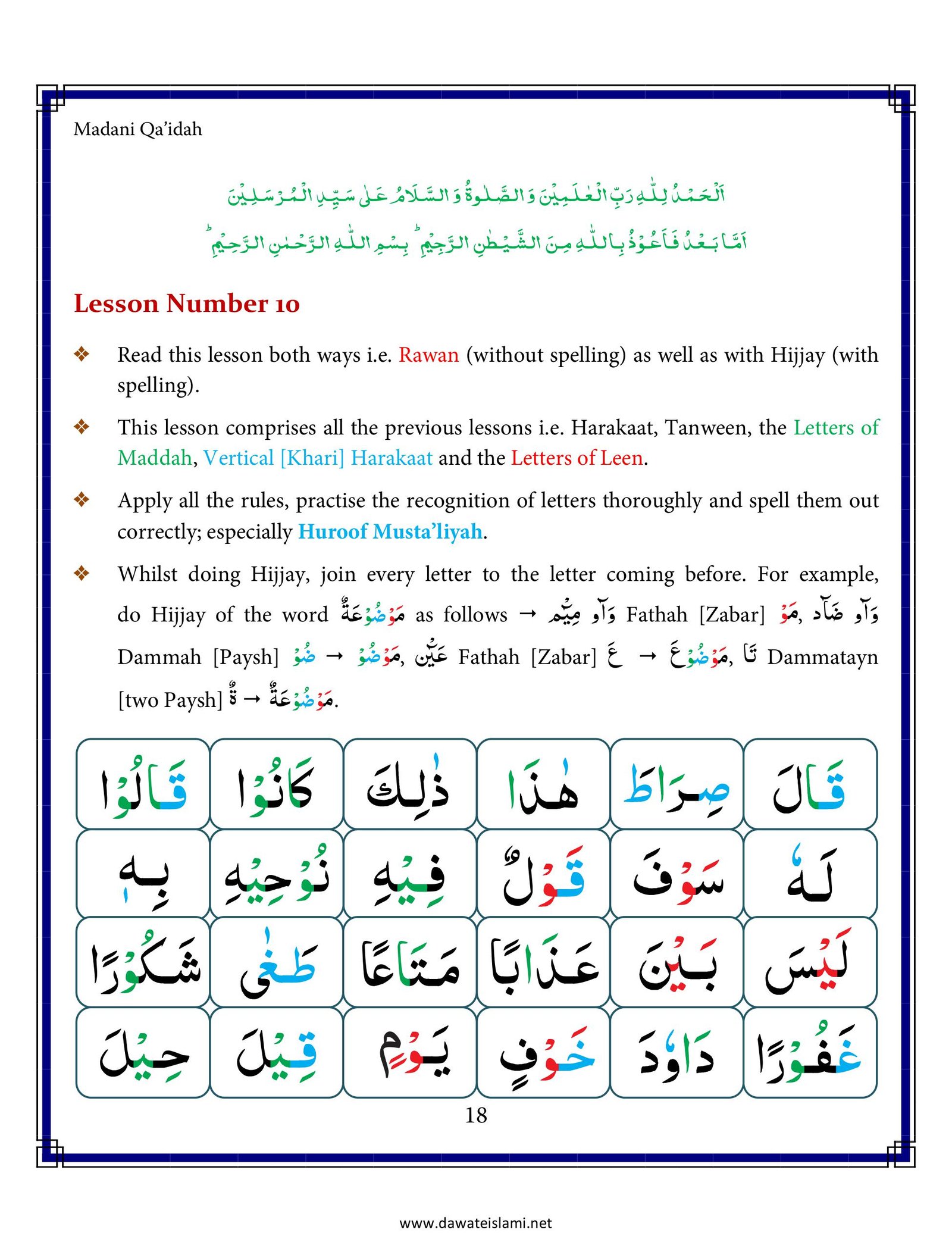
Welcome to Madni Qaida in English Page 29 at Learning Quraan. Lesson 10 brings together everything so far: Harakaat, Tanween, Letters of Maddah, Khari Harakaat and Letters of Leen. It is read both with spelling and fluently.
This page is part of Lesson 10: Revision of All Previous Rules. See every page on the Madni Qaida in English index, or learn with a teacher in our online Quran courses.
What is on Madni Qaida in English Page 29?
- How to spell a word by joining each letter to the one before it, shown with موضوعة.
- Common words such as قال, صراط, هذا and ذلك.
- Words mixing Maddah and Leen such as خوف and يوم.
How to Practise This Page
- Read every word with Hijjay first, then Rawan.
- When spelling, join each letter to the one before it.
- Check each word for Harakaat, Tanween, Maddah, Khari Harakaat and Leen before reading it.
Lesson 10: Everything Together
Lesson 10 is the first review lesson. Its words mix everything learnt so far: the Harakaat, Tanween, the Letters of Maddah, the Khari Harakaat and the Letters of Leen. The page asks for four things:
- Read every word both ways: Hijjay (spelled out) and Rawan (fluently).
- Apply every rule from Lessons 3 to 9 while reading.
- Recognise each letter properly and spell it correctly, above all the heavy Huroof-e-Musta‘liyah.
- When spelling, join each new part to everything before it.
Joined Hijjay, Step by Step
The page shows the new way of spelling with the word مَوْضُوْعَةٌ. Instead of spelling each part and stopping, the child adds each part to what has already been read:
| Step | Spell | Joined so far |
|---|---|---|
| 1 | Meem, Waw, Zabar: “maw” | مَوْ |
| 2 | Ḍad, Waw, Pesh: “ḍoo” | مَوْضُوْ “mawḍoo” |
| 3 | Ain, Zabar: “‘a” | مَوْضُوْعَ “mawḍoo‘a” |
| 4 | Ta, two Pesh: “tun” | مَوْضُوْعَةٌ “mawḍoo‘atun” |
Spelling this way builds the habit of reading the whole word, which is exactly what Rawan reading needs.
All 24 Words on Page 29
The colours still help: the Letters of Maddah are green, the Letters of Leen red and the heavy letters blue.
| Word | Read | What to notice |
|---|---|---|
| قَالَ | qaa-la | Alif Maddah |
| صِرَاطَ | ṣi-raa-ṭa | Alif Maddah; heavy Ṣad and Ṭa |
| هٰذَا | haa-dhaa | Khara Zabar, then Alif Maddah |
| ذٰلِكَ | dhaa-li-ka | Khara Zabar |
| كَانُوْا | kaa-noo | Alif and Waw Maddah; the last Alif is silent |
| قَالُوْا | qaa-loo | Alif and Waw Maddah; the last Alif is silent |
| لَهٗ | la-hoo | Ulta Pesh |
| سَوْفَ | saw-fa | Waw Leen |
| قَوْلٌ | qaw-lun | Waw Leen, then Dammatayn |
| فِيْهِ | fee-hi | Ya Maddah |
| نُوْحِيْهِ | noo-ḥee-hi | Waw and Ya Maddah |
| بِهٖ | bi-hee | Khari Zer |
| لَيْسَ | lay-sa | Ya Leen |
| بَيْنَ | bay-na | Ya Leen |
| عَذَابًا | ‘a-dhaa-ban | Alif Maddah, then Fathatayn |
| مَتَاعًا | ma-taa-‘an | Alif Maddah, then Fathatayn |
| طَغٰى | ṭa-ghaa | Khara Zabar; the final Ya is silent |
| شَكُوْرًا | sha-koo-ran | Waw Maddah, then Fathatayn |
| غَفُوْرًا | gha-foo-ran | Waw Maddah, then Fathatayn |
| دَاوٗدَ | daa-woo-da | Alif Maddah, then Ulta Pesh on Waw |
| خَوْفٍ | khaw-fin | Waw Leen, then Kasratayn |
| يَوْمِ | yaw-mi | Waw Leen |
| قِيْلَ | qee-la | Ya Maddah |
| حِيْلَ | ḥee-la | Ya Maddah |
Found in the Quran
Most of these are real Quranic words. Some of the places they occur:
| Word | Where it occurs |
|---|---|
| صِرَاطَ | Surah al-Fatihah 1:7 |
| يَوْمِ | Surah al-Fatihah 1:4 |
| ذٰلِكَ | Surah al-Baqarah 2:2 |
| هٰذَا | Surah Quraysh 106:3 |
| خَوْفٍ | Surah Quraysh 106:4 |
| سَوْفَ | Surah at-Takathur 102:3 |
| لَيْسَ | Surah ash-Shura 42:11 |
| طَغٰى | Surah an-Nazi‘at 79:17 |
| مَتَاعًا | Surah an-Nazi‘at 79:33 |
| شَكُوْرًا | Surah al-Isra 17:3 |
| دَاوٗدَ | Surah an-Nisa 4:163 |
| قِيْلَ | Surah Hud 11:44 |
| حِيْلَ | Surah Saba 34:54 |
Inside a verse a word can join the next one, and later rules (stopping, Noon Saakin and Tanween) can change how it ends. Here each word is read on its own, as written.
Mistakes to Watch For
- Reading the silent letters. The Alif at the end of كَانُوْا and the Ya at the end of طَغٰى are written but not read.
- Stretching Leen. سَوْفَ and لَيْسَ glide; they are not “saawfa” or “laaysa”.
- Short Khari Harakaat. لَهٗ is “lahoo” and بِهٖ “bihee”, each with a two-count stretch.
- Thin heavy letters. The Ṣad and Ṭa of صِرَاطَ stay heavy, and so does its Ra.
A Five-Minute Practice Plan
- Minute 1: spell مَوْضُوْعَةٌ the joined way, then نُوْحِيْهِ.
- Minute 2: read the Maddah words: قَالَ then فِيْهِ then قِيْلَ then شَكُوْرًا.
- Minute 3: read the Leen words: سَوْفَ then لَيْسَ then بَيْنَ then يَوْمِ.
- Minute 4: read the Khari Harakaat words: هٰذَا then ذٰلِكَ then لَهٗ then بِهٖ then دَاوٗدَ.
- Minute 5: read the whole page Rawan.
Check Yourself
صِرَاطَ · ذٰلِكَ · قَوْلٌ · نُوْحِيْهِ · عَذَابًا · طَغٰى · دَاوٗدَ · خَوْفٍ
Source: the page shown above is from the Madani Qa‘idah (English edition), Lesson 10, book page 18, published by Maktaba-tul-Madinah (Dawat-e-Islami). Quran references are given as surah and verse. Lesson notes written by Learning Quraan.
Madni Qaida in English: Page Directory
Jump to any page of the English edition, or go back to the full page index.
Explore Our Free Islamic Tools
Enhance your daily Islamic practices with our online interactive Islamic Tools:- Count daily recitations on our Digital Tasbih Counter.
- Find the Qibla direction with our Qibla Finder.
- Convert dates with the Hijri Date Converter.
- Search meaningful names with our Islamic Names Finder.
- Calculate obligations with the Zakat Calculator and Islamic Inheritance Calculator.
Get One-on-One Tutoring Support
Learn more about our qualified Quran teachers on our About Us page, review pricing on our Fee structure page, or visit our Contact Us page to book a free trial class.
← Previous: Page 28👉 Proceed to Page 30 – Lesson 10: Quranic Words
Page images: Madani Qa’idah, published by Maktaba-tul-Madinah (Dawat-e-Islami), shown here as a study reference.
