
Madni Qaida in English Page 25 – Lesson 7 Chart and Lesson 8: Khari (Vertical) Harakaat
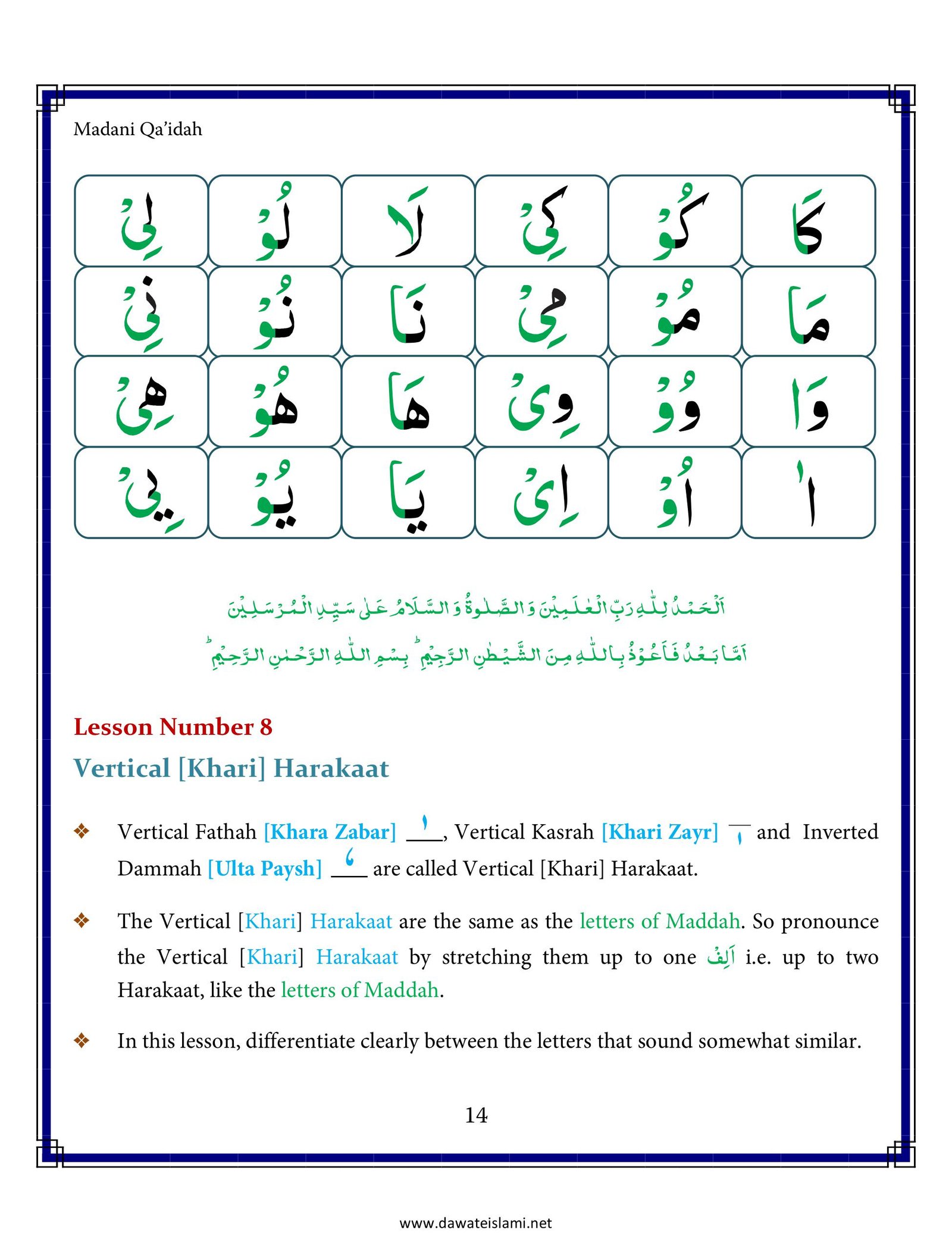
Welcome to Madni Qaida in English Page 25 at Learning Quraan. Page 25 completes the Maddah chart and begins Lesson 8, the Vertical (Khari) Harakaat: the standing Zabar, the standing Zayr and the inverted Paysh.
This page is part of Lesson 8: Khari Harakaat (Vertical Vowels). See every page on the Madni Qaida in English index, or learn with a teacher in our online Quran courses.
What is on Madni Qaida in English Page 25?
- The last rows of Maddah practice, including يَا, يُو and يِي.
- What the three vertical vowel signs look like.
- Khari Harakaat are stretched like the Letters of Maddah, one Alif (two counts).
How to Practise This Page
- Treat the standing Zabar, standing Zayr and inverted Paysh exactly like Maddah: two counts.
- Keep contrasting the similar-sounding letters as you did in Lesson 4.
- Look at the vowel mark first, then say the letter with the right length.
The Last Maddah Sounds of Lesson 7
The four rows at the top finish the Lesson 7 chart that runs from page 24. Eight letters, each joined to all three Letters of Maddah, and every one stretched for two counts:
| Letter | With Alif | With Waw | With Ya |
|---|---|---|---|
| ك Kaf | كَا kaa | كُوْ koo | كِیْ kee |
| ل Lam | لَا laa | لُوْ loo | لِیْ lee |
| م Meem | مَا maa | مُوْ moo | مِیْ mee |
| ن Noon | نَا naa | نُوْ noo | نِیْ nee |
| و Waw | وَا waa | وُوْ woo | وِیْ wee |
| ه Ha | هَا haa | هُوْ hoo | هِیْ hee |
| ا Alif (Hamzah) | اٰ aa | اُوْ oo | اِیْ ee |
| ی Ya | یَا yaa | یُوْ yoo | یِیْ yee |
- لَا is Lam joined to Alif, written as the Lam-Alif shape from Lesson 2: “laa”.
- اٰ Instead of writing two Alifs, the first box of the Alif row puts a small vertical Fathah on the Alif. It is read “aa”, just like an Alif Maddah. That mark is the subject of Lesson 8, which starts on this page.
- وُوْ and یِیْ: the same letter appears twice, once as the moving letter and once as the Letter of Maddah: “woo”, “yee”.
Lesson 8: The Khari (Vertical) Harakaat
Lesson 8 adds three new marks. They look like the ordinary Harakaat stood on end, and they are called the Khari Harakaat:
| Mark | Name | Read like | Example |
|---|---|---|---|
| ـٰ | Khara Zabar (vertical Fathah) | Fathah + Alif: “aa” | تٰ taa |
| ـٖ | Khari Zer (vertical Kasrah) | Kasrah + Ya: “ee” | تٖ tee |
| ـٗ | Ulta Pesh (inverted Dammah) | Dammah + Waw: “oo” | تٗ too |
The page explains why they are long: each one stands in place of a Letter of Maddah. So they are stretched exactly like the Letters of Maddah, for one Alif, which is two Harakaat. The page also asks for the same care as Lesson 4: keep the sound-alike letters clearly apart.
Where You Will Meet Them
The Quran printed in the Indo-Pak script uses these marks constantly. Three familiar examples:
| Word | Mark | Where it occurs |
|---|---|---|
| الرَّحْمٰنِ | Khara Zabar on Meem: “raḥmaani” | Surah al-Fatihah 1:3 |
| بِهٖ | Khari Zer on Ha: “bihee” | Surah al-Baqarah 2:22 |
| لَهٗ | Ulta Pesh on Ha: “lahoo” | Surah al-Baqarah 2:255 (Ayat al-Kursi) |
Mistakes to Watch For
- Reading Khara Zabar short. تٰ is “taa”, two counts, not “ta”.
- Mistaking Ulta Pesh for Dammah. تٗ (long “too”) and تُ (short “tu”) look alike; the Ulta Pesh is turned the other way.
- Missing the Khari Zer. It is a small vertical stroke under the letter, easy to read as a Kasrah.
A Five-Minute Practice Plan
- Minute 1: read the four Lesson 7 rows, two counts on every box.
- Minute 2: compare: كَا then كُوْ then كِیْ, then the same sounds in Lesson 8 form: كٰ then كٗ then كٖ.
- Minute 3: short against long: تَ then تٰ; تِ then تٖ; تُ then تٗ.
- Minute 4: read the three Quran words in the table above.
- Minute 5: read the Check Yourself line below.
Check Yourself
لَا · مُوْ · نِیْ · هَا · اٰ · یُوْ · تٰ · تٖ · تٗ
Source: the page shown above is from the Madani Qa‘idah (English edition), Lessons 7 and 8, book page 14, published by Maktaba-tul-Madinah (Dawat-e-Islami). Quran references are given as surah and verse. Lesson notes written by Learning Quraan.
Madni Qaida in English: Page Directory
Jump to any page of the English edition, or go back to the full page index.
Explore Our Free Islamic Tools
Enhance your daily Islamic practices with our online interactive Islamic Tools:- Count daily recitations on our Digital Tasbih Counter.
- Find the Qibla direction with our Qibla Finder.
- Convert dates with the Hijri Date Converter.
- Search meaningful names with our Islamic Names Finder.
- Calculate obligations with the Zakat Calculator and Islamic Inheritance Calculator.
Get One-on-One Tutoring Support
Learn more about our qualified Quran teachers on our About Us page, review pricing on our Fee structure page, or visit our Contact Us page to book a free trial class.
← Previous: Page 24👉 Proceed to Page 26 – Lesson 8: Practice Chart
Page images: Madani Qa’idah, published by Maktaba-tul-Madinah (Dawat-e-Islami), shown here as a study reference.
