
Madni Qaida in English Page 52 – Lesson 19 Words and Lesson 20: Miscellaneous Rules
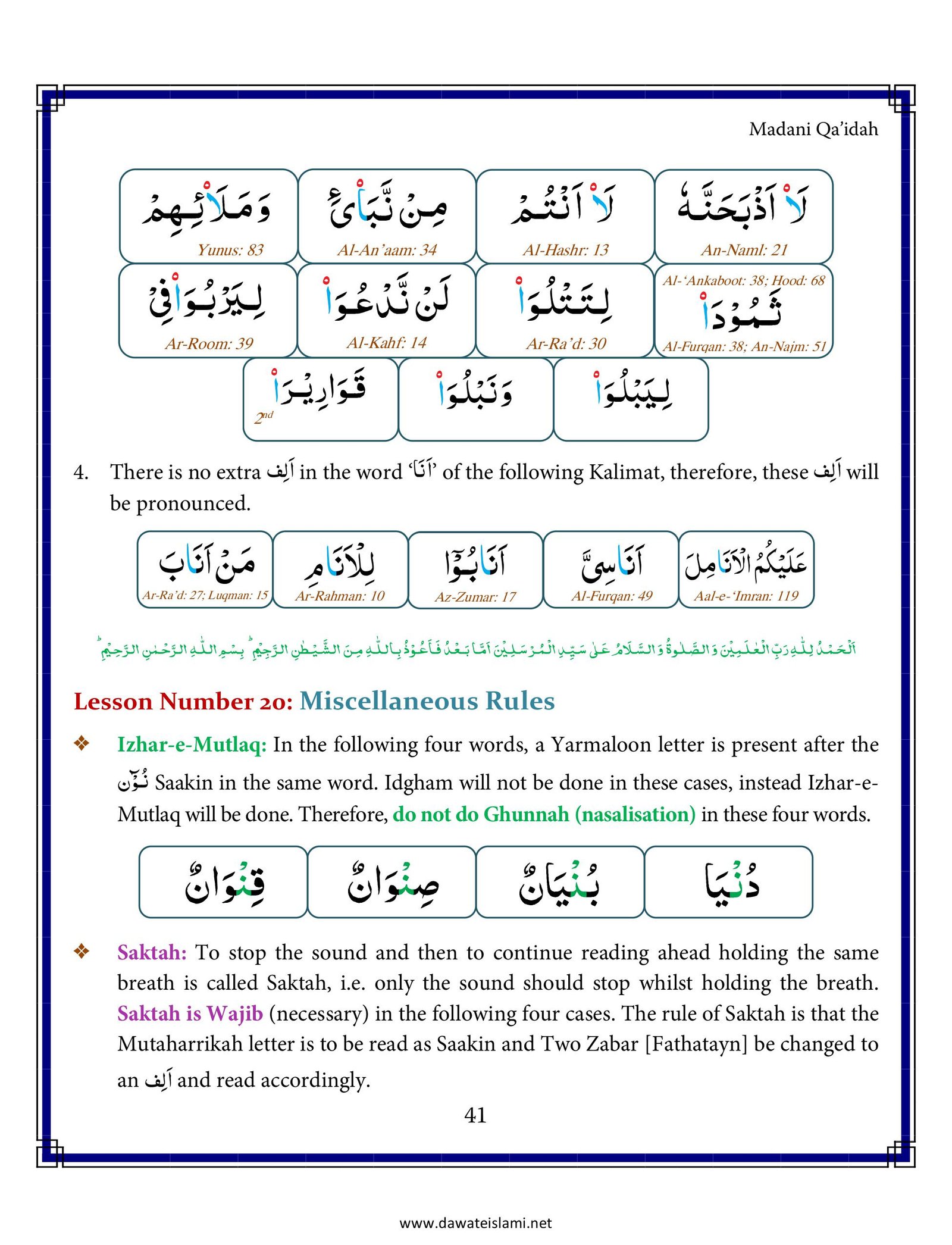
Welcome to Madni Qaida in English Page 52 at Learning Quraan. Page 52 completes the list of extra-Alif words, notes words where the Alif is real and must be read, then starts Lesson 20 with Izhar Mutlaq and Saktah.
This page is part of Lesson 20: Miscellaneous Rules. See every page on the Madni Qaida in English index, or learn with a teacher in our online Quran courses.
What is on Madni Qaida in English Page 52?
- More words with an extra Alif, each with its Surah and verse reference.
- Izhar Mutlaq: no Ghunnah in دنيا, بنيان, صنوان and قنوان.
- Saktah: a brief stop without breathing, necessary in four places.
How to Practise This Page
- Izhar Mutlaq: no Ghunnah in the four words dunya, bunyan, sinwan, qinwan.
- Saktah: stop the sound without taking a breath in the four marked places.
- Learn the special cases (Saad with a small Seen, Tasheel, Imalah) with their verse references.
More Words Where the Extra Alif Is Never Read
The top rows continue Group 3 from page 51: the circled Alif is not read in Wasl or in Waqf.
| Word | Where it occurs |
|---|---|
| لَا۟اَذْبَحَنَّهٗ | Surah an-Naml 27:21 |
| لَا۟اَنْتُمْ | Surah al-Hashr 59:13 |
| مِنْ نَّبَا۟ئِ | Surah al-An‘am 6:34 |
| وَمَلَا۟ئِهِمْ | Surah Yunus 10:83 |
| ثَمُوْدَا۟ | Surah Hud 11:68 |
| لِتَتْلُوَا۟ | Surah ar-Ra‘d 13:30 |
| لَنْ نَّدْعُوَا۟ | Surah al-Kahf 18:14 |
| لِيَرْبُوَا۟ | Surah ar-Rum 30:39 |
| لِيَبْلُوَا۟ | Surah Muhammad 47:4 |
| وَنَبْلُوَا۟ | Surah Muhammad 47:31 |
| قَوَارِيْرَا۟ | Surah ad-Dahr 76:16 (second) |
ثَمُوْدَا۟ occurs in four places, which the page lists: Surah Hud 11:68, al-Furqan 25:38, al-‘Ankabut 29:38 and an-Najm 53:51. Note the two قَوَارِيْرَا: the first (76:15) belongs to Group 1, the second (76:16) to Group 3.
4. An Alif That Is Not Extra
Words with اَنَا inside them are not the word اَنَا۟, so their Alif is real and is always read:
| Word | Where it occurs |
|---|---|
| عَلَيْكُمُ الْاَنَامِلَ | Surah Al ‘Imran 3:119 |
| اَنَاسِيَّ | Surah al-Furqan 25:49 |
| اَنَابُوْٓا | Surah az-Zumar 39:17 |
| لِلْاَنَامِ | Surah ar-Rahman 55:10 |
| مَنْ اَنَابَ | Surah Luqman 31:15 |
Lesson 20 Begins: Izhar-e-Mutlaq
Lesson 20 collects some separate rules. The first is Izhar-e-Mutlaq. In four words a Yarmaloon letter comes straight after a Noon Saakinah in the same word. Idgham (Lesson 14) only happens across two words, so here the Noon is read clearly, without Ghunnah:
دُنْيَا · بُنْيَانٌ · صِنْوَانٌ · قِنْوَانٌ
The second rule, Saktah, is a short silent pause: the voice stops but the breath is held, and reading carries on. The page explains that it is required (Wajib) in four places, where the moving letter is read as Saakin and a Fathatayn becomes an Alif. The four places follow on page 53.
Mistakes to Watch For
- Ghunnah in دُنْيَا. It is “dunyaa”, with a clear Noon.
- Reading اَنَاسِيَّ without its Alif. That Alif is not extra.
- Breathing in Saktah. The breath must not be taken; only the sound stops.
A Five-Minute Practice Plan
- Minute 1: the Group 3 words, Alif silent.
- Minute 2: the Group 4 words, Alif read.
- Minute 3: the four Izhar-e-Mutlaq words.
- Minute 4: compare دُنْيَا (clear Noon) with مَنْ يَّقُوْلُ (Idgham).
- Minute 5: read the Check Yourself line below.
Check Yourself
لَا۟اَنْتُمْ · لِتَتْلُوَا۟ · لَنْ نَّدْعُوَا۟ · اَنَابُوْٓا · لِلْاَنَامِ · صِنْوَانٌ
Source: the page shown above is from the Madani Qa‘idah (English edition), Lessons 19 and 20, book page 41, published by Maktaba-tul-Madinah (Dawat-e-Islami). The page gives each reference by surah and verse; they are repeated here. Lesson notes written by Learning Quraan.
Madni Qaida in English: Page Directory
Jump to any page of the English edition, or go back to the full page index.
Explore Our Free Islamic Tools
Enhance your daily Islamic practices with our online interactive Islamic Tools:- Count daily recitations on our Digital Tasbih Counter.
- Find the Qibla direction with our Qibla Finder.
- Convert dates with the Hijri Date Converter.
- Search meaningful names with our Islamic Names Finder.
- Calculate obligations with the Zakat Calculator and Islamic Inheritance Calculator.
Get One-on-One Tutoring Support
Learn more about our qualified Quran teachers on our About Us page, review pricing on our Fee structure page, or visit our Contact Us page to book a free trial class.
← Previous: Page 51👉 Proceed to Page 53 – Lesson 20: Saktah and Imalah
Page images: Madani Qa’idah, published by Maktaba-tul-Madinah (Dawat-e-Islami), shown here as a study reference.
