
Madni Qaida in English Page 43 – Lesson 14: Idgham and Iqlab Practice
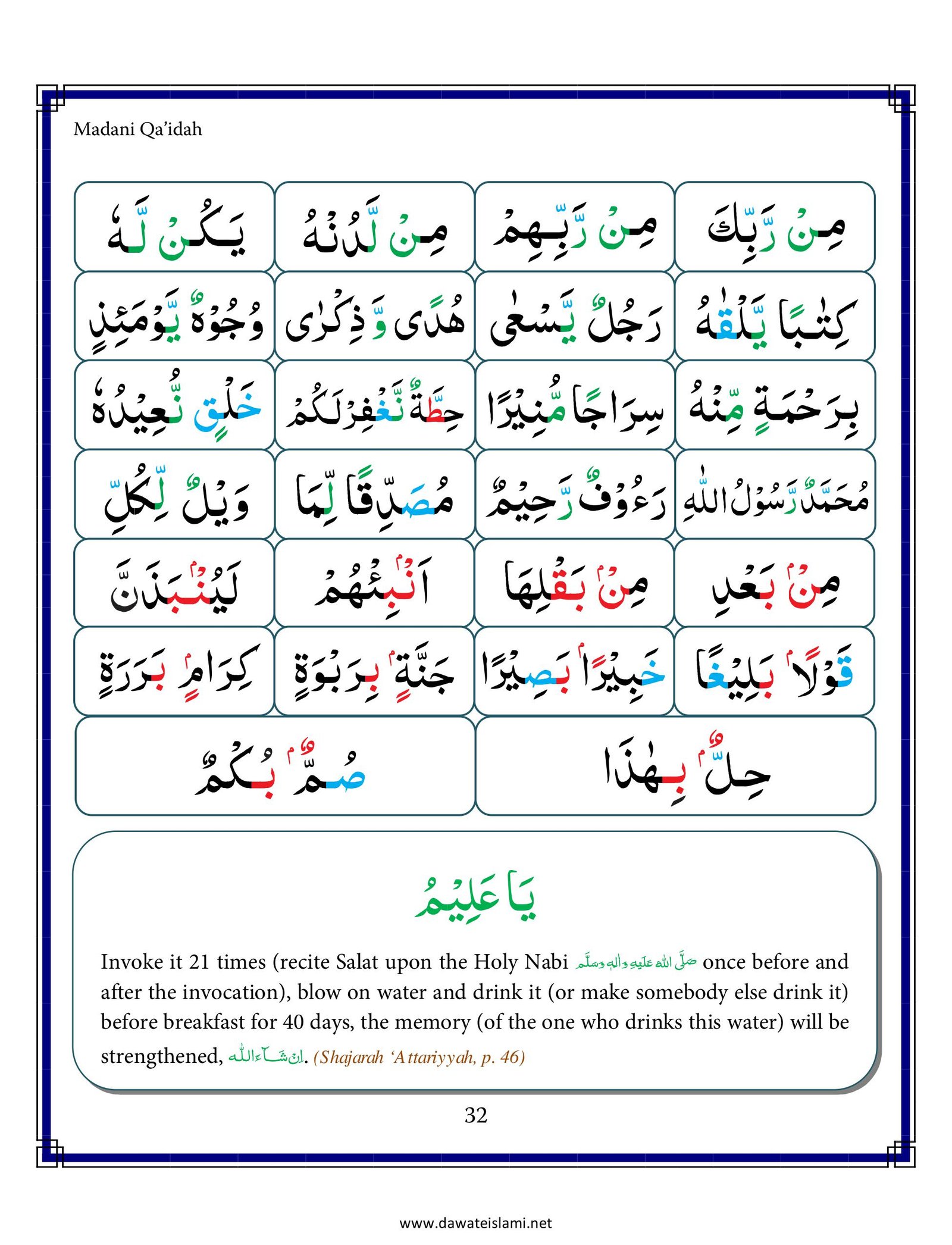
Welcome to Madni Qaida in English Page 43 at Learning Quraan. Page 43 practises Idgham and Iqlab in real Quranic phrases and ends with a short invocation for memory.
This page is part of Lesson 14: Noon Saakinah and Tanween (Idgham and Iqlab). See every page on the Madni Qaida in English index, or learn with a teacher in our online Quran courses.
What is on Madni Qaida in English Page 43?
- Phrases such as من ربك, هدى وذكرى and رجل يسعى.
- Iqlab examples such as من بعد and انبئهم.
- The invocation Ya ‘Aleemu, recommended for strengthening memory.
How to Practise This Page
- Learn the six Yarmaloon letters: ي ر م ل و ن.
- Merge without Ghunnah into ر and ل, and with Ghunnah into the other four.
- Before ب, change the Noon sound into a Meem with Ghunnah: that is Iqlab.
Idgham, Letter by Letter
The first four rows practise Idgham. Rows 1 and 4 use ر and ل, so they are read without Ghunnah: the Noon disappears and the Ra or Lam is simply doubled. Rows 2 and 3 use ی و م ن, so they keep the Ghunnah:
| Example | Idgham | Where it occurs |
|---|---|---|
| مِنْ رَّبِّكَ | without Ghunnah | Surah al-Baqarah 2:147 |
| مِنْ رَّبِّهِمْ | without Ghunnah | Surah al-Baqarah 2:5 |
| مِنْ لَّدُنْهُ | without Ghunnah | Surah an-Nisa 4:40 |
| يَكُنْ لَّهٗ | without Ghunnah | Surah al-Ikhlas 112:4 |
| كِتٰبًا يَّلْقٰىهُ | with Ghunnah | Surah al-Isra 17:13 |
| رَجُلٌ يَّسْعٰى | with Ghunnah | Surah Ya-Sin 36:20 |
| هُدًى وَّذِكْرٰى | with Ghunnah | Surah Ghafir 40:54 |
| وُجُوْهٌ يَّوْمَئِذٍ | with Ghunnah | Surah al-Ghashiyah 88:2 |
| بِرَحْمَةٍ مِّنْهُ | with Ghunnah | Surah at-Tawbah 9:21 |
| سِرَاجًا مُّنِيْرًا | with Ghunnah | Surah al-Ahzab 33:46 |
| حِطَّةٌ نَّغْفِرْ لَكُمْ | with Ghunnah | Surah al-Baqarah 2:58 |
| خَلْقٍ نُّعِيْدُهٗ | with Ghunnah | Surah al-Anbiya 21:104 |
| مُحَمَّدٌ رَّسُوْلُ اللّٰهِ | without Ghunnah | Surah al-Fath 48:29 |
| رَءُوْفٌ رَّحِيْمٌ | without Ghunnah | Surah at-Tawbah 9:128 |
| مُصَدِّقًا لِّمَا | without Ghunnah | Surah al-Baqarah 2:41 |
| وَيْلٌ لِّكُلِّ | without Ghunnah | Surah al-Humazah 104:1 |
Iqlab: Noon Becomes Meem
The last three rows practise Iqlab. Before ب, a Noon Saakinah or Tanween changes into a Meem, and the Meem is read with Ghunnah. The Quran printed in the Indo-Pak script puts a small Meem (ۢ ) above the Noon or the Tanween to show this:
| Example | Read | Where it occurs |
|---|---|---|
| مِنْۢ بَعْدِ | mim-ba‘-di | Surah al-Baqarah 2:27 |
| مِنْۢ بَقْلِهَا | mim-baq-li-haa | Surah al-Baqarah 2:61 |
| اَنْۢبِئْهُمْ | am-bi’-hum | Surah al-Baqarah 2:33 |
| لَيُنْۢبَذَنَّ | la-yum-ba-dhan-na | Surah al-Humazah 104:4 |
| قَوْلًاۢ بَلِيْغًا | qaw-lam-ba-lee-ghan | Surah an-Nisa 4:63 |
| خَبِيْرًاۢ بَصِيْرًا | kha-bee-ram-ba-ṣee-ran | Surah al-Isra 17:96 |
| جَنَّةٍۢ بِرَبْوَةٍ | jan-na-tim-bi-rab-wa-tin | Surah al-Baqarah 2:265 |
| كِرَامٍۢ بَرَرَةٍ | ki-raa-mim-ba-ra-ra-tin | Surah ‘Abasa 80:16 |
| حِلٌّۢ بِهٰذَا | ḥil-lum-bi-haa-dhaa | Surah al-Balad 90:2 |
| صُمٌّۢ بُكْمٌ | ṣum-mum-buk-mun | Surah al-Baqarah 2:18 |
The page spells مِنْۢ بَعْدِ as “Meem, Noon, Zer: min; Ba, Ain, Zabar: ba‘; Dal, Zer: di”, but it is read “mim-ba‘di”, with the lips closing for the Meem and a nasal hold before the Ba.
The Name of Allah at the Bottom
The box at the foot of the page gives a wazifa with يَا عَلِيْمُ (“O All-Knowing”). The book suggests reciting it 21 times, with Salat upon the Holy Prophet ﷺ once before and once after, blowing on water and drinking it before breakfast for 40 days, to strengthen the memory, and cites Shajarah ‘Attariyyah, p. 46.
Mistakes to Watch For
- Ghunnah with Ra or Lam. مِنْ رَّبِّكَ is “mir-rabbika”, with no nasal sound.
- Saying a Noon before Ba. مِنْۢ بَعْدِ is not “min ba‘di”.
- Pressing the lips hard in Iqlab. The lips close lightly for the Meem while the Ghunnah is held.
A Five-Minute Practice Plan
- Minute 1: rows 1 and 4, with no Ghunnah.
- Minute 2: rows 2 and 3, with Ghunnah.
- Minute 3: the Iqlab rows.
- Minute 4: compare مِنْ رَّبِّكَ (no Ghunnah) with مِنْ مِّثْلِهٖ (Ghunnah) and مِنْۢ بَعْدِ (Iqlab).
- Minute 5: read the Check Yourself line below.
Check Yourself
Name the rule, then read:
يَكُنْ لَّهٗ · رَجُلٌ يَّسْعٰى · سِرَاجًا مُّنِيْرًا · وَيْلٌ لِّكُلِّ · اَنْۢبِئْهُمْ · كِرَامٍۢ بَرَرَةٍ
Source: the page shown above is from the Madani Qa‘idah (English edition), Lesson 14, book page 32, published by Maktaba-tul-Madinah (Dawat-e-Islami). Quran references are given as surah and verse. Lesson notes written by Learning Quraan.
Madni Qaida in English: Page Directory
Jump to any page of the English edition, or go back to the full page index.
Explore Our Free Islamic Tools
Enhance your daily Islamic practices with our online interactive Islamic Tools:- Count daily recitations on our Digital Tasbih Counter.
- Find the Qibla direction with our Qibla Finder.
- Convert dates with the Hijri Date Converter.
- Search meaningful names with our Islamic Names Finder.
- Calculate obligations with the Zakat Calculator and Islamic Inheritance Calculator.
Get One-on-One Tutoring Support
Learn more about our qualified Quran teachers on our About Us page, review pricing on our Fee structure page, or visit our Contact Us page to book a free trial class.
← Previous: Page 42👉 Proceed to Page 44 – Lesson 15: Meem Saakinah
Page images: Madani Qa’idah, published by Maktaba-tul-Madinah (Dawat-e-Islami), shown here as a study reference.
