
Madni Qaida in English Page 01 – Front Cover of the English Madani Qa'idah
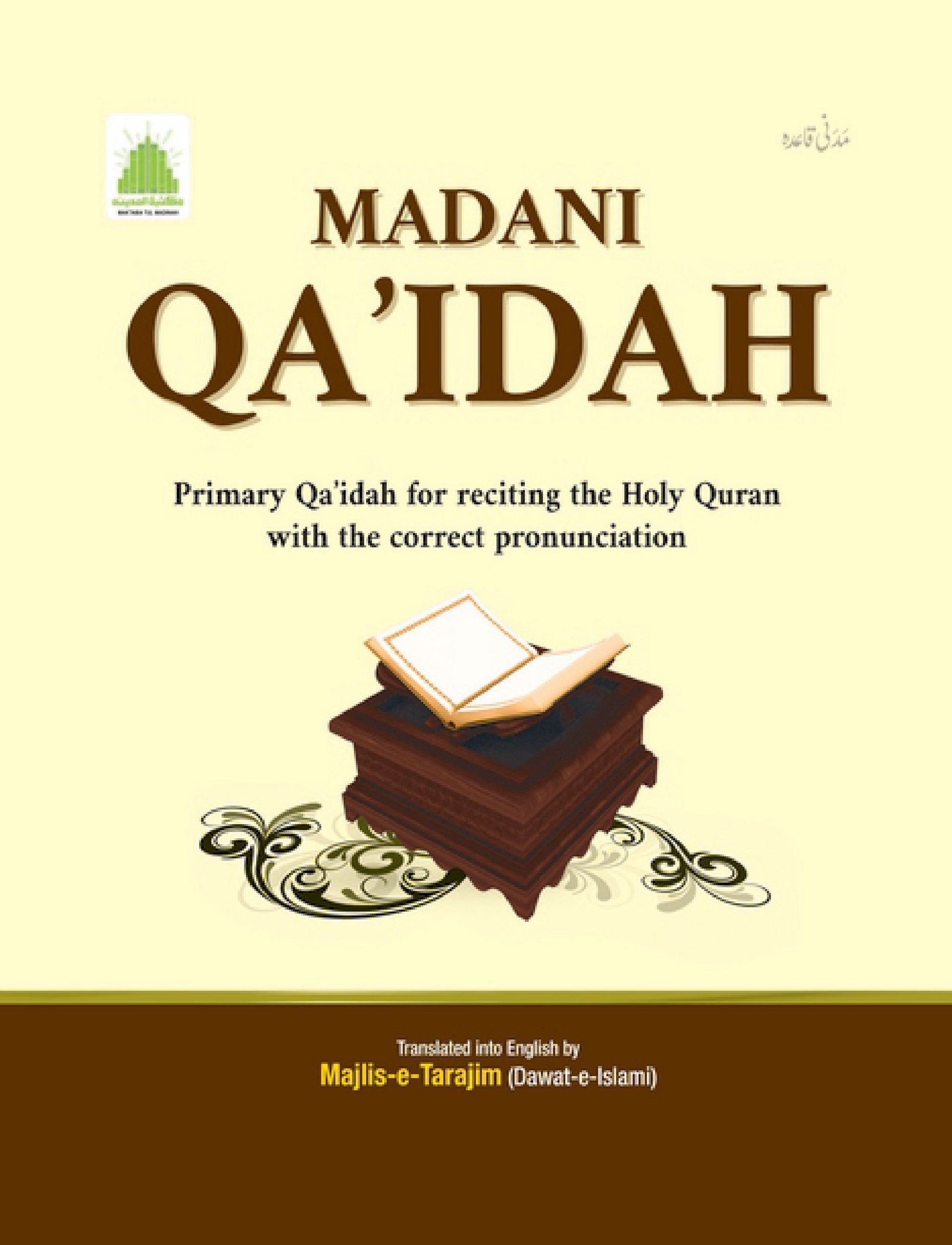
Welcome to Madni Qaida in English Page 01 at Learning Quraan. This is the front cover of the English edition of Madani Qa’idah, a primary Qa’idah for reciting the Holy Quran with correct pronunciation. The English translation is by Majlis-e-Tarajim (Dawat-e-Islami).
This page is part of the opening pages of the book. See every page on the Madni Qaida in English index, or learn with a teacher in our online Quran courses.
What is on Madni Qaida in English Page 01?
- The full title: Madani Qa’idah, a beginner’s book for correct Quran recitation.
- Who translated it into English: Majlis-e-Tarajim (Dawat-e-Islami).
- Where the course starts: turn to the Makharij chart on the next page.
How to Practise This Page
- Read the opening pages once with your child before starting Lesson 1, so they know what the book is for.
- Keep the Makharij chart and the articulation diagram nearby: you will come back to them in almost every lesson.
- Recite the du’a for study and Salat upon the Prophet ﷺ before each class to build a good routine.
About the Madani Qa‘idah
The Madani Qa‘idah is a beginner’s book for learning to read the Quran with correct pronunciation. It was prepared in Urdu by Majlis Madrasa-tul-Madinah, the Quran-teaching department of Dawat-e-Islami, and translated into English by Majlis-e-Tarajim. It is published by Maktaba-tul-Madinah (Dawat-e-Islami) and is used in Madrasa-tul-Madinah classes for children and adults.
The book takes a learner from the single Arabic letters to fluent reading in 22 short lessons. Its main features are colour-coded letters (heavy letters, Qalqalah, Ghunnah and Madd each have their own colour), plenty of Quranic words for practice, and a final lesson on the words of Salah.
How This Online Edition Is Arranged
Each page of the English edition has its own page on our site, with the scan at the top and our notes underneath. The 76 pages fall into four parts:
| Part | Our pages | What is in it |
|---|---|---|
| Front matter | 1 to 11 | Covers, the chart of the places of the letters, the du‘a for reading, the translator’s note and the introduction |
| Lessons 1 to 22 | 12 to 60 | The reading course, from single letters to the words of Salah |
| Questions and answers | 61 to 73 | 82 revision questions on every lesson, plus basic rulings of Wudu and Salah |
| End matter | 74 to 77 | Table of contents, a poem for learners, and the back cover |
For a lesson-by-lesson map, see page 11. To convert the book’s own page numbers to ours, see the table of contents notes on page 74.
Where to Start
- A complete beginner starts at Lesson 1 on page 12.
- A child who knows the letters can begin at Lesson 3 (Harakaat) after a quick check of Lessons 1 and 2.
- An adult revising Tajweed can go straight to Lesson 12 onwards, then test themselves with the question-and-answer pages.
The book is also available in Urdu; see the Madni Qaida in Urdu. For a teacher to guide your child through it, see our online Quran classes for kids, our Tajweed course and Hifz course.
Source: the page shown above is the front cover of the Madani Qa‘idah (English edition), translated by Majlis-e-Tarajim and published by Maktaba-tul-Madinah (Dawat-e-Islami). Notes written by Learning Quraan.
Madni Qaida in English: Page Directory
Jump to any page of the English edition, or go back to the full page index.
Explore Our Free Islamic Tools
Enhance your daily Islamic practices with our online interactive Islamic Tools:- Count daily recitations on our Digital Tasbih Counter.
- Find the Qibla direction with our Qibla Finder.
- Convert dates with the Hijri Date Converter.
- Search meaningful names with our Islamic Names Finder.
- Calculate obligations with the Zakat Calculator and Islamic Inheritance Calculator.
Get One-on-One Tutoring Support
Learn more about our qualified Quran teachers on our About Us page, review pricing on our Fee structure page, or visit our Contact Us page to book a free trial class.
← All Pages👉 Proceed to Page 02 – Makharij Chart
Page images: Madani Qa’idah, published by Maktaba-tul-Madinah (Dawat-e-Islami), shown here as a study reference.
