
Madni Qaida in English Page 35 – Lesson 12: Noon Saakinah and Tanween (Izhar and Ikhfa)
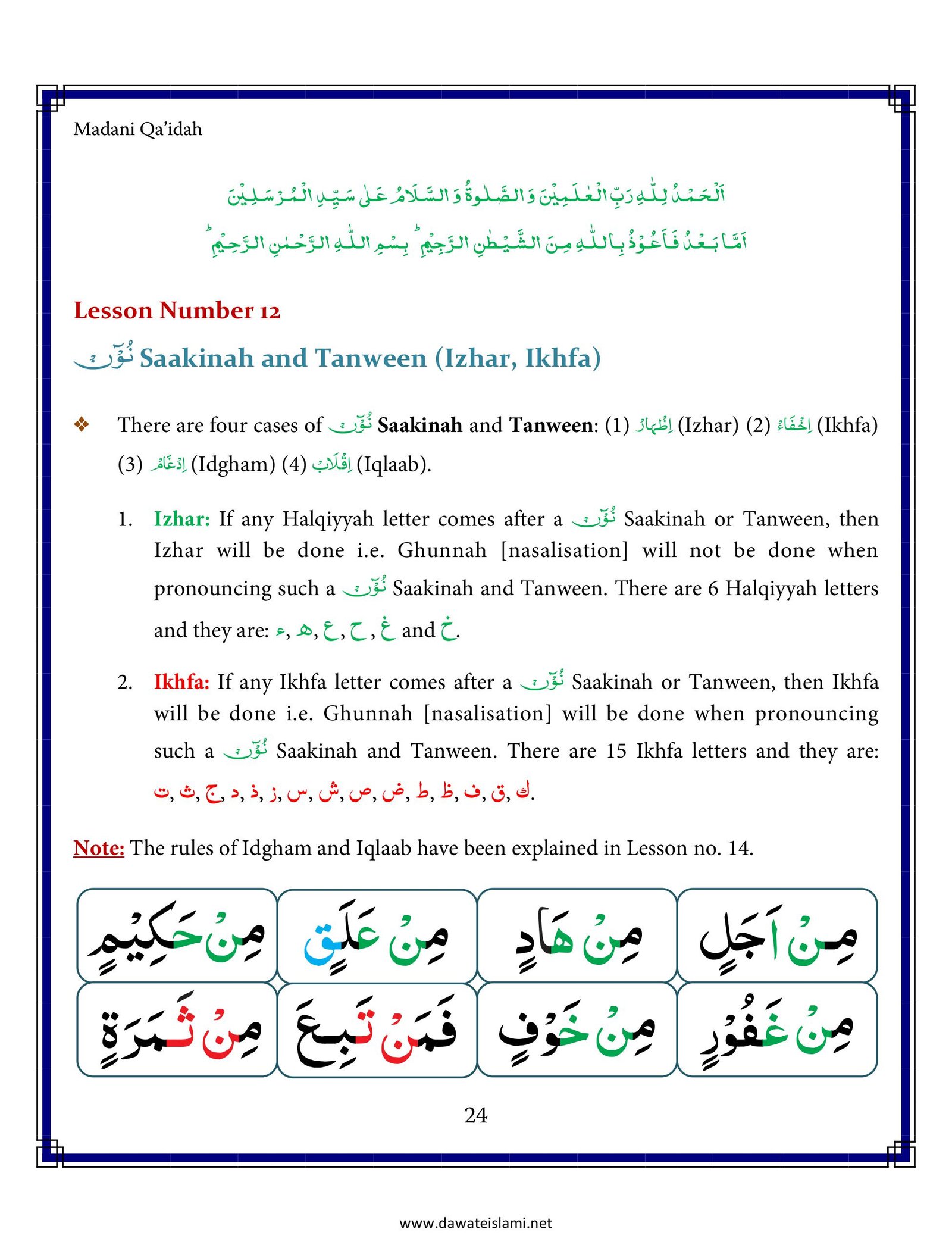
Welcome to Madni Qaida in English Page 35 at Learning Quraan. Lesson 12 opens the rules of Noon Saakinah and Tanween. It lists the four cases (Izhar, Ikhfa, Idgham, Iqlab) and explains the first two in detail.
This page is part of Lesson 12: Noon Saakinah and Tanween (Izhar and Ikhfa). See every page on the Madni Qaida in English index, or learn with a teacher in our online Quran courses.
What is on Madni Qaida in English Page 35?
- Izhar: before the 6 throat letters, no Ghunnah.
- Ikhfa: before the 15 Ikhfa letters, with Ghunnah.
- First examples of Izhar such as مِنْ اَجَلٍ and مِنْ عَلَقٍ.
How to Practise This Page
- Before a throat letter (ء ه ع ح غ خ), say the Noon clearly with no Ghunnah: Izhar.
- Before any of the 15 Ikhfa letters, hide the Noon with a Ghunnah of about one Alif.
- Mark the letter after each Noon Saakin or Tanween before you read the word.
Lesson 12: Noon Saakinah and Tanween
Lesson 12 starts the rules of Noon Saakinah (a Noon with a Sukoon, نْ) and Tanween. Since Lesson 5 showed that Tanween is really a Noon Saakinah at the end of a word, the same rules apply to both. What happens to the Noon depends on the letter that comes after it. There are four rules:
| Rule | When | How it sounds | Lesson |
|---|---|---|---|
| Izhar (clear) | A throat letter follows: ء ه ع ح غ خ | The Noon is said clearly, with no Ghunnah | 12 |
| Ikhfa (hidden) | One of 15 letters follows: ت ث ج د ذ ز س ش ص ض ط ظ ف ق ك | The Noon is hidden and read with Ghunnah | 12 |
| Idgham (merged) | Explained later | — | 14 |
| Iqlab (changed) | Explained later | — | 14 |
Izhar: Say the Noon Clearly
The six Izhar letters are the throat letters from Lesson 4: ء and ه from the deepest part, ع and ح from the middle, غ and خ from the top. Because they are made far back in the throat, the Noon before them is said clearly from its own place, and the sound does not linger in the nose.
Ikhfa: Hide the Noon
Before the fifteen Ikhfa letters, the Noon is not said fully. The tongue does not press firmly on the Noon’s place; instead the sound passes through the nose (Ghunnah) while the mouth gets ready for the next letter. The page prints Izhar in green and Ikhfa in red.
The Eight Examples on Page 35
| Example | Rule | Letter after the Noon | Where it occurs |
|---|---|---|---|
| مِنْ اَجَلٍ | Izhar | ء | |
| مِنْ هَادٍ | Izhar | ه | Surah ar-Ra‘d 13:33 |
| مِنْ عَلَقٍ | Izhar | ع | Surah al-‘Alaq 96:2 |
| مِنْ حَكِيْمٍ | Izhar | ح | Surah Fussilat 41:42 |
| مِنْ غَفُوْرٍ | Izhar | غ | Surah Fussilat 41:32 |
| مِنْ خَوْفٍ | Izhar | خ | Surah Quraysh 106:4 |
| فَمَنْ تَبِعَ | Ikhfa | ت | Surah al-Baqarah 2:38 |
| مِنْ ثَمَرَةٍ | Ikhfa | ث | Surah al-Baqarah 2:25 |
The first six take the throat letters in order, one each; the last two begin the Ikhfa letters, which continue on the next page.
Mistakes to Watch For
- Ghunnah in Izhar. مِنْ عَلَقٍ must not sound like “mi-ng ‘alaq”. The Noon is clean.
- A full Noon in Ikhfa. In فَمَنْ تَبِعَ the tongue should not press hard on the Noon before the Ta.
- Forgetting Tanween. The same rules apply to Tanween; that practice starts on page 37.
A Five-Minute Practice Plan
- Minute 1: say the six throat letters in order: ء ه ع ح غ خ.
- Minute 2: read the six Izhar examples, keeping every Noon clear.
- Minute 3: compare مِنْ هَادٍ (clear) with مِنْ ثَمَرَةٍ (hidden).
- Minute 4: say the fifteen Ikhfa letters slowly from the list above.
- Minute 5: read the Check Yourself line below.
Check Yourself
Say which rule applies to each, then read it:
مِنْ اَجَلٍ · مِنْ خَوْفٍ · فَمَنْ تَبِعَ · مِنْ حَكِيْمٍ · مِنْ ثَمَرَةٍ
Source: the page shown above is from the Madani Qa‘idah (English edition), Lesson 12, book page 24, published by Maktaba-tul-Madinah (Dawat-e-Islami). Quran references are given as surah and verse. Lesson notes written by Learning Quraan.
Madni Qaida in English: Page Directory
Jump to any page of the English edition, or go back to the full page index.
Explore Our Free Islamic Tools
Enhance your daily Islamic practices with our online interactive Islamic Tools:- Count daily recitations on our Digital Tasbih Counter.
- Find the Qibla direction with our Qibla Finder.
- Convert dates with the Hijri Date Converter.
- Search meaningful names with our Islamic Names Finder.
- Calculate obligations with the Zakat Calculator and Islamic Inheritance Calculator.
Get One-on-One Tutoring Support
Learn more about our qualified Quran teachers on our About Us page, review pricing on our Fee structure page, or visit our Contact Us page to book a free trial class.
← Previous: Page 34👉 Proceed to Page 36 – Lesson 12: Word Practice
Page images: Madani Qa’idah, published by Maktaba-tul-Madinah (Dawat-e-Islami), shown here as a study reference.
